
Science
Hollow Glass Fiber Sensors Enhance Particle Accelerator Monitoring

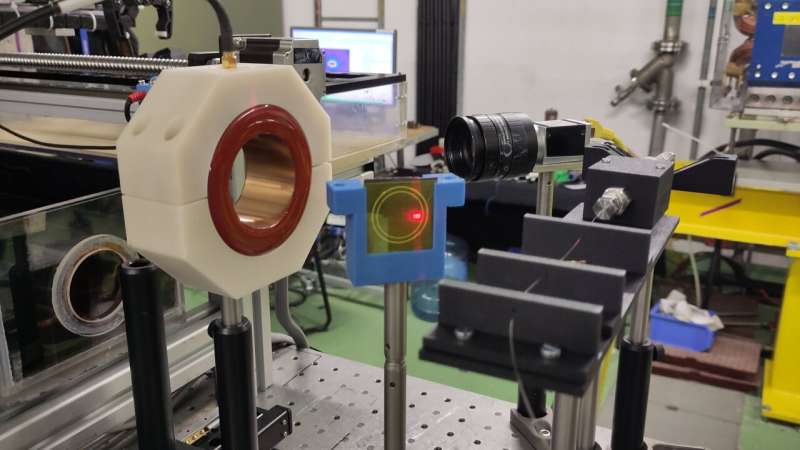
A team of researchers at CERN is testing innovative hollow-core optical fibers that could significantly improve the monitoring of particle beams in accelerators. These fibers, which are no thicker than a human hair, are being evaluated for their ability to withstand extreme radiation conditions in the Super Proton Synchrotron, CERN’s second-largest accelerator, which supports experiments in the North Area.
Unlike conventional optical fibers that transmit light through solid glass, hollow-core fibers utilize a microstructured design that allows light to travel through a gas-filled core by exploiting resonance and antiresonance effects. By incorporating a scintillating gas inside these fibers, which emits flashes of light when struck by particles, researchers aim to create robust radiation sensors. These sensors can help adjust beam profiles and positions and may allow for real-time measurement of the beam dose delivered to experimental targets.
The reliability of particle beam measurements is critical for both experimental and beam physicists at CERN. Currently, the operation of all of CERN’s accelerators depends on data from thousands of beam sensors distributed throughout the facilities. However, these sensors can fail in high-energy or high-intensity environments, which raises concerns for both CERN’s experiments and medical applications, such as FLASH radiotherapy. The FLASH technique, which delivers radiation at ultra-high dose rates, presents unique challenges that necessitate the development of new monitoring technologies.
Testing and Collaboration for Enhanced Performance
A collaboration between CERN’s beam diagnostics team and researchers focused on medical applications is exploring new tools designed to endure extreme radiation. The concept was tested at various CERN facilities, including the CLEAR facility, during 2024 and 2025. In these experiments, a fiber filled with an argon-nitrogen mixture was exposed to an electron beam. The fiber was connected to a silicon photomultiplier, which detects single photons. Each time the beam passed through the fiber, the gas inside illuminated, transmitting the signal to the detector.
The initial results, presented at the International Beam Instrumentation Conference in November 2025, demonstrated promising outcomes. According to Inaki Ortega Ruiz, who leads the beam instrumentation consolidation for the SPS North Experimental Area, “The fiber’s measurements of the beam profile closely matched those from a traditional YAG screen, a crystal that glows when struck by particles. Even after receiving a radiation dose high enough to damage many instruments, the fiber showed no sign of performance loss.”
These findings suggest that hollow-core optical fibers could be a game-changing solution for the future of particle accelerators and medical applications. As the research continues, scientists plan to enhance the connections between the fibers and detectors, test sealed fibers pre-filled with gas, and investigate the long-term radiation hardness of these innovative tools.
By bridging the gap between accelerator technology and medical research, the advancements being tested at CERN could one day play a significant role in the safe delivery of FLASH therapy for cancer treatment, potentially transforming patient outcomes in the field of oncology. The ongoing collaboration underscores the importance of developing tools that can withstand the extreme conditions present in both scientific and medical settings, paving the way for further innovations in particle beam monitoring.

Taste Test Reveals Best Mince Pies from Major UK Supermarkets

Baba Vanga Predicts Alien Contact and Global Upheaval in 2026

Astronomers Uncover the Pulsating Mystery of 3I/ATLAS

Ajax Match Abandoned After Fireworks Erupt in Stands

Asia’s Longest Domestic Flights: Some Stretch Over 3,000 Miles

Inmates Sneak in Fried Chicken Takeaways at HMP Wandsworth

Parkdean Resorts Launches Major Black Friday Discounts for 2026 Stays

Former Rockstar Employee Reveals GTA 6 Animations in Leak

Maintain Your HVAC System: Avoid Costly Repairs This Winter

Iconic 90s TV Show House Hits Market for £1.1 Million

Milk Bank Urges Mothers to Donate for Premature Babies’ Health

Alessia Russo Signs Long-Term Deal with Arsenal Ahead of WSL Season

Shoppers Flock to Discounted Neck Pillow on Amazon for Travel Comfort

Museums Body Critiques EHRC Proposals on Gender Facilities

Trump Visits Europe: Business, Politics, or Leisure?

Japanese Teen Sorato Shimizu Breaks U18 100m Record in 10 Seconds

Couple Shares Inspiring Love Story Defying Height Stereotypes

Anglian Water Raises Concerns Over Proposed AI Data Centre
-
 Entertainment2 months ago
Iconic 90s TV Show House Hits Market for £1.1 Million
-
 Lifestyle4 months ago
Milk Bank Urges Mothers to Donate for Premature Babies’ Health
-
 Sports3 months ago
Alessia Russo Signs Long-Term Deal with Arsenal Ahead of WSL Season
-
 Lifestyle4 months ago
Shoppers Flock to Discounted Neck Pillow on Amazon for Travel Comfort
-
 Politics4 months ago
Museums Body Critiques EHRC Proposals on Gender Facilities
-
 Business4 months ago
Trump Visits Europe: Business, Politics, or Leisure?
-
 Lifestyle4 months ago
Japanese Teen Sorato Shimizu Breaks U18 100m Record in 10 Seconds
-
 Politics4 months ago
Couple Shares Inspiring Love Story Defying Height Stereotypes
-
 World4 months ago
Anglian Water Raises Concerns Over Proposed AI Data Centre
-

 Sports4 months ago
Bournemouth Dominates Everton with 3-0 Victory in Premier League Summer Series
-

 World4 months ago
Wreckage of Missing Russian Passenger Plane Discovered in Flames
-

 Lifestyle4 months ago
Shoppers Rave About Roman’s £42 Midi Dress, Calling It ‘Elegant’