
Science
Scientists Unveil Exciton Diffusion in Nanostructures for Energy Advances

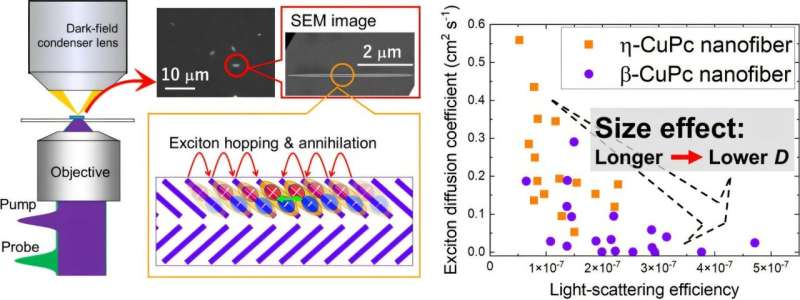
Researchers at Ehime University have made significant strides in understanding the exciton diffusion process in organic semiconductor materials. Their findings, published on November 18, 2025, in The Journal of Physical Chemistry Letters, reveal new insights that could enhance the performance of next-generation photoenergy conversion devices and organic solar cells.
Organic semiconductors, known for their light weight and mechanical flexibility, have become pivotal in the development of advanced energy technologies. A key factor affecting their efficiency is the ability of photoexcited excitons to migrate between molecules, a process known as exciton diffusion. Previous research primarily focused on ensemble averages, limiting the ability to observe the behavior of excitons within individual nanostructures.
In this groundbreaking study, Associate Professor Yukihide Ishibashi and his research team developed a femtosecond time-resolved single-particle spectroscopy technique. This innovative method allows for the direct visualization of exciton diffusion in individual copper phthalocyanine (CuPc) nanofibers.
Key Findings on Exciton Behavior
The research indicates that CuPc nanofibers exhibit two distinct crystalline phases: the η (eta) phase and the β (beta) phase. These phases differ significantly in molecular packing and the strength of π–π interactions. The study found that the exciton diffusion coefficient of η-phase nanofibers is approximately three times greater than that of β-phase nanofibers. This notable difference signifies enhanced long-range energy transport for the η phase, attributed to a larger molecular tilt angle and stronger π-electronic overlap.
Moreover, the findings revealed a distribution of diffusion coefficients even within the same crystalline phase. This suggests that microscopic defects and structural disorders play a crucial role in influencing exciton transport efficiency.
Implications for Future Technologies
This research represents the first direct observation of exciton diffusion at the nanoscale within organic crystals. By clarifying the relationship between molecular packing and photoenergy migration, the study lays the groundwork for developing new design principles aimed at improving the efficiency of organic photoenergy conversion and optoelectronic devices.
The implications of these findings extend beyond academic interest. As the demand for efficient energy solutions grows, advancements in organic semiconductor technology could significantly impact the future of renewable energy sources, making this research a vital step toward more sustainable energy systems.
In summary, the work led by Yukihide Ishibashi at Ehime University not only advances the understanding of exciton dynamics but also opens doors to the design of highly efficient organic electronic materials, potentially transforming the landscape of energy conversion technologies. For further details, refer to the study titled “Femtosecond Single-Particle Spectroscopy of Exciton Diffusion in Individual Copper Phthalocyanine Nanofibers,” published in The Journal of Physical Chemistry Letters.

Taste Test Reveals Best Mince Pies from Major UK Supermarkets

Baba Vanga Predicts Alien Contact and Global Upheaval in 2026

Astronomers Uncover the Pulsating Mystery of 3I/ATLAS

Ajax Match Abandoned After Fireworks Erupt in Stands

Asia’s Longest Domestic Flights: Some Stretch Over 3,000 Miles

Inmates Sneak in Fried Chicken Takeaways at HMP Wandsworth

Parkdean Resorts Launches Major Black Friday Discounts for 2026 Stays

Former Rockstar Employee Reveals GTA 6 Animations in Leak

Maintain Your HVAC System: Avoid Costly Repairs This Winter

Iconic 90s TV Show House Hits Market for £1.1 Million

Milk Bank Urges Mothers to Donate for Premature Babies’ Health

Alessia Russo Signs Long-Term Deal with Arsenal Ahead of WSL Season

Shoppers Flock to Discounted Neck Pillow on Amazon for Travel Comfort

Museums Body Critiques EHRC Proposals on Gender Facilities

Trump Visits Europe: Business, Politics, or Leisure?

Japanese Teen Sorato Shimizu Breaks U18 100m Record in 10 Seconds

Couple Shares Inspiring Love Story Defying Height Stereotypes

Anglian Water Raises Concerns Over Proposed AI Data Centre
-
 Entertainment2 months ago
Iconic 90s TV Show House Hits Market for £1.1 Million
-
 Lifestyle4 months ago
Milk Bank Urges Mothers to Donate for Premature Babies’ Health
-
 Sports3 months ago
Alessia Russo Signs Long-Term Deal with Arsenal Ahead of WSL Season
-
 Lifestyle4 months ago
Shoppers Flock to Discounted Neck Pillow on Amazon for Travel Comfort
-
 Politics4 months ago
Museums Body Critiques EHRC Proposals on Gender Facilities
-
 Business4 months ago
Trump Visits Europe: Business, Politics, or Leisure?
-
 Lifestyle4 months ago
Japanese Teen Sorato Shimizu Breaks U18 100m Record in 10 Seconds
-
 Politics4 months ago
Couple Shares Inspiring Love Story Defying Height Stereotypes
-
 World4 months ago
Anglian Water Raises Concerns Over Proposed AI Data Centre
-

 Sports4 months ago
Bournemouth Dominates Everton with 3-0 Victory in Premier League Summer Series
-

 World4 months ago
Wreckage of Missing Russian Passenger Plane Discovered in Flames
-

 Lifestyle4 months ago
Shoppers Rave About Roman’s £42 Midi Dress, Calling It ‘Elegant’