
World
Asia’s Longest Domestic Flights: Some Stretch Over 3,000 Miles

Asia, the world’s largest continent, is home to some of the most extensive domestic flight networks globally. The sheer size of its nations means that domestic flights often cover remarkable distances. Data from Cirium, an aviation analytics firm, reveals that some domestic routes scheduled for December 2023 exceed 3,000 miles, emphasizing the vastness of air travel across Asia.
Russia Dominates with the Longest Flights
Russia stands out with the longest domestic flights in Asia, as it is not only the largest country in the region but also the largest globally by land area. This December, two domestic routes surpass the 3,000-mile mark. The longest connects Yekaterinburg (SVX) and Vladivostok (VVO), measuring a staggering 3,147 miles (5,065 km). Ural Airlines operates this route daily using Airbus A320 narrowbody aircraft.
Another significant route within Russia links Yekaterinburg to Khabarovsk (KHV), covering approximately 3,021 miles (4,862 km). On these flights, passengers can expect block times of over seven hours when traveling westbound to Yekaterinburg. While the Airbus A320neo primarily serves these corridors, older A320-200 models also appear occasionally. Notably, CFM56 engines power these jets, which have been integral to Ural Airlines’ fleet since they were selected in 2008.
China’s Extensive Domestic Connections
Just south of Russia, China ranks second in land area among Asian countries. The longest domestic route in China for December stretches 2,620 miles (4,216 km) from Shanghai Pudong (PVG) to Kashi (KHG) in the Xinjiang Uygur Autonomous Region. This route is serviced daily by both China Eastern and China Southern Airlines. China Eastern employs Airbus A321 and Boeing 737 narrowbody jets for this route, with block times reaching up to seven hours and five minutes.
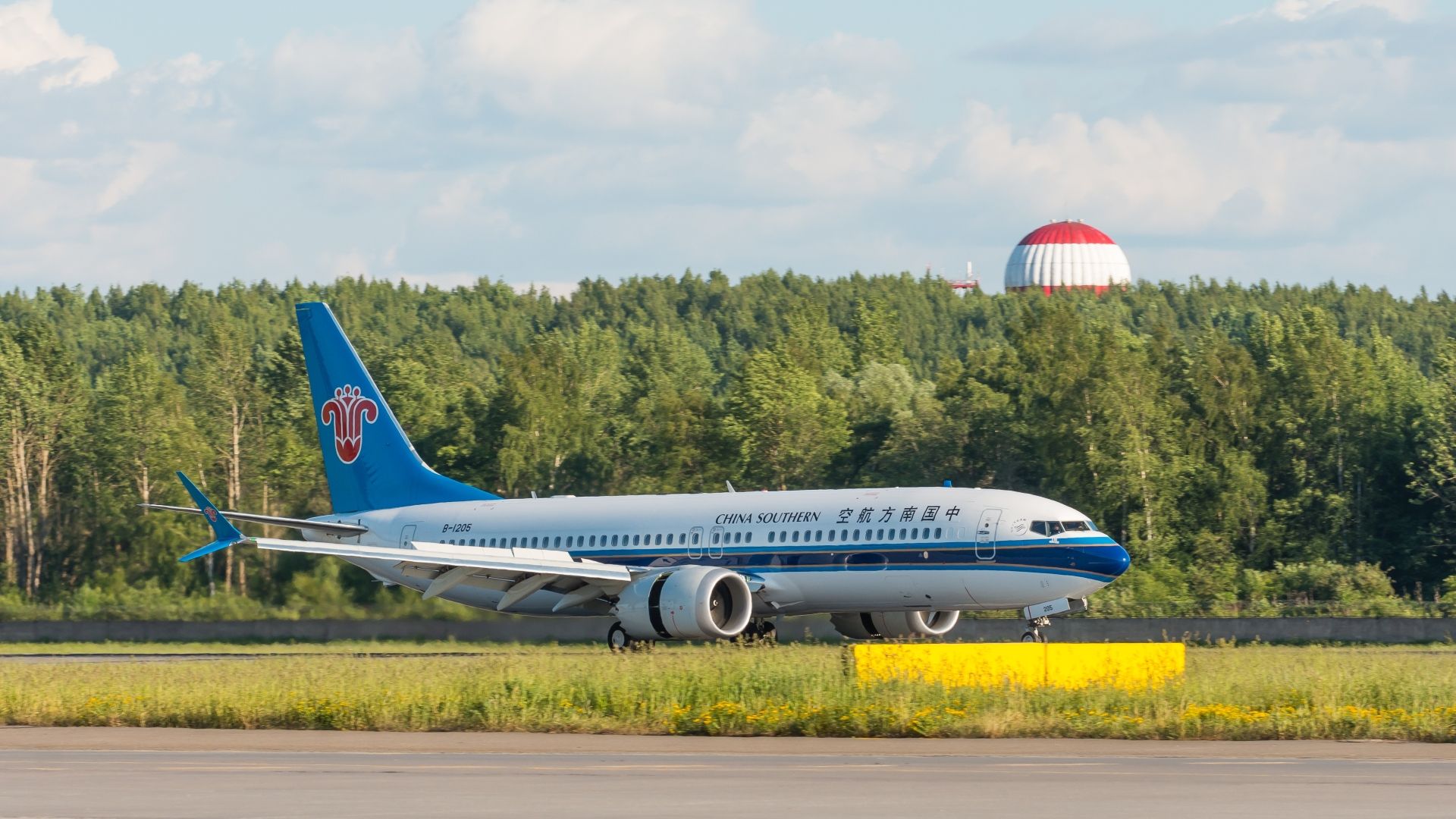
China Southern Airlines operates this corridor with a lower frequency, offering two flights weekly in each direction using the Boeing 737 MAX 8. Passengers flying to Kashi experience block times exceeding seven hours, while flights back to Shanghai can be as short as five hours and 35 minutes. These extensive routes highlight how critical remote airports are for travel within the country, connecting regions from Tibet to the islands in the South China Sea.
India and Indonesia also contribute to Asia’s long domestic flights, albeit with shorter distances than their counterparts in Russia and China. India’s longest domestic route measures 1,542 miles (2,482 km), linking New Delhi (DEL) to Veer Savarkar International Airport (IXZ) in the Andaman and Nicobar Islands. Air India operates this route twice daily, alongside Air India Express, both utilizing the Airbus A320neo.
Indonesia, while smaller in land area than India, has a significant domestic route that exceeds India’s longest at 2,347 miles (3,777 km). This route connects Jakarta (CGK) with Jayapura (DJJ) and is served twice daily by Garuda Indonesia, with additional flights from Batik Air. Both airlines predominantly use the Boeing 737-800 for these operations.
As domestic air travel continues to grow in Asia, these long-haul routes illustrate the ongoing demand for connectivity across vast distances. The efforts of airlines to bridge these gaps underscore the importance of air travel in enhancing regional access and mobility for millions of passengers.

Taste Test Reveals Best Mince Pies from Major UK Supermarkets

Baba Vanga Predicts Alien Contact and Global Upheaval in 2026

Astronomers Uncover the Pulsating Mystery of 3I/ATLAS

Ajax Match Abandoned After Fireworks Erupt in Stands

Asia’s Longest Domestic Flights: Some Stretch Over 3,000 Miles

Inmates Sneak in Fried Chicken Takeaways at HMP Wandsworth

Parkdean Resorts Launches Major Black Friday Discounts for 2026 Stays

Former Rockstar Employee Reveals GTA 6 Animations in Leak

Maintain Your HVAC System: Avoid Costly Repairs This Winter

Iconic 90s TV Show House Hits Market for £1.1 Million

Milk Bank Urges Mothers to Donate for Premature Babies’ Health

Alessia Russo Signs Long-Term Deal with Arsenal Ahead of WSL Season

Shoppers Flock to Discounted Neck Pillow on Amazon for Travel Comfort

Museums Body Critiques EHRC Proposals on Gender Facilities

Trump Visits Europe: Business, Politics, or Leisure?

Japanese Teen Sorato Shimizu Breaks U18 100m Record in 10 Seconds

Couple Shares Inspiring Love Story Defying Height Stereotypes

Anglian Water Raises Concerns Over Proposed AI Data Centre
-
 Entertainment2 months ago
Iconic 90s TV Show House Hits Market for £1.1 Million
-
 Lifestyle4 months ago
Milk Bank Urges Mothers to Donate for Premature Babies’ Health
-
 Sports3 months ago
Alessia Russo Signs Long-Term Deal with Arsenal Ahead of WSL Season
-
 Lifestyle4 months ago
Shoppers Flock to Discounted Neck Pillow on Amazon for Travel Comfort
-
 Politics4 months ago
Museums Body Critiques EHRC Proposals on Gender Facilities
-
 Business4 months ago
Trump Visits Europe: Business, Politics, or Leisure?
-
 Lifestyle4 months ago
Japanese Teen Sorato Shimizu Breaks U18 100m Record in 10 Seconds
-
 Politics4 months ago
Couple Shares Inspiring Love Story Defying Height Stereotypes
-
 World4 months ago
Anglian Water Raises Concerns Over Proposed AI Data Centre
-

 Sports4 months ago
Bournemouth Dominates Everton with 3-0 Victory in Premier League Summer Series
-

 World4 months ago
Wreckage of Missing Russian Passenger Plane Discovered in Flames
-

 Lifestyle4 months ago
Shoppers Rave About Roman’s £42 Midi Dress, Calling It ‘Elegant’