
Entertainment
Graduate’s Research on Ants Sparks Viral Debate on Social Media

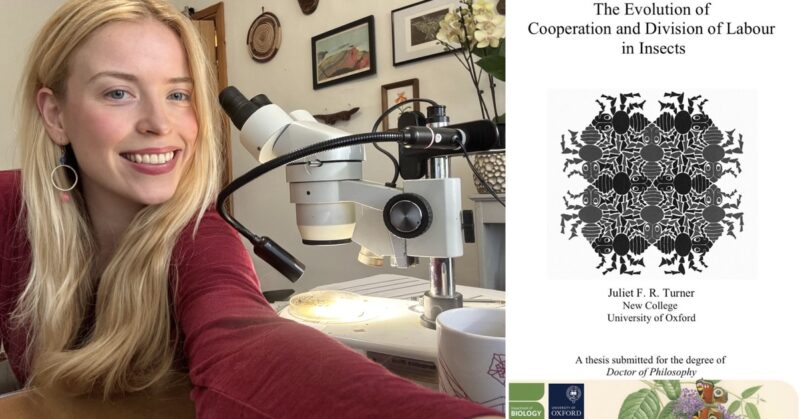
A recent exchange on social media has ignited a heated discussion surrounding academic achievements and societal perceptions of certain fields of study. On November 14, 2025, Juliet Turner, an ecologist and evolutionary biologist, celebrated the successful defense of her DPhil thesis at the University of Oxford. Her post, which included the declaration, “You can call me Doctor,” received a mix of congratulations and criticism, particularly from individuals questioning the relevance of her research.
Turner’s thesis focuses on the “evolution of cooperation and division of labour in insects,” a subject deemed trivial by some, particularly one vocal critic who suggested that men do not find women with degrees attractive. This sentiment was echoed by another user who claimed that people are not genuinely upset over Turner’s accomplishment but rather the nature of her research topic, which they described as “useless.”
The backlash included comments that framed Turner’s work as less impactful compared to research in fields like medicine or engineering. One comment made waves online, stating, “Most people can accept someone celebrating medical research, engineering breakthroughs, or something that clearly improves the world.” The user implied that celebrating a PhD focused on ants felt out of touch with the challenges faced by ordinary people, including financial struggles and public service issues.
Despite the criticism, Turner responded to her detractors with a robust defense of her work. In a follow-up tweet, she stated, “The irony behind all the criticism of my research is that you would struggle to find a topic more fundamental or widely applicable than my DPhil thesis.” She highlighted the broader implications of her research, which informs areas such as pure science, cancer biology, technology, and economics.
Turner elaborated on how her findings contribute to understanding complex life systems, noting that “all complex life depends on cooperation and division of labour.” She explained that insights from her thesis could help address issues in cancer biology by understanding how cellular cooperation breaks down, which parallels challenges in multicellular organisms, including humans.
The discussion surrounding Turner’s work has taken on a life of its own, with many users coming to her defense. Comments flooded in, praising her research and drawing parallels to historical figures like Charles Darwin, who also faced skepticism during his studies. One user remarked, “When Darwin was collecting beetles, I’m sure everyone thought he was wasting his time,” emphasizing that curiosity-driven research can lead to significant breakthroughs.
Turner’s situation has not only highlighted the ongoing debate about the value of different academic fields but also underscored the importance of public engagement in science. Many users expressed gratitude for the dialogue sparked by the criticism, stating that it has led to greater awareness and interest in her research area.
As the conversation continues, Turner remains committed to her work and expressed eagerness to share her findings once her thesis is published. She invited those interested in the evolution of complex life to engage further with her research, signaling a positive outlook despite the initial backlash.
This incident serves as a reminder of the diverse perspectives surrounding academic research and the significance of encouraging discussions across various fields of study.

Welsh Ambulance Service Targets Frequent 999 Callers for Support

Welsh Ambulance Service Targets Frequent 999 Callers for Better Care

Bremen’s Marble Imaging Secures €5.3M for Revolutionary Satellites

WNBA and Players Association Secure 40-Day Extension on CBA Talks

Three Vacant West Midlands Homes Auctioned for £50,000 Each

Four Long-Standing Suspects Remain at Large on West Midlands List

Taste Test Reveals Best Mince Pies from Major UK Supermarkets

Baba Vanga Predicts Alien Contact and Global Upheaval in 2026

Astronomers Uncover the Pulsating Mystery of 3I/ATLAS

Iconic 90s TV Show House Hits Market for £1.1 Million

Milk Bank Urges Mothers to Donate for Premature Babies’ Health

Alessia Russo Signs Long-Term Deal with Arsenal Ahead of WSL Season

Shoppers Flock to Discounted Neck Pillow on Amazon for Travel Comfort

Museums Body Critiques EHRC Proposals on Gender Facilities

Trump Visits Europe: Business, Politics, or Leisure?

Japanese Teen Sorato Shimizu Breaks U18 100m Record in 10 Seconds

Couple Shares Inspiring Love Story Defying Height Stereotypes

Anglian Water Raises Concerns Over Proposed AI Data Centre
-
 Entertainment2 months ago
Iconic 90s TV Show House Hits Market for £1.1 Million
-
 Lifestyle4 months ago
Milk Bank Urges Mothers to Donate for Premature Babies’ Health
-
 Sports3 months ago
Alessia Russo Signs Long-Term Deal with Arsenal Ahead of WSL Season
-
 Lifestyle4 months ago
Shoppers Flock to Discounted Neck Pillow on Amazon for Travel Comfort
-
 Politics4 months ago
Museums Body Critiques EHRC Proposals on Gender Facilities
-
 Business4 months ago
Trump Visits Europe: Business, Politics, or Leisure?
-
 Lifestyle4 months ago
Japanese Teen Sorato Shimizu Breaks U18 100m Record in 10 Seconds
-
 Politics4 months ago
Couple Shares Inspiring Love Story Defying Height Stereotypes
-
 World4 months ago
Anglian Water Raises Concerns Over Proposed AI Data Centre
-

 Sports4 months ago
Bournemouth Dominates Everton with 3-0 Victory in Premier League Summer Series
-

 World4 months ago
Wreckage of Missing Russian Passenger Plane Discovered in Flames
-

 Lifestyle4 months ago
Shoppers Rave About Roman’s £42 Midi Dress, Calling It ‘Elegant’