
Science
Avi Loeb Proposes Antimatter Composition for Comet 3I/ATLAS

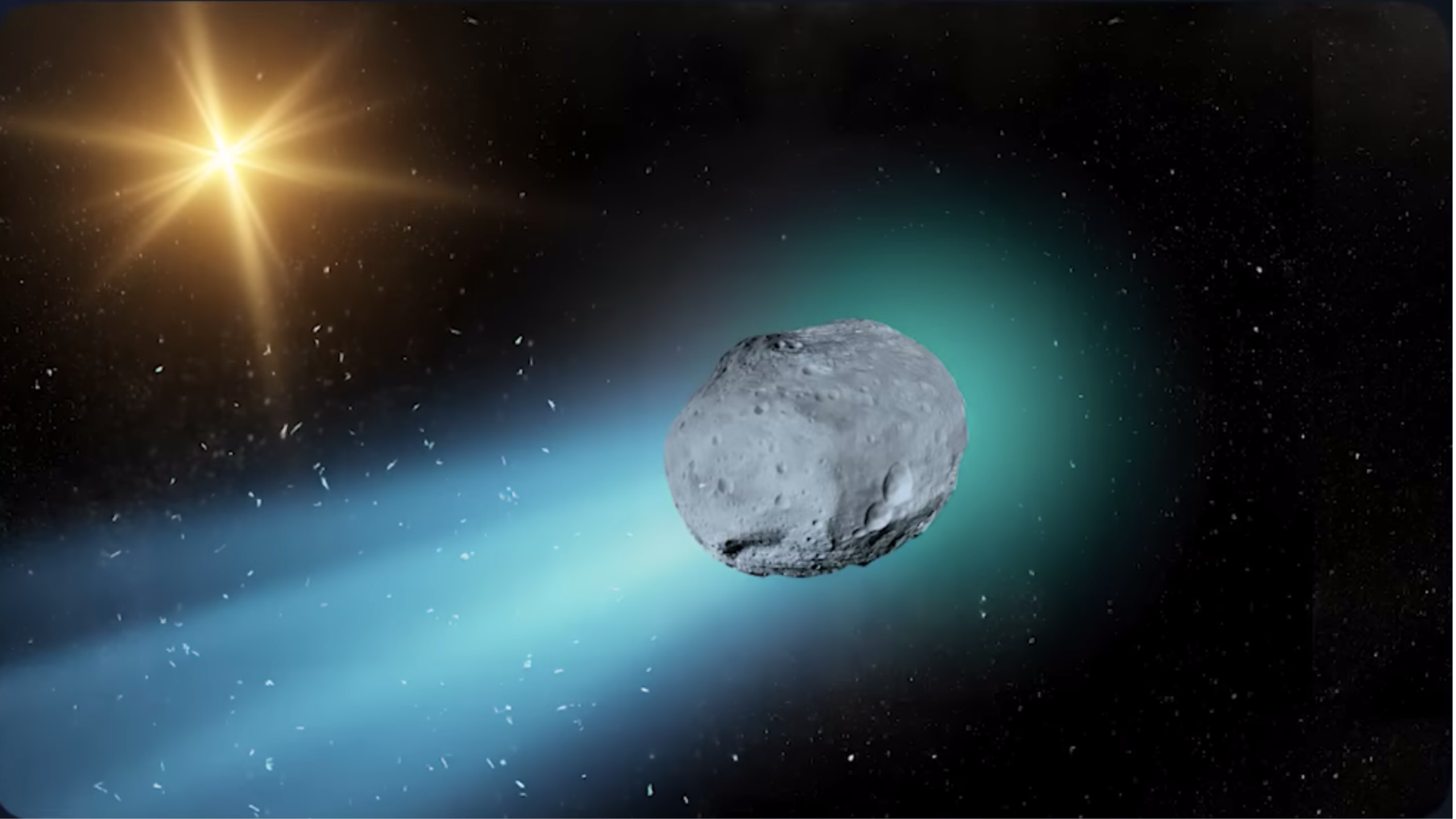
The scientific community is abuzz following a bold claim by Harvard astrophysicist Avi Loeb, who suggested that the interstellar comet 3I/ATLAS might be composed of antimatter. This assertion was made in an essay published on Medium, where Loeb described antimatter as “the most efficient fuel” in the universe. If true, this would imply that as 3I/ATLAS navigates through the solar wind, it could produce detectable gamma-ray or X-ray emissions, which could potentially be observed by NASA‘s Fermi Gamma-Ray Space Telescope.
Loeb emphasized that his theory is “pedagogical,” but it has reignited discussions regarding the nature of this cosmic object. He noted that an antimatter body traversing the Solar System would function as an exceptionally efficient engine, hinting at a possible technological origin. Officially designated as C/2025 N1, 3I/ATLAS was discovered on July 1, 2025, by the Asteroid Terrestrial-impact Last Alert System (ATLAS) in Hawaii. It is only the third confirmed interstellar visitor to enter the Solar System, following ʻOumuamua in 2017 and 2I/Borisov in 2019.
The orbit of 3I/ATLAS is notably inclined at 175° to the ecliptic, which positions it within approximately 5° of the plane of the Solar System’s planets. Observations reported by The Economist indicated that as the comet approached its closest point to the Sun, it appeared “bluer than the Sun.” Loeb interpreted this color change as potential evidence of internal energy generation rather than merely reflecting sunlight.
In addition, Loeb pointed out that 3I/ATLAS exhibited non-gravitational acceleration, suggesting an additional force acting on it. In an interview referenced by Newsweek, he stated that this observation “could indicate propulsion or an energy source other than sunlight,” though he refrained from asserting it as evidence of extraterrestrial technology.
In his essay, Loeb argued that if 3I/ATLAS were indeed made of antimatter, it could explain both its acceleration and its unusual glow through annihilation with solar particles. He elaborated that the combination of matter and antimatter provides the most efficient energy source, claiming, “complete mass-to-energy conversion is unmatched by any chemical or nuclear reaction.” Despite this intriguing theory, he acknowledged the challenges associated with antimatter, noting that producing just one gram of it would cost around $5 quadrillion. This staggering figure highlights the substance’s extreme rarity and instability.
While Loeb’s hypothesis is captivating, mainstream scientists have responded with skepticism. Dr. Samantha Lawler, an astrophysicist at the University of Regina in Canada, commented to EarthSky that “extraordinary claims require extraordinary evidence, and the evidence presented is absolutely not extraordinary.” NASA has also stated that 3I/ATLAS “behaves like a natural comet in all observable ways,” asserting that there is no credible data supporting a composition that is artificial or exotic.
Furthermore, astronomers note that non-gravitational accelerations are not uncommon among comets, often resulting from sunlight heating their surfaces and creating gas jets that can slightly alter their trajectories. Cosmologists argue that the existence of significant concentrations of antimatter in the universe is unlikely, as demonstrated by gamma-ray observations documented in research published on arXiv. Even Loeb himself acknowledged that large bodies of antimatter should have been eradicated soon after the Big Bang.
Despite the skepticism surrounding his claims, many scientists agree that 3I/ATLAS merits ongoing scrutiny. Global research teams aim to monitor its brightness, tail development, and trajectory to assess whether the anomalies Loeb identifies persist or can be explained by more conventional physics. In a separate post titled “Should We Be Happier if 3I/ATLAS Is a Comet?”, Loeb reflected that even if the object turns out to be a natural phenomenon, “we should still celebrate, because nature continues to surprise us without needing aliens or antimatter.”
As 3I/ATLAS continues its journey away from the Sun, the debate it has sparked illustrates the vast unknowns regarding interstellar materials traversing our cosmic neighborhood and the lengths to which astronomers are willing to explore for answers.

Emily Ratajkowski Dazzles in Micro Mini Dress at 2025 Fashion Awards

Russian Forces Capture Key City of Krasnoarmeysk in Donbass

Scientists Unravel Secrets Behind Dripping Faucets’ Behavior

Nice Players Assaulted by Fans After Defeat, Team Issues Statement

Four Arrested for Hacking Over 120,000 IP Cameras in South Korea

ITV Soaps Collide: Coronation Street and Emmerdale Crossover Revealed

KENJI Opens First Scottish Store in Silverburn on December 13

Leaked Video Reveals Chinese General’s Defiance During 1989 Crackdown

Scientists Uncover Mechanism Behind Cellular Aging Process

Iconic 90s TV Show House Hits Market for £1.1 Million

Milk Bank Urges Mothers to Donate for Premature Babies’ Health

Alessia Russo Signs Long-Term Deal with Arsenal Ahead of WSL Season

Shoppers Flock to Discounted Neck Pillow on Amazon for Travel Comfort

Museums Body Critiques EHRC Proposals on Gender Facilities

Trump Visits Europe: Business, Politics, or Leisure?

Japanese Teen Sorato Shimizu Breaks U18 100m Record in 10 Seconds

Couple Shares Inspiring Love Story Defying Height Stereotypes

Anglian Water Raises Concerns Over Proposed AI Data Centre
-
 Entertainment2 months ago
Iconic 90s TV Show House Hits Market for £1.1 Million
-
 Lifestyle4 months ago
Milk Bank Urges Mothers to Donate for Premature Babies’ Health
-
 Sports3 months ago
Alessia Russo Signs Long-Term Deal with Arsenal Ahead of WSL Season
-
 Lifestyle4 months ago
Shoppers Flock to Discounted Neck Pillow on Amazon for Travel Comfort
-
 Politics4 months ago
Museums Body Critiques EHRC Proposals on Gender Facilities
-
 Business4 months ago
Trump Visits Europe: Business, Politics, or Leisure?
-
 Lifestyle4 months ago
Japanese Teen Sorato Shimizu Breaks U18 100m Record in 10 Seconds
-
 Politics4 months ago
Couple Shares Inspiring Love Story Defying Height Stereotypes
-
 World4 months ago
Anglian Water Raises Concerns Over Proposed AI Data Centre
-

 Sports4 months ago
Bournemouth Dominates Everton with 3-0 Victory in Premier League Summer Series
-

 World4 months ago
Wreckage of Missing Russian Passenger Plane Discovered in Flames
-

 Lifestyle4 months ago
Shoppers Rave About Roman’s £42 Midi Dress, Calling It ‘Elegant’