
Science
AI Revolutionizes Cancer Care: Faster Diagnoses and Personalized Treatments

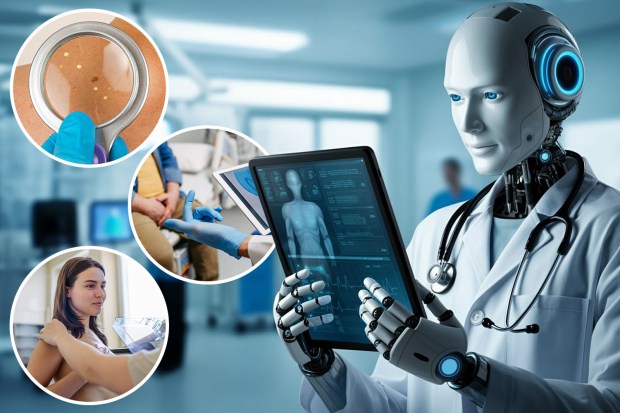
Artificial intelligence (AI) is rapidly transforming cancer care, enhancing research, diagnosis, and treatment capabilities. Recent announcements indicate that the NHS will implement AI tools on an unprecedented scale, aiming to provide millions of patients with faster and smarter care. This initiative includes a trial involving 700,000 women to identify potential signs of breast cancer.
The potential applications of AI in oncology are vast. In August, researchers revealed that AI technology could soon detect throat cancer by analyzing the sound of a patient’s voice. Furthermore, scientists have developed an AI-modeled personalized vaccine for melanoma skin cancer, bringing it closer to reality.
Advancements in Research
AI is transforming the landscape of cancer research by facilitating prevention and early detection efforts. Research labs analyze vast amounts of data daily, seeking patterns in genetic codes and compiling decades of information. This traditionally labor-intensive process is now significantly expedited by AI.
Professor Nuria Lopez-Bigas from Spain’s Institute for Research in Biomedicine explains the impact of AI on research: “Before AI, we would look at a patient’s tumor and guess which mutations to experiment on and see what happened, but it was slow. With AI, we can analyze thousands of tumors from people around the world and identify patterns that indicate which mutations are the drivers.” This advancement has led to research timelines being accelerated by years, if not decades.
In another remarkable development, King’s College London utilized ChatGPT-4 to identify new drug combinations for breast cancer treatment. The AI system suggested 12 previously untested combinations, seven of which showed promise in lab tests. Similarly, the Institute for Cancer Research achieved a 99 percent accuracy rate in training AI to determine how different medications alter the physical shape of human cancer cells. This innovation could reduce the duration of pre-human testing from three years to just three months.
Enhancing Diagnosis and Treatment
The NHS is actively incorporating AI into hospital settings to improve cancer diagnosis. AI systems can analyze pixels much smaller than a human hair, unveiling concerns in scans or test results that might escape the attention of busy doctors. The National Institute for Health and Care Excellence (NICE) has encouraged hospitals to adopt AI for mole assessments. The AI detection system, known as DERM, compares smartphone images of moles against a vast database to help doctors determine their cancerous nature.
Machine learning is also being trialed for earlier detection of lung, breast, and prostate cancers. Dr. Joe Barnett, a radiologist at the Royal Free NHS Trust in London, highlights AI’s role in lung cancer screening: “It can detect potential masses quickly, helping me to spend less time looking for lumps and freeing me up to think about if they might be cancerous.” A two-year study involving 3,000 men will evaluate similar technology for prostate cancer after trials indicated its ability to identify smaller MRI abnormalities than human radiologists.
In a groundbreaking initiative, researchers at Oregon Health and Science University trained an algorithm to identify early signs of throat cancer by analyzing voice recordings.
Patient-Centric Innovations
While AI cannot yet perform cancer treatments, it is empowering doctors to make faster and more informed decisions. The focus on “precision,” “personalized,” and “tailored” therapies enhances treatment effectiveness while minimizing side effects. The American Society of Clinical Oncology has introduced a ChatGPT-style tool that assists oncologists by providing treatment options based on patients’ individual data and the latest scientific research.
Dr. Julie Gralow, a breast cancer specialist and President of the Association for Clinical Oncology, emphasizes the urgency of utilizing AI in practice: “AI won’t replace oncologists, but those who use it will replace those who don’t.” Additionally, AI can simulate the effects of new therapies on “virtual patients,” optimizing medication dosages and tracking patient responses in real-time.
The integration of AI into surgical robotics is also gaining momentum. Robots are being programmed to enhance decision-making and automate tasks during cancer surgeries. Leading robot manufacturer Intuitive is employing AI to record surgical procedures and provide feedback to surgeons on performance improvements. Notably, scientists at Johns Hopkins University successfully programmed a robot to conduct imitation surgery without human intervention.
AI’s capabilities extend to patient monitoring as well. By linking wearable sensors that track vital signs to doctors’ computers, AI can facilitate continuous patient assessment during recovery.
Looking Ahead
According to the Cancer Research Institute in the United States, the intersection of AI and cancer care represents an “emerging revolution” that is poised to reshape diagnostics and treatment approaches. Professor Lopez-Bigas expresses optimism for the future, stating, “I have a feeling that the biggest leap is yet to come.”
In England, cancer screenings play a critical role in early detection, significantly enhancing survival chances. The NHS offers three national screening programs: cervical, breast, and bowel screenings, which aim to identify potential health issues before symptoms arise.
As AI continues to evolve and integrate into cancer care, its impact on improving patient outcomes and streamlining processes is expected to be profound. The collaboration between technology and medicine heralds a new era in the fight against cancer, promising hope and innovation for patients and healthcare providers alike.

Cattle Showcases Thrive at RUAS Winter Fair 2023

UK and US Strike Zero Tariff Agreement on Pharmaceuticals

Maya Jama Stuns in Strapless Ensemble at Qatar Grand Prix

Russia and Saudi Arabia Launch Visa-Free Travel Agreement

ISOLDE Facility Marks 10 Years of Advancements in Nuclear Research

Voters Demand Resignation of Chancellor Rachel Reeves Over Tax Hikes

Shoppers Save 30% on Marks & Spencer’s Viral Velvet Dress

Health Campaigners Urge End to Smoking Exemption for Lounges

Charity Shop Surprise: Woman Finds Joggers Worth £2,000 for £8

Iconic 90s TV Show House Hits Market for £1.1 Million

Milk Bank Urges Mothers to Donate for Premature Babies’ Health

Alessia Russo Signs Long-Term Deal with Arsenal Ahead of WSL Season

Shoppers Flock to Discounted Neck Pillow on Amazon for Travel Comfort

Museums Body Critiques EHRC Proposals on Gender Facilities

Trump Visits Europe: Business, Politics, or Leisure?

Japanese Teen Sorato Shimizu Breaks U18 100m Record in 10 Seconds

Couple Shares Inspiring Love Story Defying Height Stereotypes

Anglian Water Raises Concerns Over Proposed AI Data Centre
-
 Entertainment2 months ago
Iconic 90s TV Show House Hits Market for £1.1 Million
-
 Lifestyle4 months ago
Milk Bank Urges Mothers to Donate for Premature Babies’ Health
-
 Sports3 months ago
Alessia Russo Signs Long-Term Deal with Arsenal Ahead of WSL Season
-
 Lifestyle4 months ago
Shoppers Flock to Discounted Neck Pillow on Amazon for Travel Comfort
-
 Politics4 months ago
Museums Body Critiques EHRC Proposals on Gender Facilities
-
 Business4 months ago
Trump Visits Europe: Business, Politics, or Leisure?
-
 Lifestyle4 months ago
Japanese Teen Sorato Shimizu Breaks U18 100m Record in 10 Seconds
-
 Politics4 months ago
Couple Shares Inspiring Love Story Defying Height Stereotypes
-
 World4 months ago
Anglian Water Raises Concerns Over Proposed AI Data Centre
-

 Sports4 months ago
Bournemouth Dominates Everton with 3-0 Victory in Premier League Summer Series
-

 World4 months ago
Wreckage of Missing Russian Passenger Plane Discovered in Flames
-

 Lifestyle4 months ago
Shoppers Rave About Roman’s £42 Midi Dress, Calling It ‘Elegant’