
Politics
Senate Hearing Exposes Attorney General Pam Bondi’s Controversial Actions

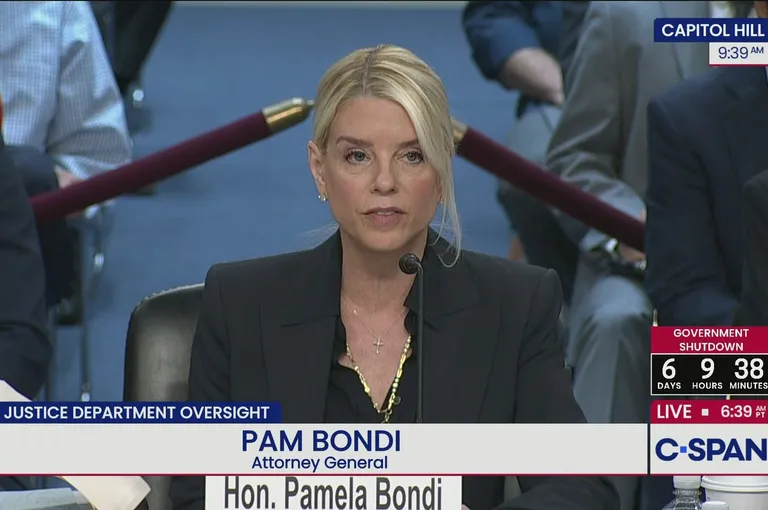
The recent oversight hearing of Attorney General Pam Bondi by the Senate Judiciary Committee on October 7, 2025, highlighted significant concerns regarding her conduct and the operations of the Department of Justice (DOJ). The session marked Bondi’s first appearance before lawmakers since a tumultuous summer, which included controversial federal law enforcement deployments in Democratic-run cities and the indictment of former FBI Director James Comey.
Throughout the hearing, Bondi exhibited a troubling dismissal of the questions posed by Democratic senators, instead focusing on affirming her loyalty to Donald Trump. This attitude raised eyebrows among lawmakers who perceived her responses as contemptuous rather than informative. In a statement that many viewed as misleading, Bondi claimed, “We have made tremendous progress towards those ends,” referring to her efforts to end what she termed the “weaponization of justice.”
According to ABC News, the hearing was characterized by Bondi’s refusal to acknowledge any legitimate oversight from the Senate, suggesting a troubling trend in the relationship between the executive branch and legislative oversight. The hearing followed the DOJ’s controversial actions, including deploying federal agents in response to rising crime, which Bondi attributed to a cooperative effort with local law enforcement. Yet, many critics argue that her portrayal diverges sharply from the realities on the ground.
Constitutional Concerns Raised
Bondi’s comments during the hearing raised alarms about her understanding of constitutional authority and local governance. In her opening statement, she asserted that a surge of federal resources into Washington, D.C., exemplified effective DOJ operations. However, critics pointed out that her administration’s actions, particularly the executive orders issued by Trump, undermined the autonomy of D.C.’s local government.
On August 11, 2025, Trump declared a “Crime Emergency in the District of Columbia,” which Bondi used to justify increased federal control over local policing. This prompted a swift backlash from D.C. officials, who described the orders as unconstitutional. In response, D.C. filed a lawsuit against Trump, asserting that the federal government was infringing upon their home rule powers, a move that emphasized the ongoing tension between local and federal authorities.
The District’s legal complaint pointed out that no president had previously attempted to assert such control, highlighting the historical context of D.C.’s governance. The lawsuit underscored that Congress had granted D.C. residents the right to govern themselves, a right that Trump and Bondi appeared to overlook.
Contentious Exchanges with Senators
The hearing featured intense exchanges between Bondi and Democratic senators, particularly Dick Durbin and Sheldon Whitehouse. Durbin pressed Bondi on whether she had consulted with the White House regarding the deployment of National Guard troops. Bondi’s evasive responses led to accusations of politicizing her role as Attorney General. Durbin emphasized that the American public deserved transparency regarding the rationale behind such military deployments.
Whitehouse questioned Bondi about the controversial $50,000 cash payment made to former ICE chief Tom Homan by undercover FBI agents, which raised eyebrows regarding potential bribery. Bondi repeatedly deflected the inquiry, stating that the investigation found no credible evidence of wrongdoing, a claim met with skepticism by several senators.
The contentious nature of the hearing painted a picture of a department that some lawmakers believe has shifted away from its foundational purpose of impartial justice. Notably, Adam Schiff highlighted claims that Bondi’s office had engaged in politically motivated prosecutions, calling into question the integrity of the DOJ under her leadership.
Bondi’s testimony and the surrounding events have prompted significant public discourse on the role of the Attorney General and the necessity of accountability within the government. As the fallout from this hearing continues, it raises critical questions about governance, the rule of law, and the ethical standards expected from public officials.
The implications of Bondi’s actions and statements could resonate beyond the hearing room, influencing perceptions of the DOJ and the administration’s commitment to justice amidst a highly polarized political landscape.

Liverpool Activates Backup Plan as Man City Targets Antoine Semenyo

British Father Drowns in Thailand After Being Swept Away by Waves

TorroFX Set to Transform Trading Landscape with Launch on December 1, 2025

BBC Breakfast’s Sally Nugent Apologizes for News Disruption

Recognize Bowel Cancer Signs During Festive Overindulgence

Marie Helvin Discusses Dating Challenges and Body Confidence at 73

Danny Morrison Reflects on United Ireland, Gerry Adams, and Stormont’s Future

Southampton University and Siemens Collaborate to Advance MEMS Technology

Barcelona’s Deco Highlights Rashford’s Burden at Manchester United

Iconic 90s TV Show House Hits Market for £1.1 Million

Milk Bank Urges Mothers to Donate for Premature Babies’ Health

Alessia Russo Signs Long-Term Deal with Arsenal Ahead of WSL Season

Shoppers Flock to Discounted Neck Pillow on Amazon for Travel Comfort

Museums Body Critiques EHRC Proposals on Gender Facilities

Trump Visits Europe: Business, Politics, or Leisure?

Japanese Teen Sorato Shimizu Breaks U18 100m Record in 10 Seconds

Couple Shares Inspiring Love Story Defying Height Stereotypes

Anglian Water Raises Concerns Over Proposed AI Data Centre
-
 Entertainment2 months ago
Iconic 90s TV Show House Hits Market for £1.1 Million
-
 Lifestyle4 months ago
Milk Bank Urges Mothers to Donate for Premature Babies’ Health
-
 Sports3 months ago
Alessia Russo Signs Long-Term Deal with Arsenal Ahead of WSL Season
-
 Lifestyle4 months ago
Shoppers Flock to Discounted Neck Pillow on Amazon for Travel Comfort
-
 Politics4 months ago
Museums Body Critiques EHRC Proposals on Gender Facilities
-
 Business4 months ago
Trump Visits Europe: Business, Politics, or Leisure?
-
 Lifestyle4 months ago
Japanese Teen Sorato Shimizu Breaks U18 100m Record in 10 Seconds
-
 Politics4 months ago
Couple Shares Inspiring Love Story Defying Height Stereotypes
-
 World4 months ago
Anglian Water Raises Concerns Over Proposed AI Data Centre
-

 Sports4 months ago
Bournemouth Dominates Everton with 3-0 Victory in Premier League Summer Series
-

 World4 months ago
Wreckage of Missing Russian Passenger Plane Discovered in Flames
-

 Lifestyle4 months ago
Shoppers Rave About Roman’s £42 Midi Dress, Calling It ‘Elegant’