
Science
Researchers Enhance Search for Neutrinoless Double Beta Decay

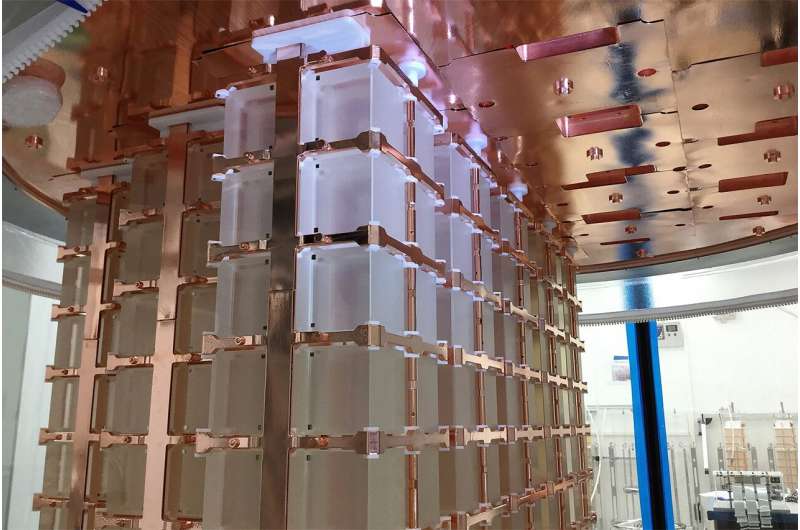
Deep beneath the Gran Sasso mountain in Italy, researchers are advancing the search for neutrinoless double beta decay, a phenomenon that could challenge established principles in particle physics. The experiment, known as the Cryogenic Underground Observatory for Rare Events (CUORE), has now accumulated two ton-years of data, representing an extensive effort to document this rare nuclear decay process.
Neutrinoless double beta decay is a theoretical event in which two neutrons in an atom’s nucleus transform into protons without producing the usual two antineutrinos. If confirmed, this would demonstrate that neutrinos are their own antiparticles, a revelation that could reshape our understanding of fundamental physics. Standard double beta decay has been observed, where two neutrons convert to two protons, releasing two electrons and two antineutrinos.
In a recent study published in the journal Science, CUORE researchers reported that neutrinoless double beta decay occurs no more than once every 50 septillion years, an extremely rare event that highlights the difficulty of the search. The team utilized an advanced algorithm to filter out background noise—such as vibrations from researchers, ocean waves, and seismic activity—similar to the function of noise-cancelling headphones.
Reina Maruyama, a professor of physics and astronomy at Yale University and a member of the CUORE team, emphasized, “The focus of this data release is understanding sources of external vibrations and learning how to subtract that from our data to better search for this extremely rare decay.” The CUORE facility is strategically located in the Gran Sasso National Laboratory, nearly a mile below ground, surrounded by lead shielding sourced from a 2,000-year-old Roman shipwreck, to minimize radiation interference.
Despite these protective measures, some vibrational noise penetrates the environment. To combat this, the research team installed over two dozen sensors to monitor temperature, sound, vibration, and electrical interference near the detector. By correlating sensor data with the experimental findings, the team identified which signals were extraneous and could be disregarded.
The CUORE experiment, which began operations in 2017, is a collaborative effort led by the U.S. Department of Energy’s Lawrence Berkeley National Laboratory and involves more than 20 research institutions, including Yale. Data collection will continue through the end of this year, after which the successor experiment, the CUORE Upgrade with Particle Identification (CUPID), will take over the search for neutrinoless double beta decay.
CUPID aims to enhance the sensitivity of the experiment by incorporating advanced light sensors into its thermal detectors, improving event identification and background discrimination. The new setup will also utilize enriched molybdenum crystals instead of tellurium, further refining the detection process.
Detecting neutrinoless double beta decay could have profound implications. As noted by Karsten Heeger, the Eugene Higgins Professor of Physics at Yale and an international spokesperson for CUPID, “This unique nature of neutrinos may explain the matter-antimatter asymmetry in the universe—the fact that there is more matter than antimatter.” He added that it would challenge a fundamental principle of the Standard Model of Particle Physics known as lepton number conservation.
Yale researchers play a pivotal role in both CUORE and CUPID, contributing to low-energy analysis and mitigating backgrounds induced by muons. Alongside Maruyama and Heeger, key contributors include research scientist Penny Slocum, postdoctoral researcher Tyler Johnson, and engineer James Wilhelmi, with support from graduate students Ridge Liu, Maya Moore, Zach Muraskin, and former graduate student Samantha Pagan.
As the scientific community watches closely, the CUORE project continues to pave the way for groundbreaking discoveries in the realm of particle physics, with potential impacts that reach far beyond the laboratory’s confines.

LaLiga Thrills: Key Highlights from Recent Fixtures Unveiled

Germany Intensifies Deportations of Afghan and Syrian Migrants

Shoppers Embrace Next’s £36 Knit as Trendy Christmas Alternative

Harbour Energy Announces 100 Job Cuts Amid Industry Challenges

Amy Childs Shares Weight Gain Journey, Emphasizing Self-Love

UK and US Set to Finalize Zero-Tariff Agreement on Pharmaceuticals

Liverpool Activates Backup Plan as Man City Targets Antoine Semenyo

British Father Drowns in Thailand After Being Swept Away by Waves

TorroFX Set to Transform Trading Landscape with Launch on December 1, 2025

Iconic 90s TV Show House Hits Market for £1.1 Million

Milk Bank Urges Mothers to Donate for Premature Babies’ Health

Alessia Russo Signs Long-Term Deal with Arsenal Ahead of WSL Season

Shoppers Flock to Discounted Neck Pillow on Amazon for Travel Comfort

Museums Body Critiques EHRC Proposals on Gender Facilities

Trump Visits Europe: Business, Politics, or Leisure?

Japanese Teen Sorato Shimizu Breaks U18 100m Record in 10 Seconds

Couple Shares Inspiring Love Story Defying Height Stereotypes

Anglian Water Raises Concerns Over Proposed AI Data Centre
-
 Entertainment2 months ago
Iconic 90s TV Show House Hits Market for £1.1 Million
-
 Lifestyle4 months ago
Milk Bank Urges Mothers to Donate for Premature Babies’ Health
-
 Sports3 months ago
Alessia Russo Signs Long-Term Deal with Arsenal Ahead of WSL Season
-
 Lifestyle4 months ago
Shoppers Flock to Discounted Neck Pillow on Amazon for Travel Comfort
-
 Politics4 months ago
Museums Body Critiques EHRC Proposals on Gender Facilities
-
 Business4 months ago
Trump Visits Europe: Business, Politics, or Leisure?
-
 Lifestyle4 months ago
Japanese Teen Sorato Shimizu Breaks U18 100m Record in 10 Seconds
-
 Politics4 months ago
Couple Shares Inspiring Love Story Defying Height Stereotypes
-
 World4 months ago
Anglian Water Raises Concerns Over Proposed AI Data Centre
-

 Sports4 months ago
Bournemouth Dominates Everton with 3-0 Victory in Premier League Summer Series
-

 World4 months ago
Wreckage of Missing Russian Passenger Plane Discovered in Flames
-

 Lifestyle4 months ago
Shoppers Rave About Roman’s £42 Midi Dress, Calling It ‘Elegant’