
Science
NASA Scientists Investigate Mysterious 3I/ATLAS Object’s Speed

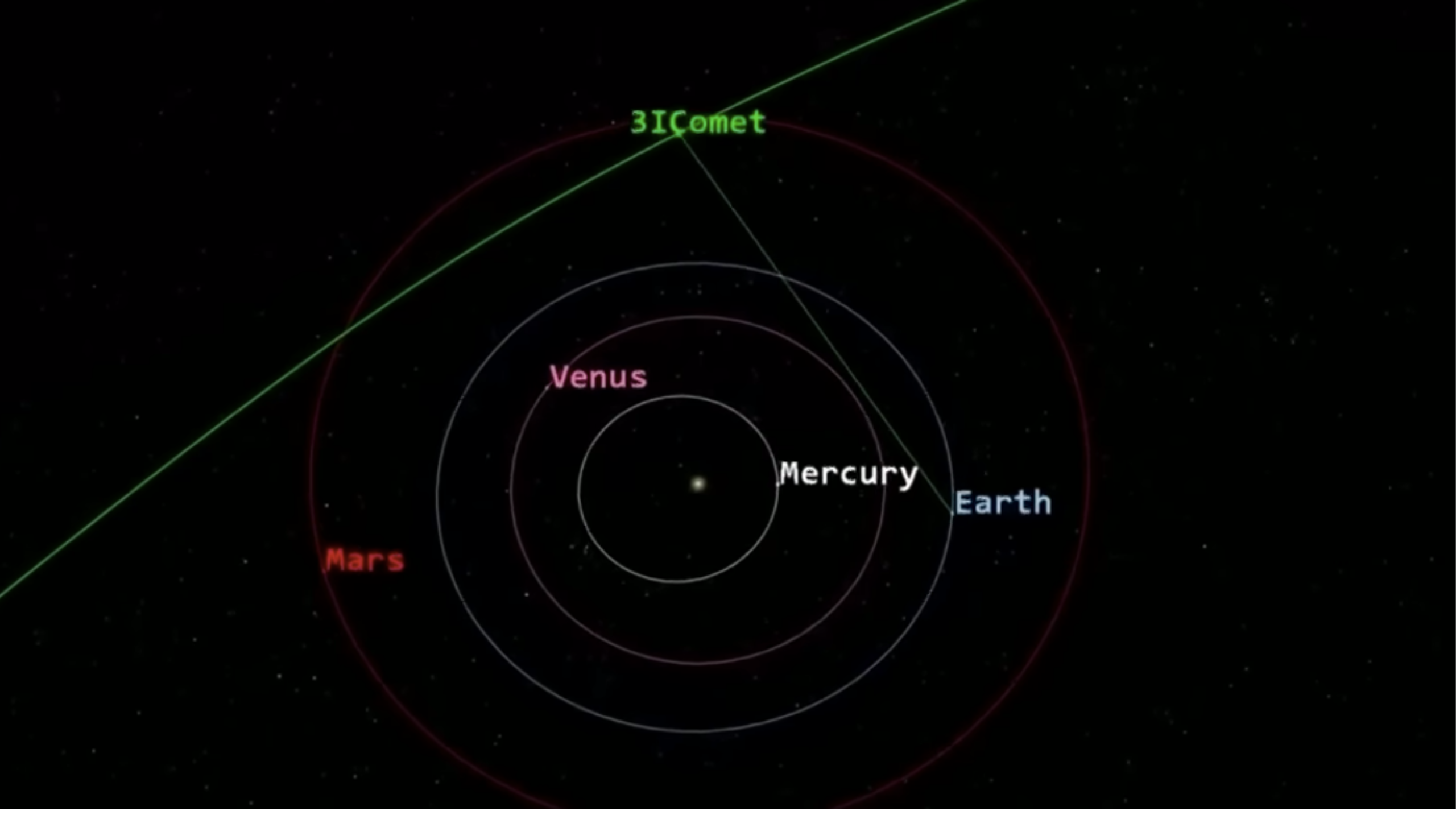
An object identified as 3I/ATLAS has entered our solar system, sparking intense discussions among scientists and the public. Its incredible velocity, measured at 58 km/s (36 miles/s) relative to the Sun, raises questions about its origin and whether it could be an artificial object. While some theorists suggest it may be an alien probe, the majority of astronomers assert that its speed is a natural characteristic of an ancient interstellar object.
The controversy surrounding 3I/ATLAS stems from its trajectory and speed, which some claim cannot be explained by natural forces. However, leading astronomers emphasize that such velocities are expected for objects originating outside our solar system. Avi Loeb, an astrophysicist from Harvard University, has garnered attention for proposing that 3I/ATLAS might be a sophisticated alien probe, citing peculiarities like a “glowing solar shield.” Despite these claims, the scientific community largely remains sceptical, insisting on the necessity of exhausting natural explanations before entertaining extraordinary hypotheses.
3I/ATLAS: An Ancient Traveler
The consensus among scientists is that 3I/ATLAS is most likely a comet. Its behaviour, including any visible tail or glow, can be attributed to natural phenomena associated with comets, rather than advanced propulsion systems. For instance, a comet’s tail may appear to glow based on the viewing angle from Earth, an optical illusion rather than evidence of alien technology.
What makes astronomers confident in categorizing 3I/ATLAS as an interstellar visitor? The object is following an extremely hyperbolic path, as indicated by its orbital eccentricity, which is a staggering 6.2. This value confirms that the object is not bound by the Sun’s gravity, differing significantly from the closed, elliptical orbits of planets and comets within our solar system.
The high velocity at which 3I/ATLAS entered our solar system further supports its interstellar origin. It is accelerating as it approaches the Sun, with predictions indicating it will reach even higher speeds before being flung back into the depths of space, never to return.
The Cosmic Journey of 3I/ATLAS
If 3I/ATLAS is not an alien spacecraft, what might its true origin be? Research suggests that the object is a relic from the galaxy’s past, likely ejected from its own star system billions of years ago. This expulsion may have been the result of a close encounter with a giant planet or another star. Some studies propose that 3I/ATLAS may be between 7.6 billion and 14 billion years old, making it potentially older than our own solar system.
The trajectory and velocity of 3I/ATLAS hint that it belongs to the galactic thick disk, a group of ancient stars known for having a lower heavy-element content than our Sun. This means that 3I/ATLAS is not merely a fast-moving object; it is a messenger from an earlier epoch in the galaxy’s history.
In conclusion, while 3I/ATLAS’s speed may seem extraordinary, it is a natural trait of an ancient interstellar object. Rather than representing an enigma, it serves as a reminder of the profound complexity of our universe. As researchers continue to study interstellar objects, they may uncover further insights into the origins of our galaxy and the nature of cosmic phenomena. The ongoing quest for understanding these celestial travelers could reveal secrets that challenge our perceptions of the universe.

Moyes Faces Referee Controversy Ahead of Everton vs Chelsea Clash

Man Hospitalised After Assault Outside Shop in Sandwell

Fred MacAulay and Ally McCoist Reunite for Special World Cup Show

NoOnes Targets $1 Trillion Gift Card Market to Enhance Crypto Access

Beloved Actor Matt Clark Passes Away at 89, Fans Mourn Loss

Discover How Milk Thistle Supplements Enhance Liver Health

Irish Community Care Celebrates 60 Years of Support in Liverpool

New Affordable Housing Development Planned for Crawley Site

Millions of Parking Tickets Issued Amid Calls for Reform

Claire Tomlinson Bids Farewell to Sky Sports After 27 Years

Iconic 90s TV Show House Hits Market for £1.1 Million

Nathan Cleary’s Family Celebrates Engagement Amid Romance Rumors

Tributes Flow for Kerry Gentle, Beloved RNLI Volunteer and Artist

Milk Bank Urges Mothers to Donate for Premature Babies’ Health

Shoppers Flock to Discounted Neck Pillow on Amazon for Travel Comfort

Alessia Russo Signs Long-Term Deal with Arsenal Ahead of WSL Season

Nuneaton Town FC Advances Plans for New Stadium in Stockingford

Exploring England’s Cathedrals: A Journey Through History and Architecture
-
 Lifestyle8 months ago
Claire Tomlinson Bids Farewell to Sky Sports After 27 Years
-
 Entertainment11 months ago
Iconic 90s TV Show House Hits Market for £1.1 Million
-
 Sports1 year ago
Nathan Cleary’s Family Celebrates Engagement Amid Romance Rumors
-
 Lifestyle8 months ago
Tributes Flow for Kerry Gentle, Beloved RNLI Volunteer and Artist
-
 Lifestyle1 year ago
Milk Bank Urges Mothers to Donate for Premature Babies’ Health
-
 Lifestyle1 year ago
Shoppers Flock to Discounted Neck Pillow on Amazon for Travel Comfort
-
 Sports12 months ago
Alessia Russo Signs Long-Term Deal with Arsenal Ahead of WSL Season
-
 Sports9 months ago
Nuneaton Town FC Advances Plans for New Stadium in Stockingford
-
 Lifestyle1 year ago
Exploring England’s Cathedrals: A Journey Through History and Architecture
-

 Politics1 year ago
Museums Body Critiques EHRC Proposals on Gender Facilities
-

 Business1 year ago
Trump Visits Europe: Business, Politics, or Leisure?
-

 Lifestyle1 year ago
Japanese Teen Sorato Shimizu Breaks U18 100m Record in 10 Seconds