
Politics
Xi Urges Global Unity to Protect Supply Chains After Trump Truce

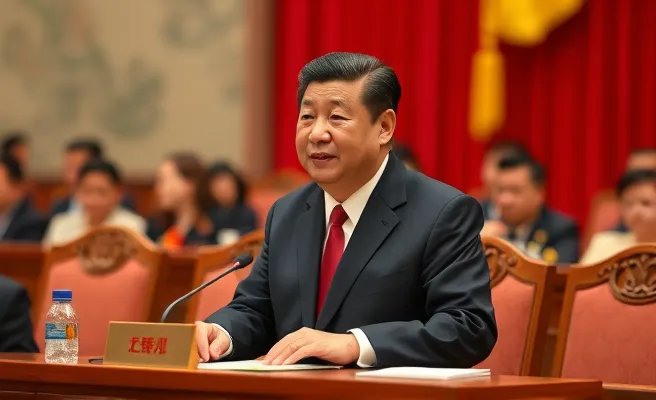
Chinese President Xi Jinping called for global cooperation during the Asia-Pacific Economic Cooperation (APEC) summit in South Korea, warning leaders against actions that could disrupt vital international supply chains. His remarks came shortly after securing a tentative trade truce with United States President Donald Trump, marking a significant moment in the ongoing economic rivalry between the two superpowers.
In his address, Xi emphasized the need for nations to unite during challenging times. He stated, “We must adhere to the principle of joining hands rather than letting go, and extending rather than breaking supply chains.” This appeal for collaboration underscored his intention to position China as a proponent of multilateralism. The summit’s audience included key figures such as US Treasury Secretary Scott Bessent, who plays a pivotal role in shaping Trump’s trade policy.
The meeting between Xi and Trump resulted in a one-year agreement, wherein the US will reduce certain tariffs in exchange for China resuming purchases of American soybeans and halting new restrictions on rare earth mineral exports. While this deal signifies a pause in escalating tensions, analysts caution that it serves as a temporary measure rather than a lasting resolution to the underlying competitive dynamics between the nations.
The Fragile Nature of the Truce
Despite the apparent easing of tensions, both countries continue to pursue strategies that suggest a broader trend of “decoupling.” During his recent tour of Asia, Trump sought to strengthen ties with Japan and South Korea, aiming to secure investments in critical sectors such as shipbuilding and rare earth minerals. This approach is intended to bolster the US’s negotiating stance in future discussions.
Xi’s remarks at the APEC summit also highlighted China’s appeal as a destination for foreign investment. He noted that China has attracted approximately $700 billion in foreign capital over the past five years. Furthermore, Xi pointed to initiatives aimed at opening China’s economy, including visa-free programs and the establishment of new free-trade zones.
However, these assertions stand in contrast to criticisms from other trading partners. The European Union has voiced concerns regarding preferential treatment given to Chinese companies, while China’s attempts to leverage its dominance over the rare earth supply chain have led many nations to seek alternatives.
Technological Self-Sufficiency and Future Challenges
Simultaneously, China is advancing its agenda for technological self-sufficiency. The Chinese Communist Party’s latest five-year plan emphasizes the need for breakthroughs in high-end semiconductor technology and the creation of supply chains that are less reliant on the United States. This strategic shift reflects a desire to reduce vulnerabilities and enhance national security in an increasingly competitive global landscape.
As Xi advocates for global unity and cooperation, the contrasting actions of China raise questions about the sincerity of its multilateral commitments. The ongoing trade tensions and strategic maneuvering between the US and China will likely continue to shape the international economic landscape for the foreseeable future. With the delicate balance of power in flux, the world watches closely to understand the implications of these developments on global trade and supply chains.

Liverpool Activates Backup Plan as Man City Targets Antoine Semenyo

British Father Drowns in Thailand After Being Swept Away by Waves

TorroFX Set to Transform Trading Landscape with Launch on December 1, 2025

BBC Breakfast’s Sally Nugent Apologizes for News Disruption

Recognize Bowel Cancer Signs During Festive Overindulgence

Marie Helvin Discusses Dating Challenges and Body Confidence at 73

Danny Morrison Reflects on United Ireland, Gerry Adams, and Stormont’s Future

Southampton University and Siemens Collaborate to Advance MEMS Technology

Barcelona’s Deco Highlights Rashford’s Burden at Manchester United

Iconic 90s TV Show House Hits Market for £1.1 Million

Milk Bank Urges Mothers to Donate for Premature Babies’ Health

Alessia Russo Signs Long-Term Deal with Arsenal Ahead of WSL Season

Shoppers Flock to Discounted Neck Pillow on Amazon for Travel Comfort

Museums Body Critiques EHRC Proposals on Gender Facilities

Trump Visits Europe: Business, Politics, or Leisure?

Japanese Teen Sorato Shimizu Breaks U18 100m Record in 10 Seconds

Couple Shares Inspiring Love Story Defying Height Stereotypes

Anglian Water Raises Concerns Over Proposed AI Data Centre
-
 Entertainment2 months ago
Iconic 90s TV Show House Hits Market for £1.1 Million
-
 Lifestyle4 months ago
Milk Bank Urges Mothers to Donate for Premature Babies’ Health
-
 Sports3 months ago
Alessia Russo Signs Long-Term Deal with Arsenal Ahead of WSL Season
-
 Lifestyle4 months ago
Shoppers Flock to Discounted Neck Pillow on Amazon for Travel Comfort
-
 Politics4 months ago
Museums Body Critiques EHRC Proposals on Gender Facilities
-
 Business4 months ago
Trump Visits Europe: Business, Politics, or Leisure?
-
 Lifestyle4 months ago
Japanese Teen Sorato Shimizu Breaks U18 100m Record in 10 Seconds
-
 Politics4 months ago
Couple Shares Inspiring Love Story Defying Height Stereotypes
-
 World4 months ago
Anglian Water Raises Concerns Over Proposed AI Data Centre
-

 Sports4 months ago
Bournemouth Dominates Everton with 3-0 Victory in Premier League Summer Series
-

 World4 months ago
Wreckage of Missing Russian Passenger Plane Discovered in Flames
-

 Lifestyle4 months ago
Shoppers Rave About Roman’s £42 Midi Dress, Calling It ‘Elegant’