
Science
Chinese Researchers Discover Room-Temperature Superconductivity

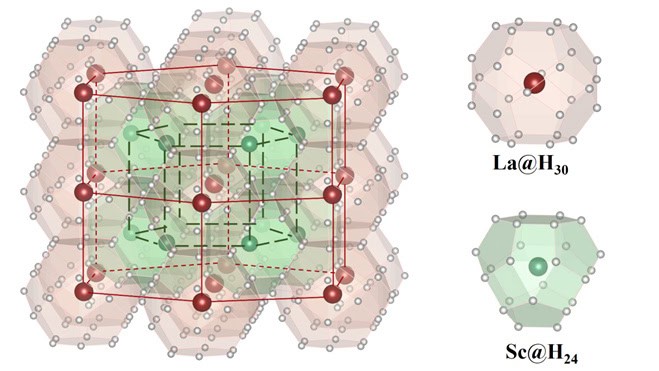
Researchers from Jilin University in China have made a significant breakthrough in the field of superconductivity. They claim to have created the first room-temperature superconductor, a ternary hydride compound known as LaSc2H24, which exhibits superconductivity at a maximum onset temperature of 298 K under extreme pressures of 250–260 GPa. This discovery, while requiring pressures comparable to those found in the Earth’s core, represents a pivotal advancement in the quest for superconductors that function at ambient conditions.
Superconductors are materials that can conduct electricity without resistance, a property typically observed at very low temperatures. Historically, the search for high-temperature superconductors has led to incremental progress. The first superconductor, solid mercury, displayed a critical temperature (Tc) of just 4.2 K. Over the decades, researchers have sought materials that can operate at higher temperatures, with significant advancements in the 1980s and 1990s leading to the discovery of copper oxide superconductors with Tc values between 30 K and 133 K.
In 2015, the record was pushed further with the discovery of a sulphide material, H3S, achieving a Tc of 203 K under 150 GPa. Subsequent discoveries, including lanthanum decahydride (LaH10) and cerium hydrides, continued to raise the bar for superconductivity, albeit still requiring substantial pressures.
Exploring Ternary Hydrides
The recent focus on ternary hydrides, which consist of three different atomic species, has opened new avenues in the search for superconductors with higher Tc values. The team led by physicist Yanming Ma explored LaSc2H24, a compound formed by introducing scandium into the established lanthanum-hydrogen (La-H) binary system. Utilizing the crystal structure prediction method known as CALYPSO, the researchers anticipated that LaSc2H24 would exhibit a hexagonal symmetry (P6/mmm).
The compound features a unique structure where hydrogen atoms form two interconnected clathrate configurations around scandium and lanthanum. This structural complexity is believed to contribute to a notably high density of states at the Fermi level, enhancing electron-phonon coupling, which is critical for superconductivity.
To synthesize LaSc2H24, the researchers employed a diamond-anvil cell, a device that generates immense pressures by compressing a sample between two diamond crystals while applying heat. The experiments revealed that the material crystallizes into the predicted hexagonal structure, confirming theoretical assumptions.
Co-author Guangtao Liu highlighted key experimental findings that demonstrate superconductivity in the La-Sc-H system. Measurements consistently indicated the onset of zero electrical resistance below the critical temperature. Furthermore, the Tc exhibited a gradual decrease when subjected to external magnetic fields, aligning with traditional superconductivity theories.
Challenges and Future Directions
The research team faced considerable challenges throughout their experiments. Initially, attempts to synthesize LaSc2H24 at pressures below 200 GPa showed no enhancement in Tc. After switching to higher pressures, the team had to meticulously manage the synthesis process, which included manually depositing precursor layers and ensuring proper electrode connections within a minuscule sample chamber measuring just 10 to 15 μm.
Liu noted that achieving the correct molar ratios of scandium and lanthanum was particularly challenging, as their differing atomic radii hindered typical solid solution formation. After extensive trials, the researchers successfully utilized a magnetron sputtering method to create the desired films of LaSc2H24 after a year of continuous investigations, despite damaging multiple diamond pairs during the process.
Sven Friedemann, a physicist at the University of Bristol, acknowledged this research as an important advancement in superconductivity, noting the newly established record transition temperature of 295 K. He expressed anticipation for further studies that explore additional superconductivity signatures.
Looking ahead, Ma’s team plans to investigate the properties of LaSc2H24 further, particularly focusing on the isotope effect and measuring superconducting critical currents. They aim to demonstrate the Meissner effect, a hallmark of superconductivity, and explore the potential for new multinary superhydrides that could exhibit improved superconducting properties at lower pressures.
This groundbreaking study highlights the potential for room-temperature superconductors to transform various technologies, from electrical generators to medical imaging, paving the way for a future where efficient, lossless electricity transmission becomes a reality. The findings are available on the arXiv pre-print server, marking a significant milestone in superconductivity research.

Liverpool Activates Backup Plan as Man City Targets Antoine Semenyo

British Father Drowns in Thailand After Being Swept Away by Waves

TorroFX Set to Transform Trading Landscape with Launch on December 1, 2025

BBC Breakfast’s Sally Nugent Apologizes for News Disruption

Recognize Bowel Cancer Signs During Festive Overindulgence

Marie Helvin Discusses Dating Challenges and Body Confidence at 73

Danny Morrison Reflects on United Ireland, Gerry Adams, and Stormont’s Future

Southampton University and Siemens Collaborate to Advance MEMS Technology

Barcelona’s Deco Highlights Rashford’s Burden at Manchester United

Iconic 90s TV Show House Hits Market for £1.1 Million

Milk Bank Urges Mothers to Donate for Premature Babies’ Health

Alessia Russo Signs Long-Term Deal with Arsenal Ahead of WSL Season

Shoppers Flock to Discounted Neck Pillow on Amazon for Travel Comfort

Museums Body Critiques EHRC Proposals on Gender Facilities

Trump Visits Europe: Business, Politics, or Leisure?

Japanese Teen Sorato Shimizu Breaks U18 100m Record in 10 Seconds

Couple Shares Inspiring Love Story Defying Height Stereotypes

Anglian Water Raises Concerns Over Proposed AI Data Centre
-
 Entertainment2 months ago
Iconic 90s TV Show House Hits Market for £1.1 Million
-
 Lifestyle4 months ago
Milk Bank Urges Mothers to Donate for Premature Babies’ Health
-
 Sports3 months ago
Alessia Russo Signs Long-Term Deal with Arsenal Ahead of WSL Season
-
 Lifestyle4 months ago
Shoppers Flock to Discounted Neck Pillow on Amazon for Travel Comfort
-
 Politics4 months ago
Museums Body Critiques EHRC Proposals on Gender Facilities
-
 Business4 months ago
Trump Visits Europe: Business, Politics, or Leisure?
-
 Lifestyle4 months ago
Japanese Teen Sorato Shimizu Breaks U18 100m Record in 10 Seconds
-
 Politics4 months ago
Couple Shares Inspiring Love Story Defying Height Stereotypes
-
 World4 months ago
Anglian Water Raises Concerns Over Proposed AI Data Centre
-

 Sports4 months ago
Bournemouth Dominates Everton with 3-0 Victory in Premier League Summer Series
-

 World4 months ago
Wreckage of Missing Russian Passenger Plane Discovered in Flames
-

 Lifestyle4 months ago
Shoppers Rave About Roman’s £42 Midi Dress, Calling It ‘Elegant’