
Science
Interstellar Comet 3I/ATLAS Exhibits Unexplained Speed Boost

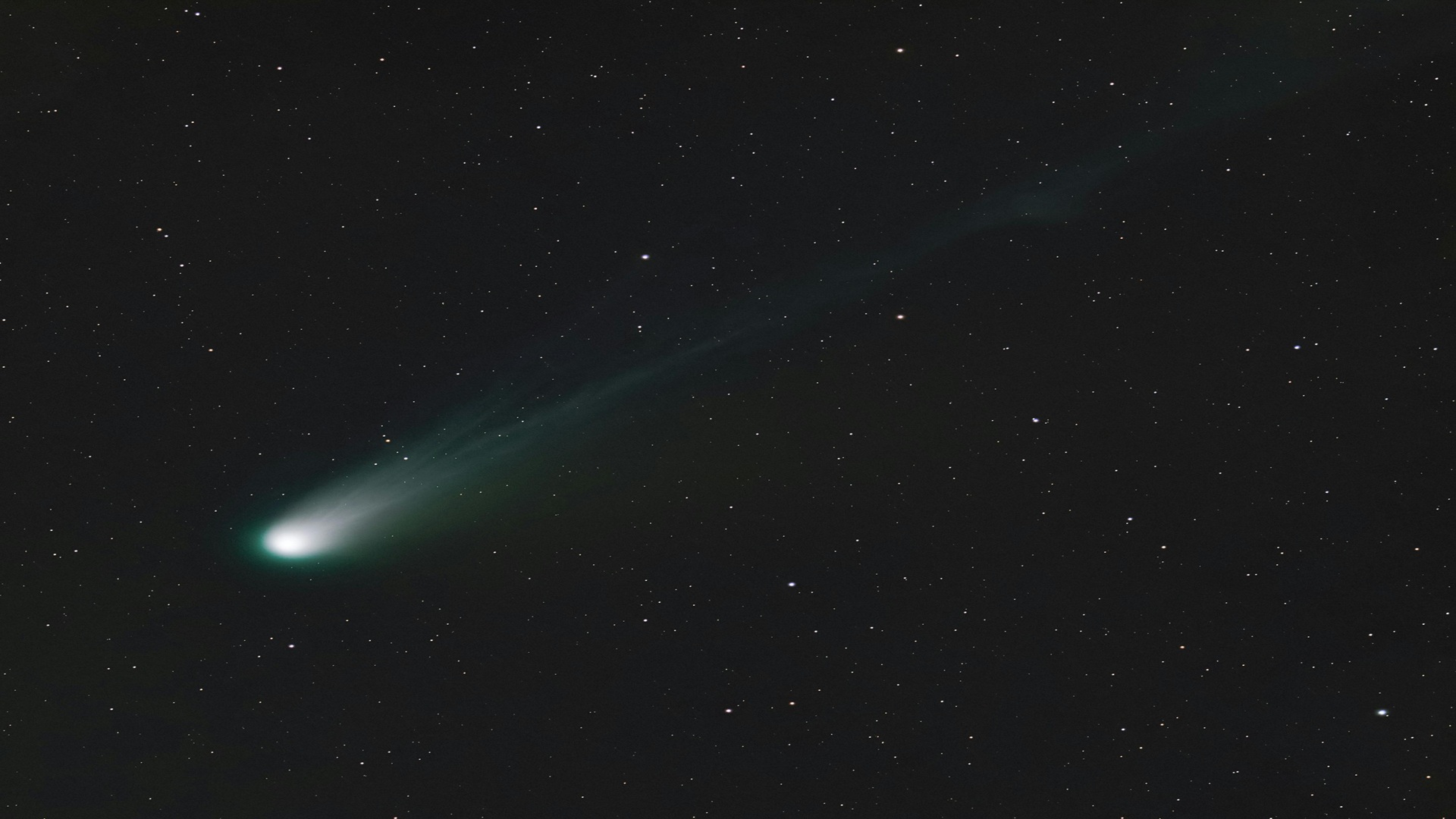
The interstellar comet 3I/ATLAS is puzzling scientists with an unexpected acceleration as it travels away from the Sun, a phenomenon that cannot be attributed solely to gravitational forces. Observational data collected by NASA indicates that this celestial object has exhibited a notable increase in speed, raising questions about its composition and behavior as it approaches Earth.
Astronomers first detected 3I/ATLAS on July 1, 2023, while it was moving through our solar system at an astonishing velocity. With an eccentricity exceeding 1, it was quickly classified as an interstellar visitor, making it only the third such object observed, following 1I/ʻOumuamua and 2I/Borisov. Initially recorded as the fastest space rock entering our solar system, it reached speeds of over 130,000 mph.
The comet’s closest approach to the Sun, known as perihelion, occurred on October 29, 2023, at a distance of approximately 210 million kilometers (about 130 million miles). Following this encounter, 3I/ATLAS accelerated to about 152,000 mph, prompting investigations into the causes behind this unusual speed boost.
NASA’s analysis shows that while the Sun’s gravity primarily influences the comet’s trajectory, an additional, unidentified force appears to have altered its path. Recent observations, particularly between October 31 and November 4, suggest that the comet has likely lost a significant amount of mass during its solar flyby, causing a non-gravitational acceleration. This means the observed increase in speed cannot be fully explained by gravitational factors alone.
Using data from the James Webb Space Telescope and other observatories, scientists detected emissions of gases such as carbon dioxide, carbon monoxide, carbonyl sulfide, and water ice from the comet. These elements are indicative of its interstellar origin. Prominent physicist Avi Loeb has expressed the need for further evidence of mass loss to confirm that 3I/ATLAS behaves like a typical comet.
Loeb outlined in a blog post that the comet has undergone a radial acceleration away from the Sun of 1.1 x 10⁻⁶ au per day squared and a transverse acceleration of 3.7 x 10⁻⁷ au per day squared. He noted that for the comet to achieve such significant acceleration, it would have to lose more than 13% of its mass near perihelion, which is a substantial amount for a natural comet.
NASA’s data indicates that while the extra push from 3I/ATLAS weakened in the days following perihelion, it remained evident and unrelated to the Sun’s gravitational influence. The comet is projected to reach its closest point to Earth on December 19, 2023, at a safe distance of approximately 270 million kilometers (about 167 million miles).
Loeb has raised the possibility that if no significant gas cloud is detected emanating from the comet, it could imply an alternative source for its speed boost, potentially hinting at an “extraterrestrial rocket engine.” The growing interest in 3I/ATLAS has led to calls for NASA to release high-resolution images taken during the comet’s close approach to Mars on October 3, 2023, when it was about 30 million kilometers away.
As the scientific community grapples with the implications of 3I/ATLAS‘s unique behavior, the debate continues: Is this acceleration simply a result of extreme outgassing, or does it point to something more revolutionary? With the comet’s high-speed exit from our solar system underway, the quest for understanding this enigmatic visitor remains ongoing.

Marie Helvin Discusses Dating Challenges and Body Confidence at 73

Danny Morrison Reflects on United Ireland, Gerry Adams, and Stormont’s Future

Southampton University and Siemens Collaborate to Advance MEMS Technology

Barcelona’s Deco Highlights Rashford’s Burden at Manchester United

Rolls-Royce Shares Surge 77% in 2025: What’s Next for Investors?

Welsh Ambulance Service Targets Frequent 999 Callers for Support

Welsh Ambulance Service Targets Frequent 999 Callers for Better Care

Bremen’s Marble Imaging Secures €5.3M for Revolutionary Satellites

WNBA and Players Association Secure 40-Day Extension on CBA Talks

Iconic 90s TV Show House Hits Market for £1.1 Million

Milk Bank Urges Mothers to Donate for Premature Babies’ Health

Alessia Russo Signs Long-Term Deal with Arsenal Ahead of WSL Season

Shoppers Flock to Discounted Neck Pillow on Amazon for Travel Comfort

Museums Body Critiques EHRC Proposals on Gender Facilities

Trump Visits Europe: Business, Politics, or Leisure?

Japanese Teen Sorato Shimizu Breaks U18 100m Record in 10 Seconds

Couple Shares Inspiring Love Story Defying Height Stereotypes

Anglian Water Raises Concerns Over Proposed AI Data Centre
-
 Entertainment2 months ago
Iconic 90s TV Show House Hits Market for £1.1 Million
-
 Lifestyle4 months ago
Milk Bank Urges Mothers to Donate for Premature Babies’ Health
-
 Sports3 months ago
Alessia Russo Signs Long-Term Deal with Arsenal Ahead of WSL Season
-
 Lifestyle4 months ago
Shoppers Flock to Discounted Neck Pillow on Amazon for Travel Comfort
-
 Politics4 months ago
Museums Body Critiques EHRC Proposals on Gender Facilities
-
 Business4 months ago
Trump Visits Europe: Business, Politics, or Leisure?
-
 Lifestyle4 months ago
Japanese Teen Sorato Shimizu Breaks U18 100m Record in 10 Seconds
-
 Politics4 months ago
Couple Shares Inspiring Love Story Defying Height Stereotypes
-
 World4 months ago
Anglian Water Raises Concerns Over Proposed AI Data Centre
-

 Sports4 months ago
Bournemouth Dominates Everton with 3-0 Victory in Premier League Summer Series
-

 World4 months ago
Wreckage of Missing Russian Passenger Plane Discovered in Flames
-

 Lifestyle4 months ago
Shoppers Rave About Roman’s £42 Midi Dress, Calling It ‘Elegant’