
Science
Predictions Heat Up for 2025 Nobel Prize in Physics Awards

On October 7, 2025, the Nobel Prize for Physics will be awarded, sparking speculation about potential winners. The selection process is shrouded in secrecy, with only members of the Nobel Committee for Physics and the Class for Physics at the Royal Swedish Academy of Sciences privy to the laureates’ identities until the announcement. This lack of transparency makes it difficult to predict who will be honoured, particularly since the details of past nominations remain confidential for 50 years.
Despite the uncertainty, many are eager to make predictions. Based on recent trends, the 2025 award is likely to recognise advancements in quantum information and algorithms. The groundbreaking work in this domain, which has laid the groundwork for functioning quantum computers and cryptographic systems, was largely initiated decades ago. Renowned figures such as Peter Shor, Gilles Brassard, Charles Bennett, and David Deutsch stand out as potential candidates, although only three can receive the prize.
Trends in Previous Nobel Awards
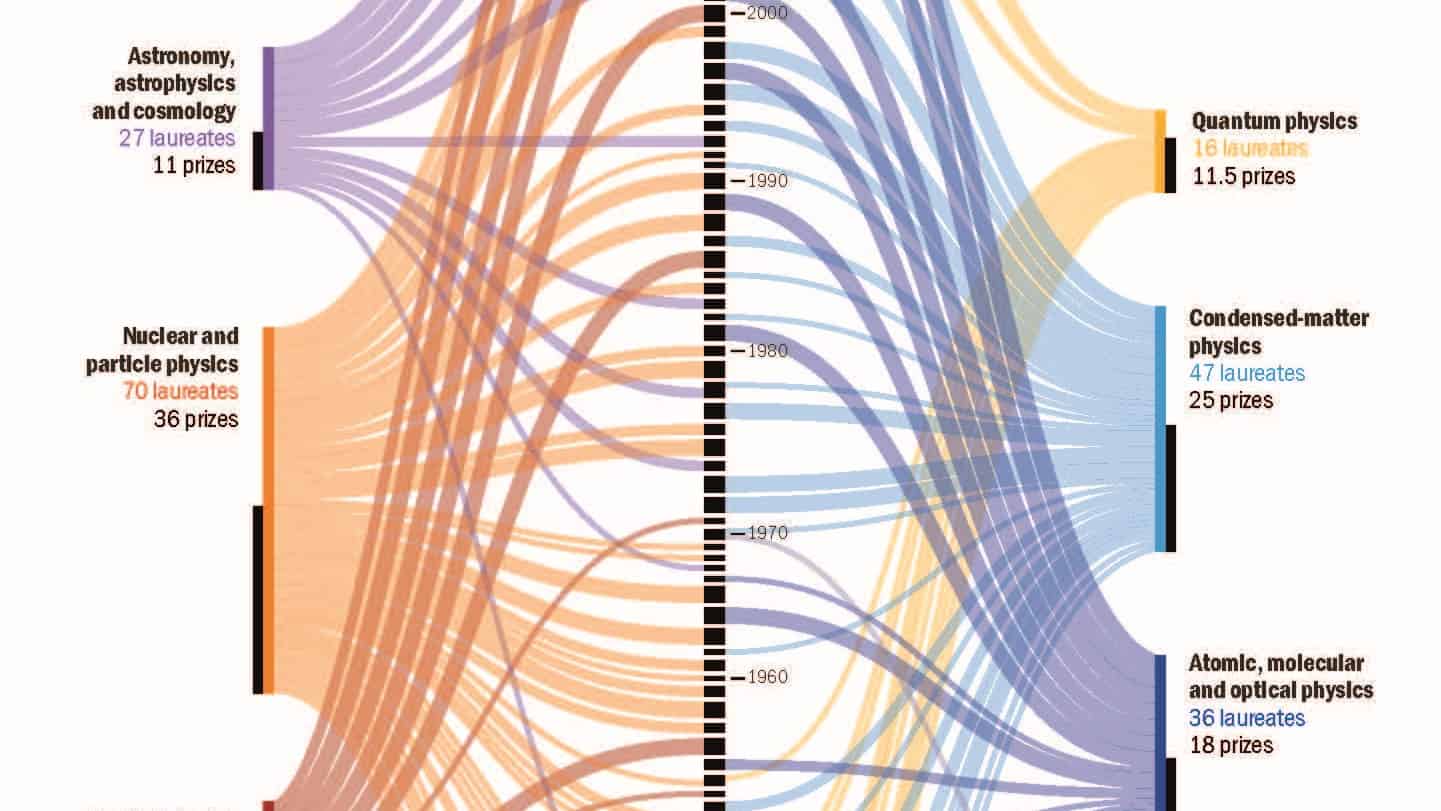
An infographic charting the history of the Nobel Prize for Physics offers insights into the committee’s focus areas over the years. Notably, there have been significant gaps in awards for specific fields since around 1990. For instance, the category of atomic, molecular, and optical physics has seen intervals of approximately 5–10 years between awards. This pattern suggests that the Nobel Committee may deliberately stagger recognitions to avoid clustering prizes within the same field.
Looking at these trends, the field of nuclear and particle physics appears overdue for recognition, having last been awarded a Nobel Prize ten years ago. While there have been notable developments, such as studies on quark–gluon plasma and antimatter behaviour, it may still be premature for a Nobel in this area. A prize for the theory of cosmic inflation could be a possibility, with Alan Guth and Andrei Linde as leading candidates. Unfortunately, the recent passing of Alexei Starobinsky in 2023 means he cannot be considered, as the Nobel Prize is not awarded posthumously.
Emerging Fields and Potential Winners
The last Nobel Prize in condensed matter physics was awarded in 2016, raising the question of what advancements could merit recognition this year. One area of significant interest is the study of metamaterials, engineered materials with unique properties, particularly in their interaction with light and sound. If the Nobel Committee chooses to honour work in this field, John Pendry, a pioneer in transformation optics, would be a leading contender. His research has greatly enhanced the understanding of how light interacts with metamaterials, paving the way for innovative applications, including invisibility cloaks.
The first working invisibility cloak was developed by experimental physicist David Smith in 2006. Smith’s work at microwave frequencies positions him as another potential nominee. Additionally, applied physicist Federico Capasso has made significant contributions to metamaterials, particularly in optical applications and the invention of the quantum cascade laser. His extensive research and achievements further bolster his candidacy for this year’s prize.
The Nobel Prize for Physics remains one of the most prestigious awards in the scientific community. As the announcement date approaches, excitement mounts over who will be recognised for their groundbreaking contributions to the field. While the selection process may remain a mystery, the anticipation for the 2025 laureates continues to inspire speculation and discussion.

Cattle Showcases Thrive at RUAS Winter Fair 2023

UK and US Strike Zero Tariff Agreement on Pharmaceuticals

Maya Jama Stuns in Strapless Ensemble at Qatar Grand Prix

Russia and Saudi Arabia Launch Visa-Free Travel Agreement

ISOLDE Facility Marks 10 Years of Advancements in Nuclear Research

Voters Demand Resignation of Chancellor Rachel Reeves Over Tax Hikes

Shoppers Save 30% on Marks & Spencer’s Viral Velvet Dress

Health Campaigners Urge End to Smoking Exemption for Lounges

Charity Shop Surprise: Woman Finds Joggers Worth £2,000 for £8

Iconic 90s TV Show House Hits Market for £1.1 Million

Milk Bank Urges Mothers to Donate for Premature Babies’ Health

Alessia Russo Signs Long-Term Deal with Arsenal Ahead of WSL Season

Shoppers Flock to Discounted Neck Pillow on Amazon for Travel Comfort

Museums Body Critiques EHRC Proposals on Gender Facilities

Trump Visits Europe: Business, Politics, or Leisure?

Japanese Teen Sorato Shimizu Breaks U18 100m Record in 10 Seconds

Couple Shares Inspiring Love Story Defying Height Stereotypes

Anglian Water Raises Concerns Over Proposed AI Data Centre
-
 Entertainment2 months ago
Iconic 90s TV Show House Hits Market for £1.1 Million
-
 Lifestyle4 months ago
Milk Bank Urges Mothers to Donate for Premature Babies’ Health
-
 Sports3 months ago
Alessia Russo Signs Long-Term Deal with Arsenal Ahead of WSL Season
-
 Lifestyle4 months ago
Shoppers Flock to Discounted Neck Pillow on Amazon for Travel Comfort
-
 Politics4 months ago
Museums Body Critiques EHRC Proposals on Gender Facilities
-
 Business4 months ago
Trump Visits Europe: Business, Politics, or Leisure?
-
 Lifestyle4 months ago
Japanese Teen Sorato Shimizu Breaks U18 100m Record in 10 Seconds
-
 Politics4 months ago
Couple Shares Inspiring Love Story Defying Height Stereotypes
-
 World4 months ago
Anglian Water Raises Concerns Over Proposed AI Data Centre
-

 Sports4 months ago
Bournemouth Dominates Everton with 3-0 Victory in Premier League Summer Series
-

 World4 months ago
Wreckage of Missing Russian Passenger Plane Discovered in Flames
-

 Lifestyle4 months ago
Shoppers Rave About Roman’s £42 Midi Dress, Calling It ‘Elegant’