
Science
Swiss Astronomers Revolutionize Exoplanet Discovery with 51 Pegasi b

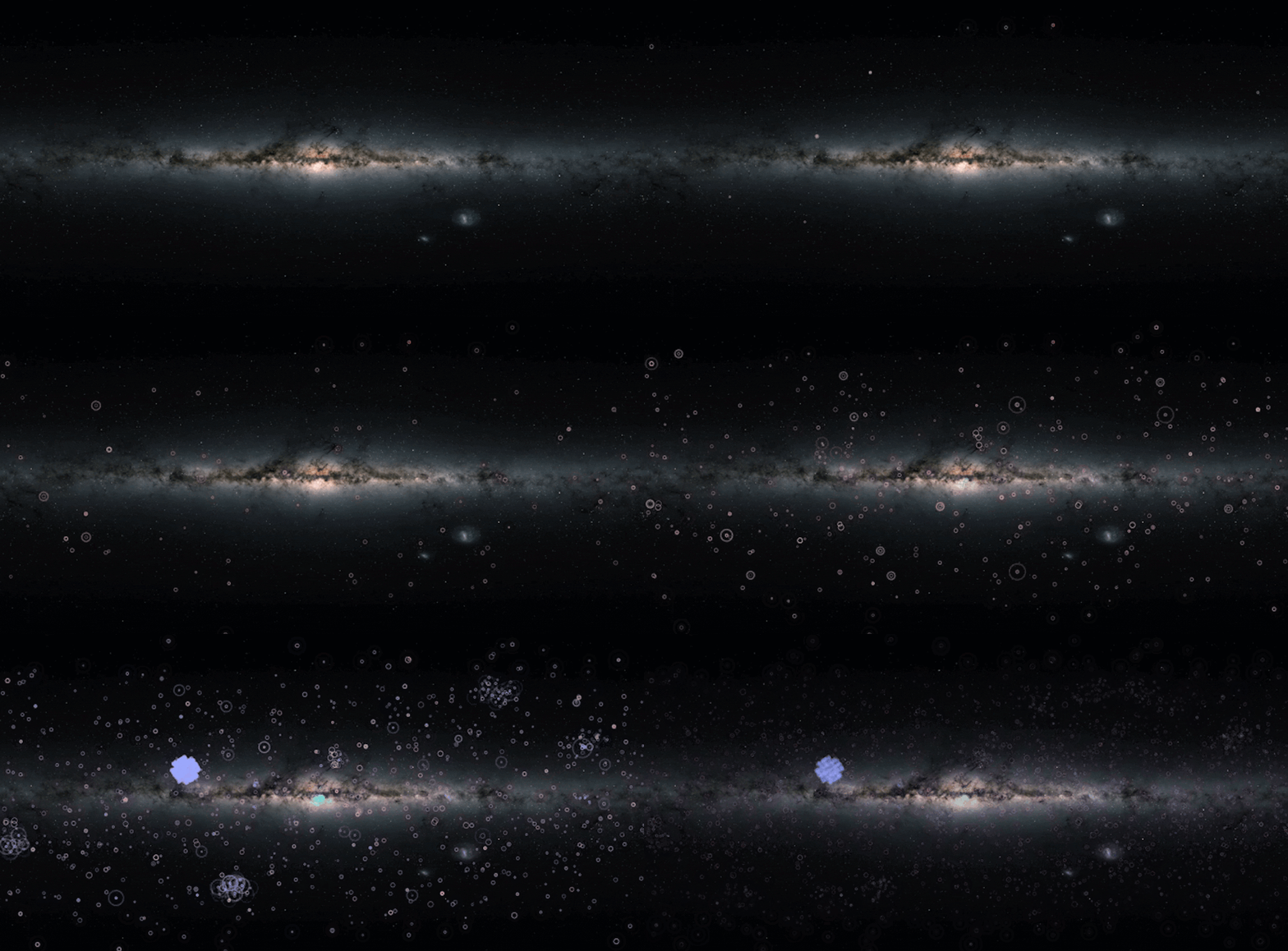
On October 6, 1995, at a scientific meeting in Florence, Italy, Swiss astronomers Michel Mayor and his PhD student Didier Queloz announced a groundbreaking discovery: the detection of a planet orbiting a star outside our Solar System. The star, known as 51 Pegasi, is located approximately 50 light-years away in the constellation Pegasus. The planet they identified, dubbed 51 Pegasi b, defied conventional expectations, being a gas giant with a mass at least half that of Jupiter, completing an orbit in just over four days.
The discovery was made possible by the Elodie spectrograph, installed at the Haute-Provence observatory in France. This instrument analyzed starlight, revealing a spectrum that acted as a “stellar barcode.” Mayor and Queloz observed the spectrum of 51 Pegasi shifting rhythmically every 4.23 days, indicating the gravitational influence of an unseen companion. After rigorous checks, they concluded that the variations were due to a gas giant in a close orbit—a finding that appeared on the front page of Nature with the headline: “A planet in Pegasus?”
Despite initial skepticism surrounding the formation of such a planet in a hostile environment, the signal was confirmed by various teams within weeks. It took nearly three years to eliminate doubts about the signal’s cause. Not only did 51 Pegasi b become the first confirmed exoplanet orbiting a Sun-like star, but it also introduced a new category of planets, known as “hot Jupiters.”
A New Era of Exoplanet Discovery
Since that pivotal moment, astronomers have catalogued over 6,000 exoplanets and candidates. The diversity of these discoveries is remarkable, ranging from ultra-hot Jupiters with temperatures exceeding 2,000 °C to planets that orbit two stars, reminiscent of fictional worlds like Tatooine from Star Wars. The revelation that most stars likely host planetary systems has transformed our understanding of the cosmos.
The Nobel Prize awarded to Mayor and Queloz in 2019 underscored the significance of their breakthrough. Yet, despite the thousands of exoplanets discovered, a planetary system resembling our own has yet to be identified. The quest for an Earth-like planet continues, propelling modern astronomers to search for undiscovered worlds.
Astronomers utilize advanced instruments such as the Harps-N spectrograph, mounted on the Telescopio Nazionale de Galileo in La Palma, Canary Islands. This sophisticated tool allows researchers to analyze starlight, potentially leading to the discovery of planets that may resemble Earth. Each signal detected brings us closer to understanding the prevalence of planetary systems akin to our own.
A Historical Perspective on Planetary Exploration
Before the mid-1990s, humanity’s knowledge of planets was restricted to our Solar System. Theories regarding planetary formation and evolution were based solely on these celestial bodies. This limited perspective was challenged by philosophers like Epicurus, who proposed the existence of numerous worlds, and Aristotle, who maintained a geocentric view of the universe.
The scientific consensus began to shift significantly following the “Great Debate” in 1920, which addressed whether the Milky Way was the entire universe. Evidence supported the notion that our galaxy was one of many, leading to a growing acknowledgment of the possibility of countless planets.
By the 1940s, the understanding of planet formation evolved, with the leading theory suggesting that planets are a natural byproduct of star formation. Despite some false detections of planets in the 1940s, the idea that billions of planets could exist in the Milky Way gained traction.
The breakthrough with 51 Pegasi b marked the beginning of a new era in astronomy. The techniques employed to detect exoplanets have advanced significantly since then. For example, the transit method—first successfully used by Canadian PhD student David Charbonneau in 1999—measures the dimming of a star as a planet transits in front of it. This method has led to the discovery of four times more exoplanets than the radial velocity technique initially used by Mayor and Queloz.
Today, astronomers can measure the masses of various planets, including those thousands of light-years away. The combination of both transit and radial velocity methods allows researchers to ascertain vital information about exoplanets, including their potential compositions.
While advances in technology have significantly broadened our understanding of the universe, the search for a true Earth twin—characterized by a similar mass and radius as Earth, orbiting a Sun-like star—remains an elusive goal.
As we look ahead, the international collaboration is developing a new instrument, Harps3, set to be installed at the Isaac Newton Telescope on La Palma later this year. This dedicated radial velocity campaign aims to enhance our chances of discovering an Earth-like planet within the next decade.
In the vastness of the universe, the search for planets akin to our own continues, driven by curiosity and the hope of uncovering the mysteries of life beyond our Solar System.

Cattle Showcases Thrive at RUAS Winter Fair 2023

UK and US Strike Zero Tariff Agreement on Pharmaceuticals

Maya Jama Stuns in Strapless Ensemble at Qatar Grand Prix

Russia and Saudi Arabia Launch Visa-Free Travel Agreement

ISOLDE Facility Marks 10 Years of Advancements in Nuclear Research

Voters Demand Resignation of Chancellor Rachel Reeves Over Tax Hikes

Shoppers Save 30% on Marks & Spencer’s Viral Velvet Dress

Health Campaigners Urge End to Smoking Exemption for Lounges

Charity Shop Surprise: Woman Finds Joggers Worth £2,000 for £8

Iconic 90s TV Show House Hits Market for £1.1 Million

Milk Bank Urges Mothers to Donate for Premature Babies’ Health

Alessia Russo Signs Long-Term Deal with Arsenal Ahead of WSL Season

Shoppers Flock to Discounted Neck Pillow on Amazon for Travel Comfort

Museums Body Critiques EHRC Proposals on Gender Facilities

Trump Visits Europe: Business, Politics, or Leisure?

Japanese Teen Sorato Shimizu Breaks U18 100m Record in 10 Seconds

Couple Shares Inspiring Love Story Defying Height Stereotypes

Anglian Water Raises Concerns Over Proposed AI Data Centre
-
 Entertainment2 months ago
Iconic 90s TV Show House Hits Market for £1.1 Million
-
 Lifestyle4 months ago
Milk Bank Urges Mothers to Donate for Premature Babies’ Health
-
 Sports3 months ago
Alessia Russo Signs Long-Term Deal with Arsenal Ahead of WSL Season
-
 Lifestyle4 months ago
Shoppers Flock to Discounted Neck Pillow on Amazon for Travel Comfort
-
 Politics4 months ago
Museums Body Critiques EHRC Proposals on Gender Facilities
-
 Business4 months ago
Trump Visits Europe: Business, Politics, or Leisure?
-
 Lifestyle4 months ago
Japanese Teen Sorato Shimizu Breaks U18 100m Record in 10 Seconds
-
 Politics4 months ago
Couple Shares Inspiring Love Story Defying Height Stereotypes
-
 World4 months ago
Anglian Water Raises Concerns Over Proposed AI Data Centre
-

 Sports4 months ago
Bournemouth Dominates Everton with 3-0 Victory in Premier League Summer Series
-

 World4 months ago
Wreckage of Missing Russian Passenger Plane Discovered in Flames
-

 Lifestyle4 months ago
Shoppers Rave About Roman’s £42 Midi Dress, Calling It ‘Elegant’