
Science
Astronomers Revolutionize Exoplanet Discovery with Groundbreaking Techniques

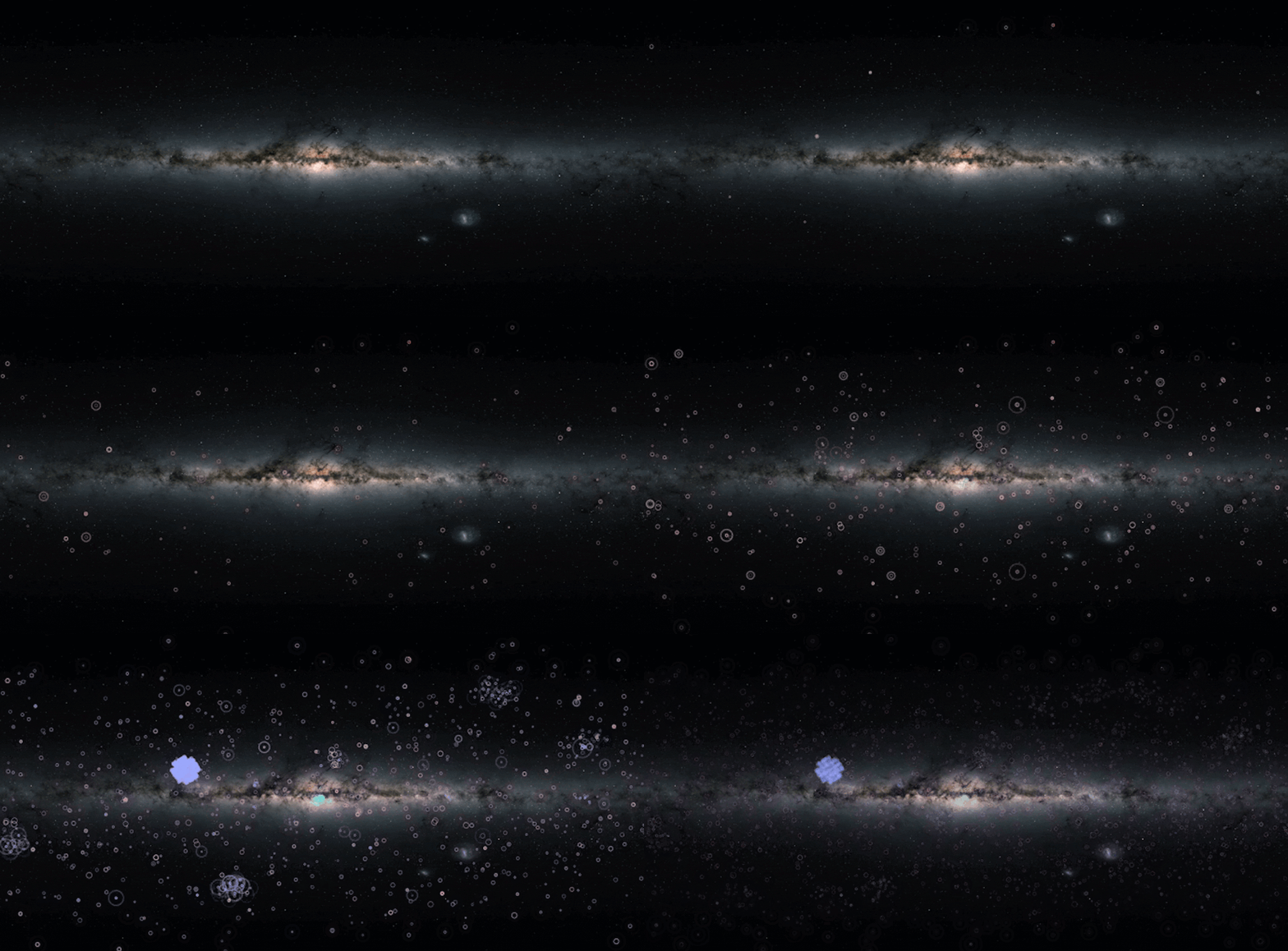
On October 6, 1995, a pivotal moment in astronomy occurred when Swiss astronomers Michel Mayor and his PhD student Didier Queloz announced the discovery of the first exoplanet orbiting a Sun-like star. This groundbreaking event took place at a scientific meeting in Florence, Italy, where they revealed that they had detected a planet, named 51 Pegasi b, orbiting the star 51 Pegasi, located approximately 50 light years away in the constellation Pegasus. This gas giant, with a mass at least half that of Jupiter, completed its orbit in just over four days, a stark contrast to any previously known planetary characteristics.
The discovery was made possible through the use of the Elodie spectrograph, a sophisticated instrument installed at the Haute-Provence Observatory in France. By analyzing the star’s light spectrum, the astronomers identified a pattern indicating that 51 Pegasi was being influenced by the gravitational pull of an unseen companion. This observation marked the beginning of a new era in astronomy, leading to the categorization of this type of exoplanet as a “hot Jupiter.”
The Impact of 51 Pegasi b
Since the revelation of 51 Pegasi b, the field of exoplanet research has experienced remarkable growth. Over the past 30 years, more than 6,000 exoplanets and candidates have been catalogued, showcasing a diverse range of planetary types. These include ultra-hot Jupiters, which can reach temperatures exceeding 2,000 °C, and even planets that orbit multiple stars, reminiscent of the fictional Tatooine from Star Wars.
The discovery not only earned Mayor and Queloz the Nobel Prize in Physics in 2019, but it also fundamentally altered our understanding of the universe. It became evident that most stars likely possess their own planetary systems. Despite this progress, researchers still have not identified a planetary system that mirrors our own.
Modern Techniques in Exoplanet Detection
Current efforts to find Earth-like planets continue to evolve, with astronomers utilizing advanced instruments like the Harps-N spectrograph, located on the Telescopio Nazionale de Galileo in La Palma, Canary Islands. This device enables scientists to disrupt the light from distant stars, an endeavor that has propelled the search for potentially habitable worlds. Each new signal detected brings researchers closer to understanding the prevalence of planetary systems similar to our Solar System.
Prior to the 1990s, the only planets known to humanity were those within our Solar System, a limited data set from which to draw conclusions about planetary formation and evolution. Theories ranged from the ancient musings of philosophers like Epicurus, who theorized about the existence of multiple worlds, to more recent scientific hypotheses that grappled with the rarity of planets. The Great Debate of 1920 between astronomers Harlow Shapley and Heber Curtis further illuminated the vastness of the universe, suggesting that our Milky Way was just one of many galaxies.
With technological advancements, the understanding of exoplanets has expanded significantly. Techniques such as the transit method, where a planet passes in front of its star, have proven effective in detecting smaller exoplanets. The success rate of finding planets using this method has surpassed the radial velocity technique initially used by Mayor and Queloz.
The quest for an Earth twin continues to motivate astronomers. The dream is to identify a planet mirroring Earth’s size, mass, and temperature, orbiting a star akin to our Sun. Recent discoveries, including potential candidates like those orbiting Kepler-78, have sparked excitement in the scientific community. Observations of transiting planets have allowed researchers to gather data on their mass and composition, bringing us closer to understanding our place in the universe.
Despite the multitude of exoplanets discovered, no system has yet been found that closely resembles ours. This raises intriguing questions about the uniqueness of our planetary system. As technology continues to advance, the search for true Earth-like planets remains a top priority for astronomers worldwide, with collaborative efforts underway to develop new instruments capable of finding these elusive worlds.
As astronomers reflect on the past three decades since the discovery of 51 Pegasi b, they remain hopeful that ongoing research will eventually lead to the discovery of an Earth twin, providing crucial insights into the potential for life beyond our Solar System.

Cattle Showcases Thrive at RUAS Winter Fair 2023

UK and US Strike Zero Tariff Agreement on Pharmaceuticals

Maya Jama Stuns in Strapless Ensemble at Qatar Grand Prix

Russia and Saudi Arabia Launch Visa-Free Travel Agreement

ISOLDE Facility Marks 10 Years of Advancements in Nuclear Research

Voters Demand Resignation of Chancellor Rachel Reeves Over Tax Hikes

Shoppers Save 30% on Marks & Spencer’s Viral Velvet Dress

Health Campaigners Urge End to Smoking Exemption for Lounges

Charity Shop Surprise: Woman Finds Joggers Worth £2,000 for £8

Iconic 90s TV Show House Hits Market for £1.1 Million

Milk Bank Urges Mothers to Donate for Premature Babies’ Health

Alessia Russo Signs Long-Term Deal with Arsenal Ahead of WSL Season

Shoppers Flock to Discounted Neck Pillow on Amazon for Travel Comfort

Museums Body Critiques EHRC Proposals on Gender Facilities

Trump Visits Europe: Business, Politics, or Leisure?

Japanese Teen Sorato Shimizu Breaks U18 100m Record in 10 Seconds

Couple Shares Inspiring Love Story Defying Height Stereotypes

Anglian Water Raises Concerns Over Proposed AI Data Centre
-
 Entertainment2 months ago
Iconic 90s TV Show House Hits Market for £1.1 Million
-
 Lifestyle4 months ago
Milk Bank Urges Mothers to Donate for Premature Babies’ Health
-
 Sports3 months ago
Alessia Russo Signs Long-Term Deal with Arsenal Ahead of WSL Season
-
 Lifestyle4 months ago
Shoppers Flock to Discounted Neck Pillow on Amazon for Travel Comfort
-
 Politics4 months ago
Museums Body Critiques EHRC Proposals on Gender Facilities
-
 Business4 months ago
Trump Visits Europe: Business, Politics, or Leisure?
-
 Lifestyle4 months ago
Japanese Teen Sorato Shimizu Breaks U18 100m Record in 10 Seconds
-
 Politics4 months ago
Couple Shares Inspiring Love Story Defying Height Stereotypes
-
 World4 months ago
Anglian Water Raises Concerns Over Proposed AI Data Centre
-

 Sports4 months ago
Bournemouth Dominates Everton with 3-0 Victory in Premier League Summer Series
-

 World4 months ago
Wreckage of Missing Russian Passenger Plane Discovered in Flames
-

 Lifestyle4 months ago
Shoppers Rave About Roman’s £42 Midi Dress, Calling It ‘Elegant’