
Science
Understanding Bird Migration Could Advance Quantum Computing

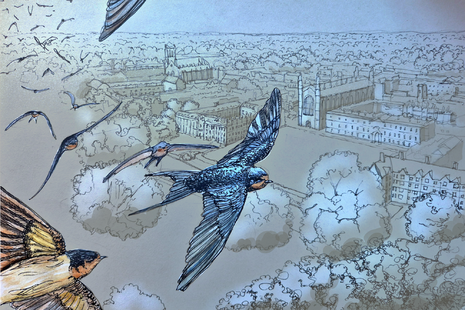
As autumn approaches, the sounds of summer birds in Cambridge give way to the arrival of migratory species such as redwings and fieldfares. This seasonal shift highlights a remarkable phenomenon: approximately 20% of the world’s bird population migrates to warmer climates during winter months. The enigmatic nature of bird migration has intrigued humans for centuries, with ancient thinkers like Aristotle even suggesting that species transformed between seasons. Modern science, however, has unveiled the complex mechanisms behind these incredible journeys.
Birds typically cover thousands of miles from the UK to Africa and back each year. They rely on a combination of visual cues and innate abilities to navigate. While geographical landmarks, such as rivers and mountains, play a role in their navigation, birds also utilize the stars for orientation, much like sailors have done for centuries. Notably, their migration routes are often encoded in their genetics. Birds whose parents followed different paths tend to adopt a route that is a blend of their parents’ directions.
The initial migration cycle is crucial, as many birds will follow the same path for the rest of their lives. To help them retrace their journeys, birds have an exceptional sense of smell that aids in recognizing familiar locations. Additionally, they possess a unique ability known as magnetoreception, which allows them to sense the Earth’s magnetic field and use it for orientation.
The mechanisms behind magnetoreception remain a topic of ongoing research. Two primary hypotheses exist regarding how birds detect magnetic fields. One theory suggests that birds’ tissues contain crystals of magnetite, a magnetic iron mineral. The size of these crystals must be just right to align with the Earth’s weak magnetic field without experiencing frictional resistance.
A more promising explanation was proposed by physicist Klaus Schulten in 1978. His theory posits that magnetoreception may have a quantum aspect. To understand this, it is essential to recognize how covalent bonds can break in two ways: heterolytically, where one atom takes both shared electrons, or homolytically, where each atom receives one electron, resulting in free radicals.
When free radicals form during chemical reactions, they can exhibit two spin states: parallel or antiparallel. If a pair of free radicals forms with antiparallel spins, the internal magnetic field may cause the electrons to switch between these states rapidly, influenced by external magnetic fields. This could explain how birds navigate using magnetoreception, potentially involving a molecule sensitive to magnetic fields, likely located in their eyes. The most promising candidate for this role is a protein known as cryptochrome 4.
In addition to their navigational prowess, scientists are also intrigued by how migratory birds manage to thrive on minimal sleep. Research has shown that many songbirds can sustain themselves with short naps, known as “micronaps,” which prevent any compromise to their physiological functions. This has caught the attention of organizations like the U.S. Defense Advanced Research Projects Agency (DARPA), which has invested in studies examining the neural circuits of migrating birds to explore the possibility of creating soldiers capable of functioning on little to no sleep.
Despite their incredible adaptations, migratory birds face threats from human activity. A 2022 study revealed that bird species richness is significantly lower in areas with wind turbines compared to control locations, suggesting that infrastructure impacts the distribution patterns of these migratory species. Additionally, artificial lighting at night poses a serious risk, as it attracts night-migrating birds, leading to increased collision rates with buildings and depleting their energy reserves.
Next time you observe a swallow gearing up for its long journey to Africa or a redwing recently arrived from Scandinavia, remember that these remarkable creatures are not only navigating vast distances but may also hold the key to advancements in quantum computing and insights into human sleep patterns. Ongoing research into bird migration is set to play a foundational role in developing transformative technologies in the future.

KENJI Opens First Scottish Store in Silverburn on December 13

Leaked Video Reveals Chinese General’s Defiance During 1989 Crackdown

Scientists Uncover Mechanism Behind Cellular Aging Process

Chiefs Fans Urge Patrick Mahomes to Rally Team with Meeting

Porn Star Sentenced for Contracting Hit on Child’s Father

KENJI Launches First Scottish Store at Silverburn on December 13

Cattle Showcases Thrive at RUAS Winter Fair 2023

UK and US Strike Zero Tariff Agreement on Pharmaceuticals

Maya Jama Stuns in Strapless Ensemble at Qatar Grand Prix

Iconic 90s TV Show House Hits Market for £1.1 Million

Milk Bank Urges Mothers to Donate for Premature Babies’ Health

Alessia Russo Signs Long-Term Deal with Arsenal Ahead of WSL Season

Shoppers Flock to Discounted Neck Pillow on Amazon for Travel Comfort

Museums Body Critiques EHRC Proposals on Gender Facilities

Trump Visits Europe: Business, Politics, or Leisure?

Japanese Teen Sorato Shimizu Breaks U18 100m Record in 10 Seconds

Couple Shares Inspiring Love Story Defying Height Stereotypes

Anglian Water Raises Concerns Over Proposed AI Data Centre
-
 Entertainment2 months ago
Iconic 90s TV Show House Hits Market for £1.1 Million
-
 Lifestyle4 months ago
Milk Bank Urges Mothers to Donate for Premature Babies’ Health
-
 Sports3 months ago
Alessia Russo Signs Long-Term Deal with Arsenal Ahead of WSL Season
-
 Lifestyle4 months ago
Shoppers Flock to Discounted Neck Pillow on Amazon for Travel Comfort
-
 Politics4 months ago
Museums Body Critiques EHRC Proposals on Gender Facilities
-
 Business4 months ago
Trump Visits Europe: Business, Politics, or Leisure?
-
 Lifestyle4 months ago
Japanese Teen Sorato Shimizu Breaks U18 100m Record in 10 Seconds
-
 Politics4 months ago
Couple Shares Inspiring Love Story Defying Height Stereotypes
-
 World4 months ago
Anglian Water Raises Concerns Over Proposed AI Data Centre
-

 Sports4 months ago
Bournemouth Dominates Everton with 3-0 Victory in Premier League Summer Series
-

 World4 months ago
Wreckage of Missing Russian Passenger Plane Discovered in Flames
-

 Lifestyle4 months ago
Shoppers Rave About Roman’s £42 Midi Dress, Calling It ‘Elegant’