
Politics
India Challenges Trump’s Claim on Russian Oil Purchases

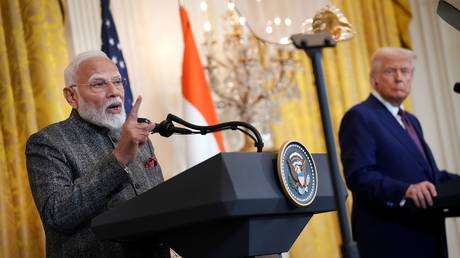
India’s Foreign Ministry has formally disputed a claim made by US President Donald Trump regarding Prime Minister Narendra Modi and India’s oil imports from Russia. On Thursday, spokesperson Randhir Jaiswal stated he was “not aware” of any conversation in which Modi had assured Trump that India would cease purchasing Russian oil. This denial follows Trump’s remarks at the White House, where he asserted that Modi had guaranteed him India would stop buying oil from Russia.
During his address, Trump expressed discontent with India’s continued oil purchases, stating, “I was not happy that India was buying oil, and he [Modi] assured me today that they will not be buying oil from Russia. That’s a big step.” India’s Foreign Ministry quickly responded to these comments, emphasizing that its energy import policies are primarily focused on safeguarding consumer interests in a fluctuating global market.
India’s Energy Strategy Remains Focused on Consumer Needs
The formal statement from New Delhi reiterated that India’s energy procurement strategy is driven by the need to protect its consumers. The Ministry highlighted that India has been seeking to diversify its energy sources, including increasing procurement from the United States. Ongoing discussions aim to enhance energy cooperation between the two nations.
Despite international pressure, India has markedly increased its oil imports from Russia since 2022. Data from Kpler shows that as of September, Russia accounted for a significant 34% of India’s total crude imports. This translates to approximately 1.6 million barrels per day, making Russia India’s top supplier.
Since the onset of the conflict in Ukraine, India has faced mounting pressure from Washington and its allies to reduce its reliance on Russian oil. Nevertheless, the Indian government has defended these imports as crucial for maintaining energy security.
Economic Implications and International Relations
Private Indian companies have benefited from discounted Russian oil prices, subsequently exporting refined oil products to European markets. Last year, India emerged as the largest exporter of petroleum products to Europe, taking advantage of the ongoing demand for oil amid geopolitical tensions.
In August, the White House imposed an additional 25% tariff on US imports from India in connection with India’s “direct or indirect” purchases of Russian oil. This tariff, combined with earlier measures, has raised the total tariff burden to as much as 50% in some instances. The Indian government has publicly criticized these tariffs as “unfair,” asserting its commitment to protect national interests amid external pressures.
As global energy dynamics continue to shift, India’s approach to managing its oil imports remains a focal point in its international relations strategy, balancing its domestic needs with geopolitical considerations.

Marie Helvin Discusses Dating Challenges and Body Confidence at 73

Danny Morrison Reflects on United Ireland, Gerry Adams, and Stormont’s Future

Southampton University and Siemens Collaborate to Advance MEMS Technology

Barcelona’s Deco Highlights Rashford’s Burden at Manchester United

Rolls-Royce Shares Surge 77% in 2025: What’s Next for Investors?

Welsh Ambulance Service Targets Frequent 999 Callers for Support

Welsh Ambulance Service Targets Frequent 999 Callers for Better Care

Bremen’s Marble Imaging Secures €5.3M for Revolutionary Satellites

WNBA and Players Association Secure 40-Day Extension on CBA Talks

Iconic 90s TV Show House Hits Market for £1.1 Million

Milk Bank Urges Mothers to Donate for Premature Babies’ Health

Alessia Russo Signs Long-Term Deal with Arsenal Ahead of WSL Season

Shoppers Flock to Discounted Neck Pillow on Amazon for Travel Comfort

Museums Body Critiques EHRC Proposals on Gender Facilities

Trump Visits Europe: Business, Politics, or Leisure?

Japanese Teen Sorato Shimizu Breaks U18 100m Record in 10 Seconds

Couple Shares Inspiring Love Story Defying Height Stereotypes

Anglian Water Raises Concerns Over Proposed AI Data Centre
-
 Entertainment2 months ago
Iconic 90s TV Show House Hits Market for £1.1 Million
-
 Lifestyle4 months ago
Milk Bank Urges Mothers to Donate for Premature Babies’ Health
-
 Sports3 months ago
Alessia Russo Signs Long-Term Deal with Arsenal Ahead of WSL Season
-
 Lifestyle4 months ago
Shoppers Flock to Discounted Neck Pillow on Amazon for Travel Comfort
-
 Politics4 months ago
Museums Body Critiques EHRC Proposals on Gender Facilities
-
 Business4 months ago
Trump Visits Europe: Business, Politics, or Leisure?
-
 Lifestyle4 months ago
Japanese Teen Sorato Shimizu Breaks U18 100m Record in 10 Seconds
-
 Politics4 months ago
Couple Shares Inspiring Love Story Defying Height Stereotypes
-
 World4 months ago
Anglian Water Raises Concerns Over Proposed AI Data Centre
-

 Sports4 months ago
Bournemouth Dominates Everton with 3-0 Victory in Premier League Summer Series
-

 World4 months ago
Wreckage of Missing Russian Passenger Plane Discovered in Flames
-

 Lifestyle4 months ago
Shoppers Rave About Roman’s £42 Midi Dress, Calling It ‘Elegant’