
Science
Astronomers Unravel Mysteries of 3I/ATLAS: An Interstellar Visitor

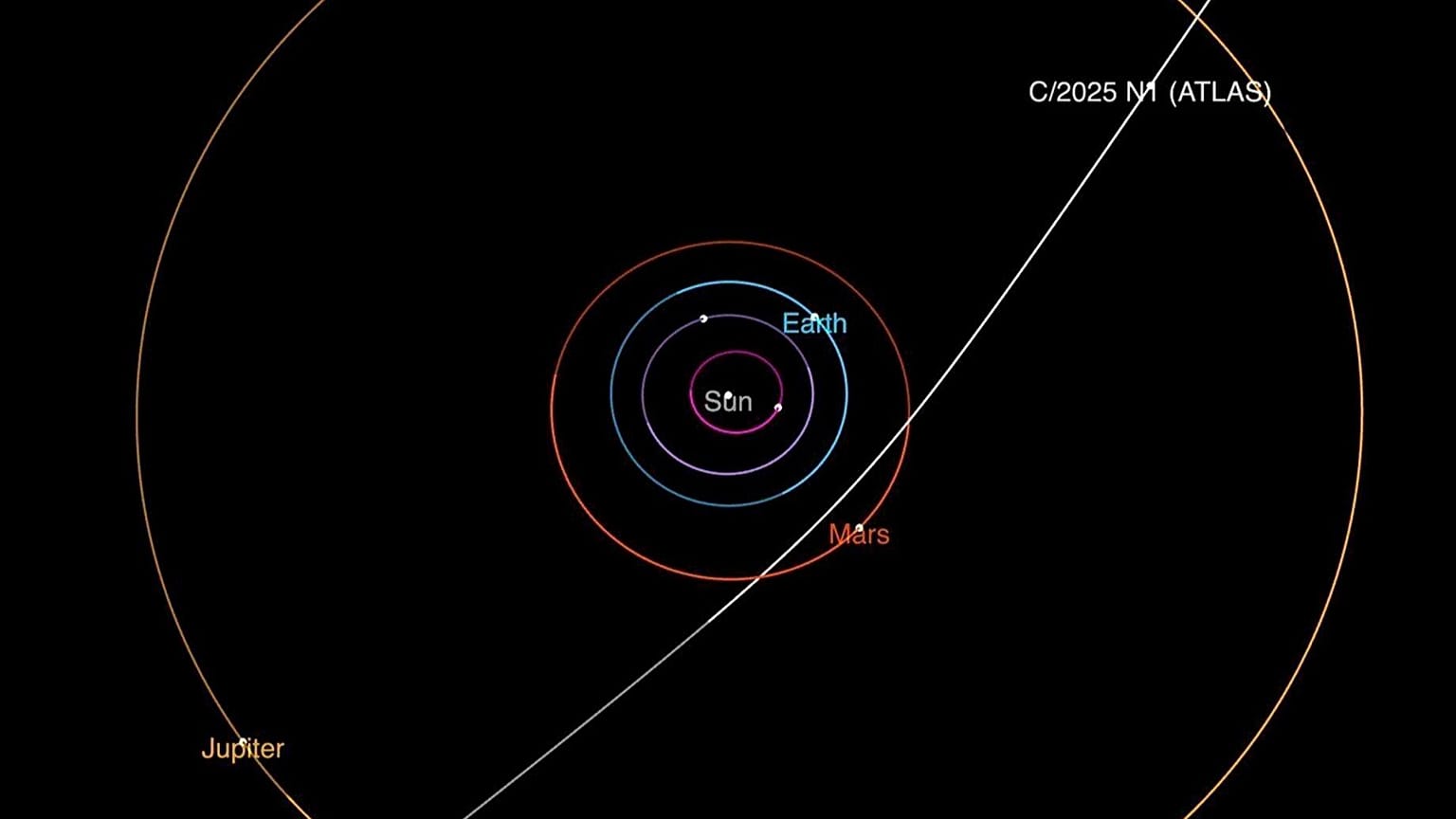
On July 1, 2025, astronomers detected a mysterious object speeding through our Solar System. Officially named 3I/ATLAS (C/2025 N1), this object is only the third confirmed interstellar visitor observed, following ʻOumuamua in 2017 and 2I/Borisov in 2019. While many scientists classify it as a natural comet, a prominent Harvard astronomer has raised questions about its potential links to extraterrestrial technology.
What Is 3I/ATLAS?
3I/ATLAS appears to behave like a comet, exhibiting a tail and increasing brightness as it approaches the Sun. The name reflects its designation: “3” for the third interstellar object found, “I” for interstellar, and “ATLAS” for the telescope network that identified it. Its trajectory suggests that it is not gravitationally bound to the Sun, implying it originated from another star system and traversed into ours.
The object is moving at an astonishing speed of over 200,000 km/h (approximately 61 km per second). As it follows a hyperbolic orbit, it is too fast to be captured by the Sun’s gravity. According to Con Stoitsis, comet and meteor director at the Astronomical Society of Victoria, “It’s going to kind of cruise through the inner solar system – in between Mars and Earth’s orbit – and then it will fly past the sun.” NASA predicts that 3I/ATLAS will make its closest approach to Earth at approximately 270 million kilometers.
Speculations of Extraterrestrial Origins
While most astronomers consider 3I/ATLAS a remarkable but natural occurrence, Professor Avi Loeb, a theoretical astrophysicist at Harvard University, is calling for a deeper investigation into the object. Through the Galileo Project, which explores potential evidence of extraterrestrial technology, Loeb has put forth provocative hypotheses regarding the nature of 3I/ATLAS.
In a series of essays on Medium, he speculates whether the object could be an artificial probe or artifact from another civilization. He raises the question in one essay, “Does 3I/ATLAS Generate Its Own Light?” suggesting that its brightness might not solely be due to reflected sunlight, a characteristic not typically associated with comets. “The hypothesis in question is that the recent interstellar visitor to our Solar System, 3I/ATLAS, is a technological artifact, and furthermore has active intelligence,” Loeb argues. He warns that if his hypothesis holds true, it could have significant ramifications for humanity.
NASA has firmly rebutted Loeb’s assertions. “It looks like a comet. It does comet things. It very, very strongly resembles, in just about every way, the comets that we know,” said Tom Statler, NASA’s lead scientist for solar system small bodies. Following the backlash, Loeb acknowledged in a blog post that “the simplest hypothesis is that 3I/ATLAS is a comet,” emphasizing his intention to challenge prevailing assumptions rather than make definitive claims.
Upcoming Visibility
3I/ATLAS is expected to reach its closest approach to the Sun on October 30, 2025, coming within 1.4 astronomical units (about 130 million miles), just inside Mars’ orbit. As astronomers continue to study its size and physical properties, NASA anticipates that the comet will become visible through ground-based telescopes in early December 2025, once it re-emerges from behind the Sun.
The journey of 3I/ATLAS captivates both scientists and amateur astronomers, serving as a reminder of the vastness of our universe and the mysteries it still holds.

Cattle Showcases Thrive at RUAS Winter Fair 2023

UK and US Strike Zero Tariff Agreement on Pharmaceuticals

Maya Jama Stuns in Strapless Ensemble at Qatar Grand Prix

Russia and Saudi Arabia Launch Visa-Free Travel Agreement

ISOLDE Facility Marks 10 Years of Advancements in Nuclear Research

Voters Demand Resignation of Chancellor Rachel Reeves Over Tax Hikes

Shoppers Save 30% on Marks & Spencer’s Viral Velvet Dress

Health Campaigners Urge End to Smoking Exemption for Lounges

Charity Shop Surprise: Woman Finds Joggers Worth £2,000 for £8

Iconic 90s TV Show House Hits Market for £1.1 Million

Milk Bank Urges Mothers to Donate for Premature Babies’ Health

Alessia Russo Signs Long-Term Deal with Arsenal Ahead of WSL Season

Shoppers Flock to Discounted Neck Pillow on Amazon for Travel Comfort

Museums Body Critiques EHRC Proposals on Gender Facilities

Trump Visits Europe: Business, Politics, or Leisure?

Japanese Teen Sorato Shimizu Breaks U18 100m Record in 10 Seconds

Couple Shares Inspiring Love Story Defying Height Stereotypes

Anglian Water Raises Concerns Over Proposed AI Data Centre
-
 Entertainment2 months ago
Iconic 90s TV Show House Hits Market for £1.1 Million
-
 Lifestyle4 months ago
Milk Bank Urges Mothers to Donate for Premature Babies’ Health
-
 Sports3 months ago
Alessia Russo Signs Long-Term Deal with Arsenal Ahead of WSL Season
-
 Lifestyle4 months ago
Shoppers Flock to Discounted Neck Pillow on Amazon for Travel Comfort
-
 Politics4 months ago
Museums Body Critiques EHRC Proposals on Gender Facilities
-
 Business4 months ago
Trump Visits Europe: Business, Politics, or Leisure?
-
 Lifestyle4 months ago
Japanese Teen Sorato Shimizu Breaks U18 100m Record in 10 Seconds
-
 Politics4 months ago
Couple Shares Inspiring Love Story Defying Height Stereotypes
-
 World4 months ago
Anglian Water Raises Concerns Over Proposed AI Data Centre
-

 Sports4 months ago
Bournemouth Dominates Everton with 3-0 Victory in Premier League Summer Series
-

 World4 months ago
Wreckage of Missing Russian Passenger Plane Discovered in Flames
-

 Lifestyle4 months ago
Shoppers Rave About Roman’s £42 Midi Dress, Calling It ‘Elegant’