
Science
Blind Patients Read Again Thanks to Innovative Electronic Eye Implant

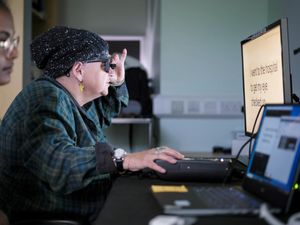
Patients who have lost their vision due to a common but untreatable age-related condition can now read again, thanks to a groundbreaking electronic eye implant known as the Prima device. This tiny implant, measuring just 2mm by 2mm and half the thickness of a human hair, is situated beneath the retina’s light-sensitive tissue. It allows individuals to perceive letters, numbers, and words through previously blind eyes, enabling some to engage in activities like crossword puzzles and reading prescription labels.
This advancement marks a significant breakthrough in artificial vision, with experts describing it as a “paradigm shift.” The first trial of the device involved 38 patients across 17 sites in five countries, including the UK, France, Italy, and the Netherlands. All participants suffered from a condition known as geographic atrophy (GA), an advanced stage of dry age-related macular degeneration (AMD). This condition affects approximately five million people globally and can lead to total sight loss as the central macula deteriorates.
The study participants had lost their central vision and retained only limited peripheral sight. The procedures were conducted at Moorfields Eye Hospital in London about three years ago, typically lasting under two hours. During surgery, surgeons performed a vitrectomy, removing the gel-like substance within the eye. They then created a trapdoor beneath the retina to implant the chip.
To utilize the device effectively, patients wear augmented-reality glasses equipped with a video camera. This camera connects to a small computer worn on the waistband, which includes a zoom feature to enlarge text. The camera projects images onto the chip, which activates the device, sending electrical signals through the retina and optical nerve to the brain where they are interpreted as visual information.
Mahi Muqit, senior vitreoretinal consultant at Moorfields Eye Hospital and the UCL Institute of Ophthalmology, described the impact on patients as “life-changing.” He noted that many patients previously resigned to blindness now express joy in being able to read books and engage in activities they once enjoyed.
“Some of them are writing, doing crossword puzzles, things they enjoy,” Muqit explained. The chip is activated about one month post-operation, and patients undergo intensive rehabilitation to help them interpret the signals and relearn how to read. The waistband computer refines the signals sent to the brain, converting them into recognizable objects and letters.
Patients have reported feeling a significant improvement in their quality of life. “You have to realize you’ve got blind patients who are depressed and socially isolated, who are now able to start to function and pick up things that they used to enjoy,” Muqit added.
Published findings in the New England Journal of Medicine indicate that 84% of participants in the trial could read letters, numbers, and words while using the Prima device, with an average ability to read five lines on a vision chart. Remarkably, some patients who could not see the chart at all prior to the device fitting have experienced substantial improvements.
While the chip is a permanent fixture, patients can choose to wear the augmented-reality glasses whenever they desire. Muqit emphasized that there are no pain or safety concerns associated with the device, as it activates only when the glasses are worn. Patients can use the system as frequently as they like without limitation.
One trial participant, Sheila Irvine, expressed her newfound capabilities, stating she now reads her prescriptions and enjoys crossword puzzles. Before the operation, she described her vision as “like having two black discs” in her eyes, with distortion around the edges.
“There was no pain during the operation, but you’re still aware of what’s happening,” Irvine recalled. “It’s a new way of looking through your eyes, and it was dead exciting when I began seeing a letter.” She acknowledged that relearning to read is a challenge, but noted, “the more hours I put in, the more I pick up.”
The developers of the Prima device, the US-based Science Corporation, are currently seeking regulatory approval to bring this revolutionary technology to a wider audience. Muqit remains optimistic about the potential for this kind of technology to be available through the NHS in the future.
“This represents a whole paradigm shift,” he emphasized. “You talk to surgeons in the UK that I’m colleagues with, and they’re all very excited by this particular technology. You know that this technology will be scalable.”

LaLiga Thrills: Key Highlights from Recent Fixtures Unveiled

Germany Intensifies Deportations of Afghan and Syrian Migrants

Shoppers Embrace Next’s £36 Knit as Trendy Christmas Alternative

Harbour Energy Announces 100 Job Cuts Amid Industry Challenges

Amy Childs Shares Weight Gain Journey, Emphasizing Self-Love

UK and US Set to Finalize Zero-Tariff Agreement on Pharmaceuticals

Liverpool Activates Backup Plan as Man City Targets Antoine Semenyo

British Father Drowns in Thailand After Being Swept Away by Waves

TorroFX Set to Transform Trading Landscape with Launch on December 1, 2025

Iconic 90s TV Show House Hits Market for £1.1 Million

Milk Bank Urges Mothers to Donate for Premature Babies’ Health

Alessia Russo Signs Long-Term Deal with Arsenal Ahead of WSL Season

Shoppers Flock to Discounted Neck Pillow on Amazon for Travel Comfort

Museums Body Critiques EHRC Proposals on Gender Facilities

Trump Visits Europe: Business, Politics, or Leisure?

Japanese Teen Sorato Shimizu Breaks U18 100m Record in 10 Seconds

Couple Shares Inspiring Love Story Defying Height Stereotypes

Anglian Water Raises Concerns Over Proposed AI Data Centre
-
 Entertainment2 months ago
Iconic 90s TV Show House Hits Market for £1.1 Million
-
 Lifestyle4 months ago
Milk Bank Urges Mothers to Donate for Premature Babies’ Health
-
 Sports3 months ago
Alessia Russo Signs Long-Term Deal with Arsenal Ahead of WSL Season
-
 Lifestyle4 months ago
Shoppers Flock to Discounted Neck Pillow on Amazon for Travel Comfort
-
 Politics4 months ago
Museums Body Critiques EHRC Proposals on Gender Facilities
-
 Business4 months ago
Trump Visits Europe: Business, Politics, or Leisure?
-
 Lifestyle4 months ago
Japanese Teen Sorato Shimizu Breaks U18 100m Record in 10 Seconds
-
 Politics4 months ago
Couple Shares Inspiring Love Story Defying Height Stereotypes
-
 World4 months ago
Anglian Water Raises Concerns Over Proposed AI Data Centre
-

 Sports4 months ago
Bournemouth Dominates Everton with 3-0 Victory in Premier League Summer Series
-

 World4 months ago
Wreckage of Missing Russian Passenger Plane Discovered in Flames
-

 Lifestyle4 months ago
Shoppers Rave About Roman’s £42 Midi Dress, Calling It ‘Elegant’