
Science
Comet 3I/ATLAS Approaches the Sun, Offering Unique Insights

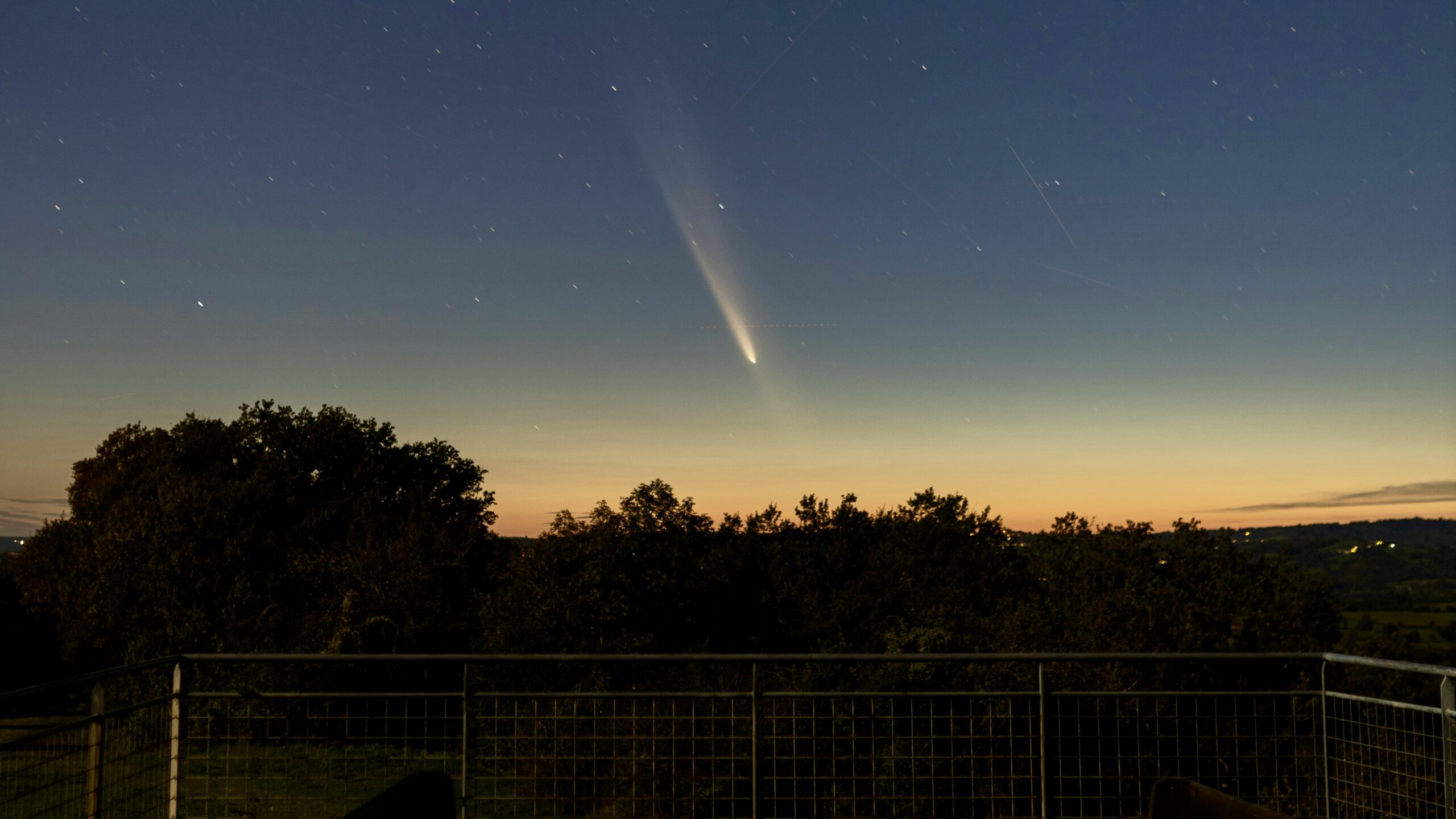
A rare celestial event is set to unfold as comet 3I/ATLAS approaches its perihelion on October 30, 2023. During this closest point to the Sun, located approximately 1.35 astronomical units (about 125 million miles or 202 million kilometers) away, the comet is expected to exhibit heightened activity. However, observers on Earth will be unable to witness this spectacle, as the comet is currently obscured by the Sun’s intense glare.
The phenomenon occurs when solar warmth causes the ice on the comet’s surface to sublimate, transforming into gas. This process creates a glowing cloud known as a coma around the nucleus and often generates two distinct tails: one composed of dust and the other an ion tail made of charged particles propelled by solar winds. As 3I/ATLAS reaches perihelion, this outgassing is anticipated to peak, significantly increasing its brightness.
Unfortunately, the view from Earth is compromised. Since late September, 3I/ATLAS has been in solar conjunction, making it invisible to terrestrial telescopes, including the renowned Hubble and James Webb space telescopes. They will only have the opportunity to observe the comet again in late November or early December.
Robotic Explorers Positioned to Observe
While Earth-based observers are left in the dark, a fleet of robotic spacecraft across the solar system is well-positioned to observe the comet’s approach. Notably, missions orbiting Mars had a clear view of the comet when it passed just 0.19 astronomical units (approximately 17.6 million miles or 28.4 million kilometers) from the Red Planet on October 3, 2023. These missions will continue to monitor 3I/ATLAS as it rounds the Sun.
Other missions, including NASA’s Psyche, which is en route to an asteroid of the same name, and the Lucy mission, heading toward Jupiter’s Trojan asteroids, are also set to observe the perihelion. The European Space Agency’s JUICE probe, which recently conducted a fly-by of Venus, is also aligned in the comet’s direction. However, it is currently using its primary antenna as a sun shield, delaying data transmission until February 2024.
Scientific Insights from a Distant Visitor
The scientific community is particularly interested in the chemical composition of 3I/ATLAS. The gas and dust released during the outgassing process provide direct samples of the comet’s makeup, offering valuable insights into the star system where it formed over seven billion years ago.
Preliminary findings indicate that 3I/ATLAS has a higher concentration of carbon dioxide and nickel compared to comets originating from our solar system. These distinctions enable astronomers to draw comparisons between the chemical profiles of our solar system and that of the comet’s distant origins. Researchers are keenly observing for any new molecules that may emerge during the peak activity at perihelion, particularly iron emissions, which have yet to be detected.
As 3I/ATLAS re-emerges from behind the Sun in late November, it may still exhibit significant activity. Although anticipated to be faint, with a predicted magnitude of 12, it could be within reach for astro-imagers and those using advanced telescopes. The powerful optics of the Hubble and James Webb space telescopes will make it an accessible target for detailed observation.
The approach of 3I/ATLAS not only captivates astronomers but also highlights the capabilities of modern space missions to capture events that remain hidden from our planet. As the comet makes its closest passage through the solar system, it provides a unique opportunity to study the building blocks of our universe and the processes that govern celestial bodies.

LaLiga Thrills: Key Highlights from Recent Fixtures Unveiled

Germany Intensifies Deportations of Afghan and Syrian Migrants

Shoppers Embrace Next’s £36 Knit as Trendy Christmas Alternative

Harbour Energy Announces 100 Job Cuts Amid Industry Challenges

Amy Childs Shares Weight Gain Journey, Emphasizing Self-Love

UK and US Set to Finalize Zero-Tariff Agreement on Pharmaceuticals

Liverpool Activates Backup Plan as Man City Targets Antoine Semenyo

British Father Drowns in Thailand After Being Swept Away by Waves

TorroFX Set to Transform Trading Landscape with Launch on December 1, 2025

Iconic 90s TV Show House Hits Market for £1.1 Million

Milk Bank Urges Mothers to Donate for Premature Babies’ Health

Alessia Russo Signs Long-Term Deal with Arsenal Ahead of WSL Season

Shoppers Flock to Discounted Neck Pillow on Amazon for Travel Comfort

Museums Body Critiques EHRC Proposals on Gender Facilities

Trump Visits Europe: Business, Politics, or Leisure?

Japanese Teen Sorato Shimizu Breaks U18 100m Record in 10 Seconds

Couple Shares Inspiring Love Story Defying Height Stereotypes

Anglian Water Raises Concerns Over Proposed AI Data Centre
-
 Entertainment2 months ago
Iconic 90s TV Show House Hits Market for £1.1 Million
-
 Lifestyle4 months ago
Milk Bank Urges Mothers to Donate for Premature Babies’ Health
-
 Sports3 months ago
Alessia Russo Signs Long-Term Deal with Arsenal Ahead of WSL Season
-
 Lifestyle4 months ago
Shoppers Flock to Discounted Neck Pillow on Amazon for Travel Comfort
-
 Politics4 months ago
Museums Body Critiques EHRC Proposals on Gender Facilities
-
 Business4 months ago
Trump Visits Europe: Business, Politics, or Leisure?
-
 Lifestyle4 months ago
Japanese Teen Sorato Shimizu Breaks U18 100m Record in 10 Seconds
-
 Politics4 months ago
Couple Shares Inspiring Love Story Defying Height Stereotypes
-
 World4 months ago
Anglian Water Raises Concerns Over Proposed AI Data Centre
-

 Sports4 months ago
Bournemouth Dominates Everton with 3-0 Victory in Premier League Summer Series
-

 World4 months ago
Wreckage of Missing Russian Passenger Plane Discovered in Flames
-

 Lifestyle4 months ago
Shoppers Rave About Roman’s £42 Midi Dress, Calling It ‘Elegant’