
Science
ESA Mobilizes Spacecraft to Track Rare Interstellar Comet 3I/ATLAS

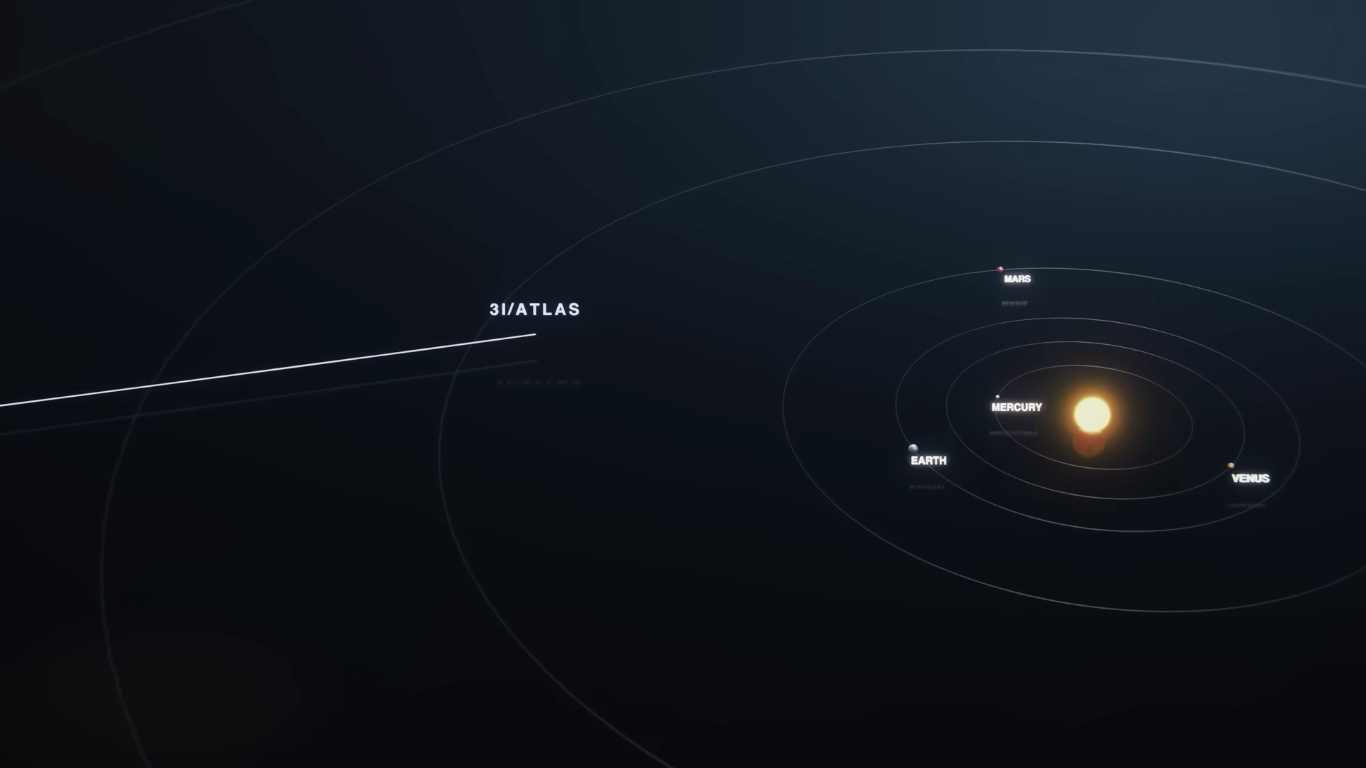
The European Space Agency (ESA) has announced plans to utilize its spacecraft around Mars and the Sun to monitor the rare interstellar comet 3I/ATLAS. This comet, only the third known interstellar visitor to our Solar System, will become invisible to ground-based telescopes during a three-month solar conjunction, beginning in late September and lasting until December 2025. During this period, the Sun will block Earth’s line of sight, making observations from spacecraft essential.
According to NASA, solar conjunction occurs when the Sun obstructs the view of objects in space from Earth. For 3I/ATLAS, this means its faint glow will be completely obscured by solar glare, hindering ground observations. This blackout coincides with the comet’s most active phase, as volatile ices sublimate and release gas and dust in proximity to the Sun.
Spacecraft Contributions to Comet Observations
To counter these observational challenges, ESA is directing the Mars Express and the ExoMars Trace Gas Orbiter to focus on 3I/ATLAS during its close approach to Mars on October 3, 2025. At that time, the comet will come within 30 million kilometres of the planet. Project scientist Colin Wilson commented that while the comet may appear as little more than a dot in their imagery, its gaseous halo and dust could still be detectable. He stated, “Even if the nucleus is too small to resolve, we can still learn from its coma and tail.”
In addition to these orbiters, other spacecraft, including the Solar Orbiter and the joint ESA–NASA mission SOHO (Solar and Heliospheric Observatory), will attempt to capture images of the comet while also monitoring solar activity. NASA’s Parker Solar Probe and STEREO-A may also contribute, utilizing their positions away from Earth to gather data.
Later in November, ESA’s JUICE spacecraft, which is on its way to study Jupiter’s icy moons, will make observations when 3I/ATLAS passes within 64 million kilometres of its trajectory. The onboard instruments may provide insights into the comet’s composition, although ESA has cautioned that results will take time to analyze.
Unprecedented Insights into 3I/ATLAS
3I/ATLAS is notable for being only the third interstellar object documented to traverse our Solar System, following 1I/’Oumuamua in 2017 and 2I/Borisov in 2019. Its hyperbolic orbit indicates that it originates from outside the Sun’s gravitational influence. Initial findings from the James Webb Space Telescope suggest 3I/ATLAS possesses an unusually high concentration of carbon dioxide in comparison to water, a deviation from typical comets, as reported by arXiv.
Further observations from NASA’s Swift mission have detected water vapor emanating from the comet at a rate of approximately 40 kilograms per second. Astronomers have expressed intrigue regarding its peculiar optical properties. A study shared on arXiv in September indicated that 3I/ATLAS reflects light differently than most comets, suggesting its dust grains may differ significantly from those found in our Solar System.
While some theories surrounding 3I/ATLAS have sparked controversy, notably from Harvard astronomer Avi Loeb, who proposed that its unusual acceleration and mass might indicate an engineered object, NASA has dismissed these claims. The agency maintains that conventional cometary processes sufficiently explain the observed data. This debate mirrors discussions surrounding ‘Oumuamua, which also prompted speculation about artificial origins. Most scientists advocate for meticulous observation and modeling before drawing any conclusions.
As 3I/ATLAS remains obscured by the Sun until December, spacecraft observations will be the only means of studying this celestial visitor. Once the comet re-emerges, ground-based telescopes will resume tracking its exit from the Solar System. As Colin Wilson noted, “This is a once-in-a-lifetime chance. Every piece of data we gather brings us closer to understanding how objects form around other stars—and what happens when they pay us a fleeting visit.”

Liverpool Activates Backup Plan as Man City Targets Antoine Semenyo

British Father Drowns in Thailand After Being Swept Away by Waves

TorroFX Set to Transform Trading Landscape with Launch on December 1, 2025

BBC Breakfast’s Sally Nugent Apologizes for News Disruption

Recognize Bowel Cancer Signs During Festive Overindulgence

Marie Helvin Discusses Dating Challenges and Body Confidence at 73

Danny Morrison Reflects on United Ireland, Gerry Adams, and Stormont’s Future

Southampton University and Siemens Collaborate to Advance MEMS Technology

Barcelona’s Deco Highlights Rashford’s Burden at Manchester United

Iconic 90s TV Show House Hits Market for £1.1 Million

Milk Bank Urges Mothers to Donate for Premature Babies’ Health

Alessia Russo Signs Long-Term Deal with Arsenal Ahead of WSL Season

Shoppers Flock to Discounted Neck Pillow on Amazon for Travel Comfort

Museums Body Critiques EHRC Proposals on Gender Facilities

Trump Visits Europe: Business, Politics, or Leisure?

Japanese Teen Sorato Shimizu Breaks U18 100m Record in 10 Seconds

Couple Shares Inspiring Love Story Defying Height Stereotypes

Anglian Water Raises Concerns Over Proposed AI Data Centre
-
 Entertainment2 months ago
Iconic 90s TV Show House Hits Market for £1.1 Million
-
 Lifestyle4 months ago
Milk Bank Urges Mothers to Donate for Premature Babies’ Health
-
 Sports3 months ago
Alessia Russo Signs Long-Term Deal with Arsenal Ahead of WSL Season
-
 Lifestyle4 months ago
Shoppers Flock to Discounted Neck Pillow on Amazon for Travel Comfort
-
 Politics4 months ago
Museums Body Critiques EHRC Proposals on Gender Facilities
-
 Business4 months ago
Trump Visits Europe: Business, Politics, or Leisure?
-
 Lifestyle4 months ago
Japanese Teen Sorato Shimizu Breaks U18 100m Record in 10 Seconds
-
 Politics4 months ago
Couple Shares Inspiring Love Story Defying Height Stereotypes
-
 World4 months ago
Anglian Water Raises Concerns Over Proposed AI Data Centre
-

 Sports4 months ago
Bournemouth Dominates Everton with 3-0 Victory in Premier League Summer Series
-

 World4 months ago
Wreckage of Missing Russian Passenger Plane Discovered in Flames
-

 Lifestyle4 months ago
Shoppers Rave About Roman’s £42 Midi Dress, Calling It ‘Elegant’