
Science
European Component Market Shows Signs of Recovery Despite Challenges

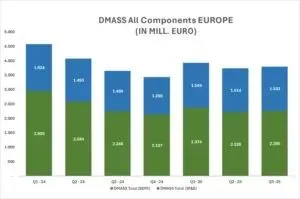
The European electronic components market is beginning to show signs of recovery after a prolonged period of stagnation, according to the chairman of DMASS Europe, Hermann Reiter. In a recent statement, Reiter noted that while there are positive trends, significant challenges remain, particularly concerning structural dependencies and supply chain vulnerabilities.
In the third quarter of 2025, semiconductor distribution in Europe recorded a modest increase of 0.8%, bringing its total value to €2.26 billion. However, the growth was uneven across the region. Notably, the Benelux countries and Turkey experienced robust growth rates of 10.3% and 27.4%, respectively. Conversely, regions including Israel, Switzerland, Eastern Europe, the United Kingdom, and Iberia faced declines compared to the same quarter in the previous year.
Sector Performance Highlights
The sector performances varied significantly, with the strongest growth observed in sensors and actuators, which surged by 19%. Other notable increases included memory chips at 6.9% and non-MOS micro logic, which rose by 21.6%. In contrast, power components saw a decline of 10%, and MOS micro logic decreased by 5.6%.
In the industrial power electronics (IPE) sector, total revenues reached €1.53 billion, reflecting a growth of 9.4%. The highest growth was recorded in Israel at 42% and Turkey at 33%. The United Kingdom experienced a slight downturn of 1.6%, while Ireland and Austria recorded more modest growths of 4.6% and 2.5%, respectively. Eastern Europe and the Nordic countries maintained mid-table positions with increases of 17.7% and 13.8%.
Within the passive and electromechanical components, there was an increase of over 8% each, while power supplies saw a significant rise of 16.9%. Batteries and accumulators, however, faced a steep decline of 9%. Notably, ac-dc converters achieved a remarkable increase of 29%.
Challenges Ahead
Despite the positive signals of recovery, DMASS warns that the market must be viewed against the backdrop of persistent geopolitical tensions and Europe’s reliance on external sources for critical technologies and materials. This dependency leaves Europe vulnerable to volatility and highlights the fragility of global supply chains, which are increasingly susceptible to political, economic, and logistical disruptions.
As the European component market navigates these complexities, industry stakeholders remain cautiously optimistic about the future, recognizing both the potential for growth and the challenges that lie ahead.

Marie Helvin Discusses Dating Challenges and Body Confidence at 73

Danny Morrison Reflects on United Ireland, Gerry Adams, and Stormont’s Future

Southampton University and Siemens Collaborate to Advance MEMS Technology

Barcelona’s Deco Highlights Rashford’s Burden at Manchester United

Rolls-Royce Shares Surge 77% in 2025: What’s Next for Investors?

Welsh Ambulance Service Targets Frequent 999 Callers for Support

Welsh Ambulance Service Targets Frequent 999 Callers for Better Care

Bremen’s Marble Imaging Secures €5.3M for Revolutionary Satellites

WNBA and Players Association Secure 40-Day Extension on CBA Talks

Iconic 90s TV Show House Hits Market for £1.1 Million

Milk Bank Urges Mothers to Donate for Premature Babies’ Health

Alessia Russo Signs Long-Term Deal with Arsenal Ahead of WSL Season

Shoppers Flock to Discounted Neck Pillow on Amazon for Travel Comfort

Museums Body Critiques EHRC Proposals on Gender Facilities

Trump Visits Europe: Business, Politics, or Leisure?

Japanese Teen Sorato Shimizu Breaks U18 100m Record in 10 Seconds

Couple Shares Inspiring Love Story Defying Height Stereotypes

Anglian Water Raises Concerns Over Proposed AI Data Centre
-
 Entertainment2 months ago
Iconic 90s TV Show House Hits Market for £1.1 Million
-
 Lifestyle4 months ago
Milk Bank Urges Mothers to Donate for Premature Babies’ Health
-
 Sports3 months ago
Alessia Russo Signs Long-Term Deal with Arsenal Ahead of WSL Season
-
 Lifestyle4 months ago
Shoppers Flock to Discounted Neck Pillow on Amazon for Travel Comfort
-
 Politics4 months ago
Museums Body Critiques EHRC Proposals on Gender Facilities
-
 Business4 months ago
Trump Visits Europe: Business, Politics, or Leisure?
-
 Lifestyle4 months ago
Japanese Teen Sorato Shimizu Breaks U18 100m Record in 10 Seconds
-
 Politics4 months ago
Couple Shares Inspiring Love Story Defying Height Stereotypes
-
 World4 months ago
Anglian Water Raises Concerns Over Proposed AI Data Centre
-

 Sports4 months ago
Bournemouth Dominates Everton with 3-0 Victory in Premier League Summer Series
-

 World4 months ago
Wreckage of Missing Russian Passenger Plane Discovered in Flames
-

 Lifestyle4 months ago
Shoppers Rave About Roman’s £42 Midi Dress, Calling It ‘Elegant’