
Science
Harvard Scientist Warns 3I/ATLAS Could Reshape Our Understanding of Space

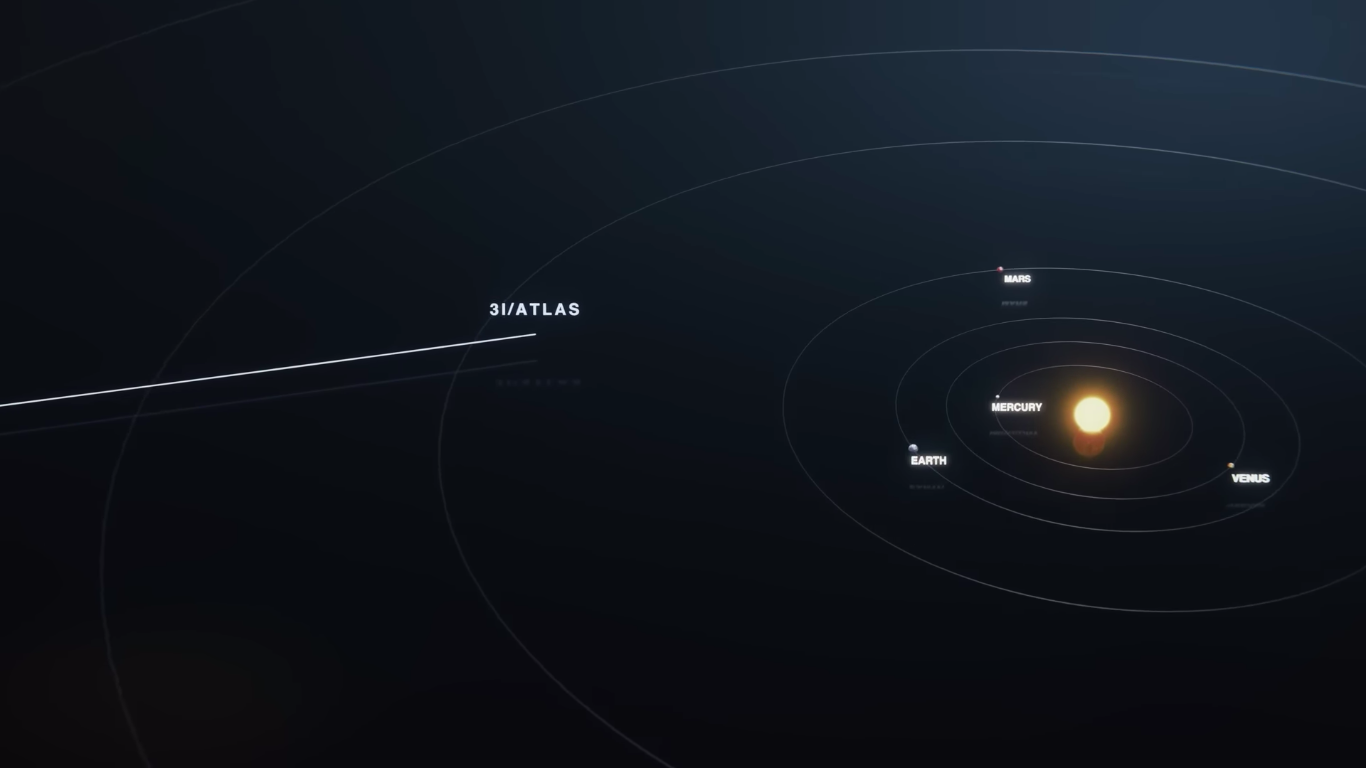
Renowned Harvard astrophysicist Dr. Avi Loeb has raised alarms about the interstellar object 3I/ATLAS, urging the public to take vacations before its closest approach to Earth on October 29, 2023. Loeb contends that this object, comparable in size to Manhattan, might not just be a cosmic rock but something much more significant, potentially an alien spacecraft. He argues that current explanations from organizations like NASA do not fully disclose the nature of this visitor, which he claims could “change everything.”
The fascination surrounding 3I/ATLAS lies in its unusual emissions. Recent observations from the Keck Observatory in Hawaii revealed that the object is releasing a plume containing four grams of nickel per second, which has never been detected in other celestial bodies. Dr. Loeb highlighted that the presence of nickel tetracarbonyl, a compound typically found in industrial processes on Earth, poses a significant mystery. “This was never observed for any other object,” he stated, underscoring the exceptional behavior of 3I/ATLAS.
While some researchers at the Keck Observatory suggest these emissions could be due to an unknown natural phenomenon, Dr. Loeb remains skeptical. He emphasized that the chemical signature aligns with industrial practices rather than natural occurrences in space. He noted, “This was a process that we can imagine only because it was used in industry.” This perspective challenges conventional understanding and invites deeper exploration into the object’s origins.
Unprecedented Anomalies Fuel Speculation
The peculiar characteristics of 3I/ATLAS extend beyond its emissions. Dr. Loeb pointed out that astronomers generally expect to find more small interstellar objects than large ones, yet one of the first observed is a colossal size. “It’s the size of Manhattan Island,” he remarked, highlighting the statistical improbability of such a large object entering our solar system.
Additionally, the trajectory of 3I/ATLAS is another surprising factor. Its orbit aligns within five degrees of the ecliptic plane of the planets, a statistical anomaly with a probability of about one in 500. The timing of its arrival coinciding with close passes by Mars, Venus, and Jupiter adds another layer of intrigue, leading Loeb to suggest a possibility of “fine-tuning.”
The Hubble Space Telescope has also contributed to the mystery by capturing an image of a jet of material emanating towards the Sun, contrary to the behavior of typical comets, which have tails that point away from the Sun. Dr. Loeb questioned, “Why are we seeing a jet pointed at the Sun?” This anomaly further complicates the narrative surrounding 3I/ATLAS and its true nature.
In a discussion with Glenn Beck, Dr. Loeb proposed that if 3I/ATLAS were indeed designed by an intelligent species, its behavior would defy conventional expectations. “If it was designed by intelligence you wouldn’t be able to forecast exactly what it would do,” he explained, likening the situation to discovering an unpredictable visitor in one’s backyard.
Calls for Transparency and Scientific Inquiry
Dr. Loeb has openly critiqued the official narrative surrounding 3I/ATLAS, suggesting that government agencies, including NASA, may not be forthcoming with information. He believes that the categorization of the object as merely an interstellar comet is an attempt to avoid causing public panic. A significant piece of data remains inaccessible due to a U.S. government shutdown: images of 3I/ATLAS captured by the Mars Reconnaissance Orbiter’s HiRISE camera, taken when it was just 12 million miles from Mars.
“Who cares about the communication departments? We want to see the data from the scientists,” an exasperated Loeb stated, emphasizing the urgency for transparency in scientific inquiry. He posits that withholding such information could hinder our understanding of potentially groundbreaking discoveries.
As the date of 3I/ATLAS’s closest approach draws near, it poses profound questions about the nature of the universe. With its improbable size, unusual trajectory, and emissions of industrial-grade metal, scientists and the public alike are left to ponder whether this is the first evidence of extraterrestrial technology or simply a new type of celestial object that could reshape our understanding of astronomy.
Dr. Loeb’s warnings serve as a reminder of the importance of open scientific inquiry. “I advise you to take your vacations before October 29th,” he reiterated, as curiosity about the cosmic mystery continues to grow. As the world awaits further data, the conversation surrounding 3I/ATLAS has only just begun, with implications that could resonate through the scientific community and beyond.

LaLiga Thrills: Key Highlights from Recent Fixtures Unveiled

Germany Intensifies Deportations of Afghan and Syrian Migrants

Shoppers Embrace Next’s £36 Knit as Trendy Christmas Alternative

Harbour Energy Announces 100 Job Cuts Amid Industry Challenges

Amy Childs Shares Weight Gain Journey, Emphasizing Self-Love

UK and US Set to Finalize Zero-Tariff Agreement on Pharmaceuticals

Liverpool Activates Backup Plan as Man City Targets Antoine Semenyo

British Father Drowns in Thailand After Being Swept Away by Waves

TorroFX Set to Transform Trading Landscape with Launch on December 1, 2025

Iconic 90s TV Show House Hits Market for £1.1 Million

Milk Bank Urges Mothers to Donate for Premature Babies’ Health

Alessia Russo Signs Long-Term Deal with Arsenal Ahead of WSL Season

Shoppers Flock to Discounted Neck Pillow on Amazon for Travel Comfort

Museums Body Critiques EHRC Proposals on Gender Facilities

Trump Visits Europe: Business, Politics, or Leisure?

Japanese Teen Sorato Shimizu Breaks U18 100m Record in 10 Seconds

Couple Shares Inspiring Love Story Defying Height Stereotypes

Anglian Water Raises Concerns Over Proposed AI Data Centre
-
 Entertainment2 months ago
Iconic 90s TV Show House Hits Market for £1.1 Million
-
 Lifestyle4 months ago
Milk Bank Urges Mothers to Donate for Premature Babies’ Health
-
 Sports3 months ago
Alessia Russo Signs Long-Term Deal with Arsenal Ahead of WSL Season
-
 Lifestyle4 months ago
Shoppers Flock to Discounted Neck Pillow on Amazon for Travel Comfort
-
 Politics4 months ago
Museums Body Critiques EHRC Proposals on Gender Facilities
-
 Business4 months ago
Trump Visits Europe: Business, Politics, or Leisure?
-
 Lifestyle4 months ago
Japanese Teen Sorato Shimizu Breaks U18 100m Record in 10 Seconds
-
 Politics4 months ago
Couple Shares Inspiring Love Story Defying Height Stereotypes
-
 World4 months ago
Anglian Water Raises Concerns Over Proposed AI Data Centre
-

 Sports4 months ago
Bournemouth Dominates Everton with 3-0 Victory in Premier League Summer Series
-

 World4 months ago
Wreckage of Missing Russian Passenger Plane Discovered in Flames
-

 Lifestyle4 months ago
Shoppers Rave About Roman’s £42 Midi Dress, Calling It ‘Elegant’