
Science
Physicists Uncover Quantum Gas Behavior Defying Classical Heating

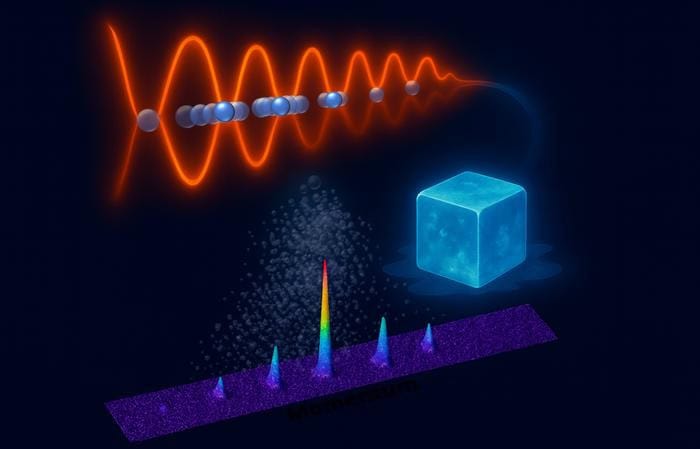
Physicists at the University of Innsbruck in Austria have made a groundbreaking discovery regarding the behavior of quantum gases. Their research reveals a unique scenario where adding energy to a system does not necessarily lead to heating. Instead, they found that a one-dimensional fluid composed of strongly interacting atoms, cooled to just a few nanokelvin above absolute zero and periodically energized with an external force, can maintain its cool state. This phenomenon could provide insights into how quantum systems transition to chaotic classical states.
Understanding chaos is essential in various scientific fields, including mathematics, physics, and biology. In our everyday world, chaos plays a significant role, influencing systems from ecology to economics. The evolution of a system is highly dependent on its initial conditions, but this process is inherently unpredictable. While chaos is well-studied in classical systems, its emergence in quantum materials remains largely unexplored.
The team led by Hanns-Christoph Nägerl has focused on the quantum kicked rotor (QKR), a model used to study chaotic behavior in quantum systems. In contrast to classical systems, where energy absorption typically leads to heating, the quantum version can resist this effect due to quantum coherence. This “dynamical localization” effect has been previously observed in dilute ultracold atomic gases, but the new research extends this understanding to strongly interacting many-body systems.
By subjecting ultracold caesium (Cs) atoms to periodic kicks through a “flashed-on lattice potential,” the researchers created a QKR. They loaded a Bose-Einstein condensate of caesium into a series of narrow one-dimensional tubes formed by laser beams. As they increased the power of the beams, they expected the atoms to absorb energy and heat up. Contrary to their expectations, the momentum distribution of the atoms stopped spreading, and the system’s energy plateaued.
“Despite being continually kicked and strongly interacting, it no longer absorbed energy,” Nägerl stated. “We say that it had localized in momentum space – a phenomenon known as many-body dynamical localization (MBDL).” In this state, quantum coherence and many-body interactions prevent the system from heating up, leading to a frozen momentum distribution that retains its structure.
The researchers varied the interaction strength between the atoms, ranging from non-interacting to strongly interacting, and consistently observed localization. Nägerl acknowledged the significance of their findings, stating, “We had not previously realized the significance of our findings and thought that perhaps we were doing something wrong, which turned out not to be the case.”
Despite its intriguing properties, MBDL is a delicate state. The researchers demonstrated this fragility by introducing randomness into the laser pulses. A small amount of disorder was enough to disrupt the localization effect, resulting in an increase in kinetic energy as the system began to absorb energy. “This test highlights that quantum coherence is crucial for preventing thermalization in such driven many-body systems,” Nägerl explained.
The complexity of simulating such systems on classical computers limits researchers to just two or three particles. In contrast, the system studied in this research, published in the journal Science, includes 20 or more particles. Nägerl remarked, “Our new experiments now provide precious data to which we can compare the QKR model system, which is a paradigmatic one in quantum physics.”
Looking ahead, the researchers plan to investigate the stability of MBDL against various external perturbations. Nägerl expressed interest in exploring whether this localization occurs in two-dimensional or three-dimensional systems. He proposed an experiment involving a one-dimensional system that interacts with a neighboring system through tunneling. Additionally, introducing local defects, such as variations in potential, could further inform their understanding of MBDL.
The ongoing research highlights the potential for breakthroughs in understanding quantum systems and their transition to classical states. As the team continues to explore the complexities of many-body dynamics, their findings may pave the way for advancements in quantum technology and materials science.

Liverpool Activates Backup Plan as Man City Targets Antoine Semenyo

British Father Drowns in Thailand After Being Swept Away by Waves

TorroFX Set to Transform Trading Landscape with Launch on December 1, 2025

BBC Breakfast’s Sally Nugent Apologizes for News Disruption

Recognize Bowel Cancer Signs During Festive Overindulgence

Marie Helvin Discusses Dating Challenges and Body Confidence at 73

Danny Morrison Reflects on United Ireland, Gerry Adams, and Stormont’s Future

Southampton University and Siemens Collaborate to Advance MEMS Technology

Barcelona’s Deco Highlights Rashford’s Burden at Manchester United

Iconic 90s TV Show House Hits Market for £1.1 Million

Milk Bank Urges Mothers to Donate for Premature Babies’ Health

Alessia Russo Signs Long-Term Deal with Arsenal Ahead of WSL Season

Shoppers Flock to Discounted Neck Pillow on Amazon for Travel Comfort

Museums Body Critiques EHRC Proposals on Gender Facilities

Trump Visits Europe: Business, Politics, or Leisure?

Japanese Teen Sorato Shimizu Breaks U18 100m Record in 10 Seconds

Couple Shares Inspiring Love Story Defying Height Stereotypes

Anglian Water Raises Concerns Over Proposed AI Data Centre
-
 Entertainment2 months ago
Iconic 90s TV Show House Hits Market for £1.1 Million
-
 Lifestyle4 months ago
Milk Bank Urges Mothers to Donate for Premature Babies’ Health
-
 Sports3 months ago
Alessia Russo Signs Long-Term Deal with Arsenal Ahead of WSL Season
-
 Lifestyle4 months ago
Shoppers Flock to Discounted Neck Pillow on Amazon for Travel Comfort
-
 Politics4 months ago
Museums Body Critiques EHRC Proposals on Gender Facilities
-
 Business4 months ago
Trump Visits Europe: Business, Politics, or Leisure?
-
 Lifestyle4 months ago
Japanese Teen Sorato Shimizu Breaks U18 100m Record in 10 Seconds
-
 Politics4 months ago
Couple Shares Inspiring Love Story Defying Height Stereotypes
-
 World4 months ago
Anglian Water Raises Concerns Over Proposed AI Data Centre
-

 Sports4 months ago
Bournemouth Dominates Everton with 3-0 Victory in Premier League Summer Series
-

 World4 months ago
Wreckage of Missing Russian Passenger Plane Discovered in Flames
-

 Lifestyle4 months ago
Shoppers Rave About Roman’s £42 Midi Dress, Calling It ‘Elegant’