
Science
Astronomers Stunned as 3I/ATLAS Defies Conventional Physics

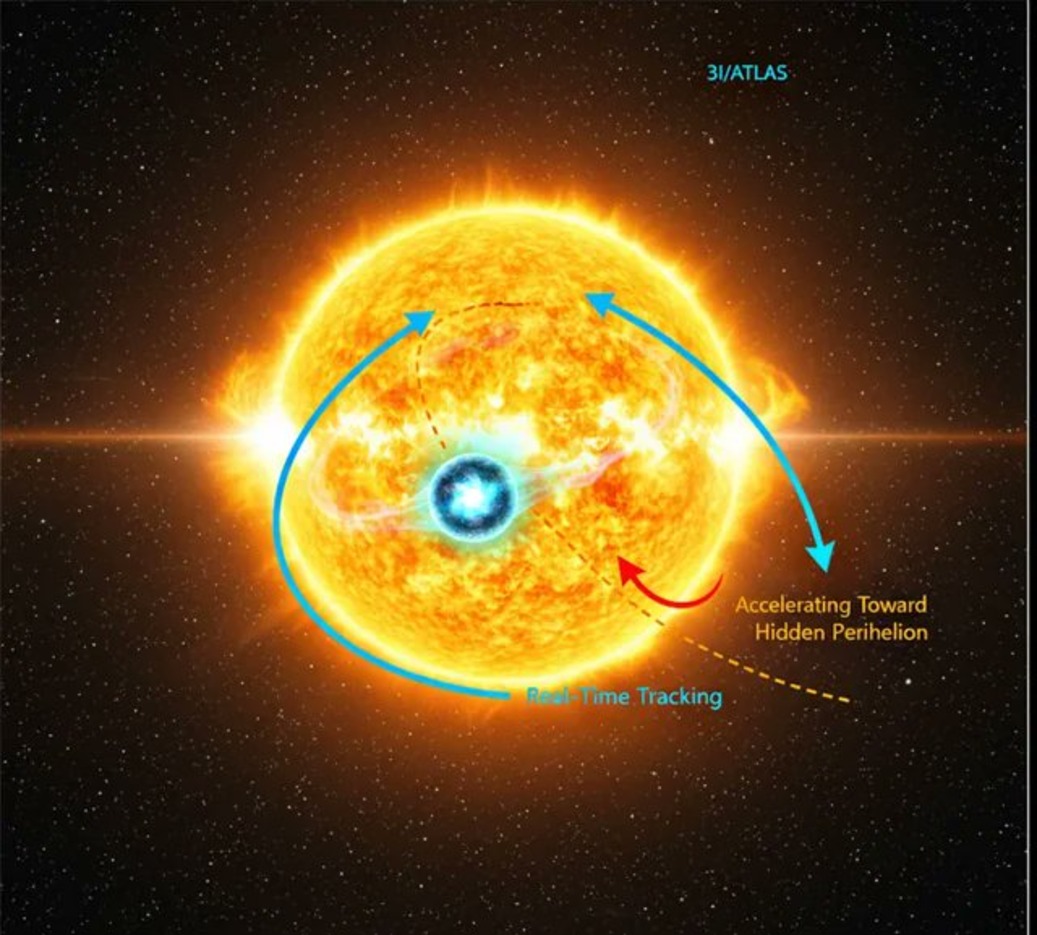
Astronomers are grappling with the peculiar behaviour of the interstellar object known as 3I/ATLAS (C/2025 N1), which is exhibiting unexpected changes in its orbit. Discovered on July 1, 2025, by the ATLAS telescope in Chile, this object is challenging existing theories of orbital mechanics. Its hyperbolic trajectory confirms it is of extrasolar origin, yet it displays characteristics that diverge sharply from those typically associated with comets in our Solar System.
Scientists have noted that 3I/ATLAS has deviated from its predicted path on at least eight occasions, resulting in a ranking of 4 on the Loeb Scale. This scale categorizes objects based on their orbital anomalies, placing 3I/ATLAS above both ʻOumuamua and Borisov regarding the severity of its anomalies. The deviations are too significant to be attributed solely to solar radiation or outgassing, leading experts to consider the potential influence of unknown external forces.
Unusual Features Raise Intrigue
Adding to the mystery, 3I/ATLAS is approaching a solar conjunction, having reached a position directly behind the Sun from Earth’s perspective on October 21, 2025. This alignment coincides with what physicists term the Oberth manoeuvre window, a theoretical period that allows for optimal momentum changes during close proximity to the Sun. The object is anticipated to reach its closest point to the Sun, or perihelion, on October 29, 2025, at a distance of 203 million kilometres.
Recent observations using data from the Keck Observatory and the TESS mission have unveiled further anomalies. According to The Debrief, 3I/ATLAS appears to possess a unique ‘anti-tail,’ a dust structure that extends away from the Sun, alongside a gas plume rich in nickel but devoid of iron. These features indicate chemical processes that are not typically seen in Solar System comets. Furthermore, the object’s coma—the cloud of dust and gas surrounding its nucleus—seems particularly faint or possibly inactive, with unusually low dust ejection rates.
Future Observations Planned
In response to these findings, both NASA and the European Space Agency (ESA) have announced plans to continue monitoring 3I/ATLAS following its perihelion. Spacecraft including Juno and JUICE will aim to gather high-resolution data regarding the object’s structure and composition. While some online discussions have speculated about its potential artificial origin, officials have reassured the public that 3I/ATLAS presents no threat to Earth. Its hyperbolic trajectory confirms it will exit the Solar System after its flyby.
The peculiar behaviour of 3I/ATLAS has reignited debates surrounding the nature of interstellar objects, drawing comparisons to ʻOumuamua, which also demonstrated unexplained accelerations. Following its perihelion on October 29, the object will begin its outbound journey, making it more accessible for observation as it emerges from behind the Sun in early November. Preliminary data is expected to be released in mid-November, with a comprehensive report on its spectral and trajectory analysis anticipated by the end of the year.
As scientists delve deeper into the implications of 3I/ATLAS‘s behaviour, they hope to clarify whether its unusual motion is a result of natural physics or represents a new class of interstellar phenomena. The ongoing study of this enigmatic object could profoundly reshape our understanding of the cosmos and the dynamics of celestial bodies beyond our Solar System.

Cattle Showcases Thrive at RUAS Winter Fair 2023

UK and US Strike Zero Tariff Agreement on Pharmaceuticals

Maya Jama Stuns in Strapless Ensemble at Qatar Grand Prix

Russia and Saudi Arabia Launch Visa-Free Travel Agreement

ISOLDE Facility Marks 10 Years of Advancements in Nuclear Research

Voters Demand Resignation of Chancellor Rachel Reeves Over Tax Hikes

Shoppers Save 30% on Marks & Spencer’s Viral Velvet Dress

Health Campaigners Urge End to Smoking Exemption for Lounges

Charity Shop Surprise: Woman Finds Joggers Worth £2,000 for £8

Iconic 90s TV Show House Hits Market for £1.1 Million

Milk Bank Urges Mothers to Donate for Premature Babies’ Health

Alessia Russo Signs Long-Term Deal with Arsenal Ahead of WSL Season

Shoppers Flock to Discounted Neck Pillow on Amazon for Travel Comfort

Museums Body Critiques EHRC Proposals on Gender Facilities

Trump Visits Europe: Business, Politics, or Leisure?

Japanese Teen Sorato Shimizu Breaks U18 100m Record in 10 Seconds

Couple Shares Inspiring Love Story Defying Height Stereotypes

Anglian Water Raises Concerns Over Proposed AI Data Centre
-
 Entertainment2 months ago
Iconic 90s TV Show House Hits Market for £1.1 Million
-
 Lifestyle4 months ago
Milk Bank Urges Mothers to Donate for Premature Babies’ Health
-
 Sports3 months ago
Alessia Russo Signs Long-Term Deal with Arsenal Ahead of WSL Season
-
 Lifestyle4 months ago
Shoppers Flock to Discounted Neck Pillow on Amazon for Travel Comfort
-
 Politics4 months ago
Museums Body Critiques EHRC Proposals on Gender Facilities
-
 Business4 months ago
Trump Visits Europe: Business, Politics, or Leisure?
-
 Lifestyle4 months ago
Japanese Teen Sorato Shimizu Breaks U18 100m Record in 10 Seconds
-
 Politics4 months ago
Couple Shares Inspiring Love Story Defying Height Stereotypes
-
 World4 months ago
Anglian Water Raises Concerns Over Proposed AI Data Centre
-

 Sports4 months ago
Bournemouth Dominates Everton with 3-0 Victory in Premier League Summer Series
-

 World4 months ago
Wreckage of Missing Russian Passenger Plane Discovered in Flames
-

 Lifestyle4 months ago
Shoppers Rave About Roman’s £42 Midi Dress, Calling It ‘Elegant’