
Top Stories
Scientists Debate Eerie Early Image of Interstellar Object 3I/ATLAS

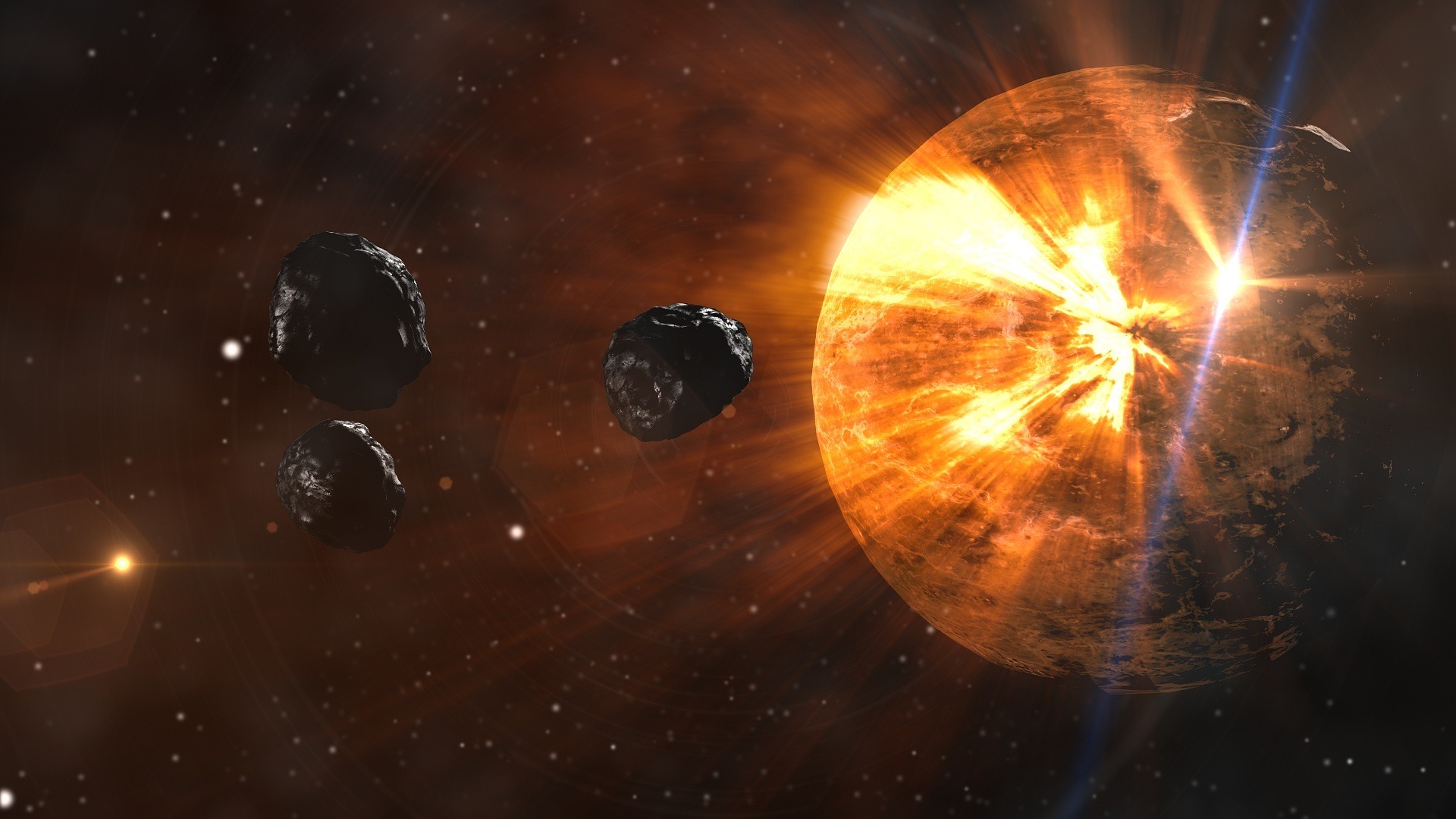
An unsettling early image of the interstellar object 3I/ATLAS has sparked intense debate among scientists as they grapple with anomalies that challenge conventional classifications. Captured by ground-based telescopes shortly after the object’s discovery, the image exhibits a highly asymmetric light distribution, diverging from expectations for a typical comet. In contrast, subsequent observations from NASA have depicted a more standard cometary body, leading to discussions about whether the initial image represents a mere artefact or a significant clue to the object’s true nature.
Astronomers quickly recognized 3I/ATLAS as a scientifically valuable object upon confirming its hyperbolic trajectory, indicating an origin beyond the solar system. This classification has been reinforced by archival observations from the Zwicky Transient Facility and follow-up imaging from multiple professional telescopes. NASA’s observations, including those from the Hubble Space Telescope, the Solar and Heliospheric Observatory (SOHO), and the Mars Reconnaissance Orbiter, reveal a diffuse body with a coma characteristic of active comets. Data confirms the presence of volatile outgassing as it approaches the Sun, with spectroscopic measurements identifying carbon dioxide, water vapour, and other compounds.
Despite this confirmation, the early amateur image, taken weeks prior to these professional observations, has raised eyebrows. Its lopsided glow does not conform to the symmetric coma patterns typically expected from solar heating. Many astronomers have dismissed the early frames as noise or exposure artefacts.
Controversy Ignited by Avi Loeb’s Commentary
The controversy surrounding the early image intensified following comments from Avi Loeb, a Harvard astrophysicist. He posited that certain features of 3I/ATLAS warrant further investigation beyond conventional explanations. Loeb introduced his “Loeb scale,” where a score of zero indicates a natural origin and ten denotes confirmed artificiality. He rated 3I/ATLAS at a four, suggesting it aligns with natural hypotheses but remains open to alternative interpretations.
In his assessments, Loeb highlighted several critical points: the object’s unusual orientation within the solar system, the image’s asymmetry potentially indicating non-gravitational forces, and unexpected nickel readings in some spectral analyses that challenge typical comet profiles. He has reiterated these views in interviews and media appearances, pointing out perceived gaps in NASA‘s public data.
Mainstream organizations have largely maintained that 3I/ATLAS is a natural comet. Peer-reviewed publications affirm this classification, with NASA‘s science teams asserting that observed features, including anti-tails and irregular jet structures, fall within expected variations due to outgassing asymmetries and viewing geometry. Researchers publishing in archives such as arXiv have provided robust spectroscopic evidence of water and carbon dioxide in the coma, reinforcing its cometary classification.
Public Discourse and Misinformation Challenges
Alongside professional debates, the public conversation has been marked by confusion and misinformation. Deepfake videos falsely attributing quotes about alien origins to prominent physicists like Michio Kaku have been disavowed by the scientists themselves, who clarified their views on 3I/ATLAS while condemning such misrepresentation. Online forums have become saturated with misleading content, prompting amateur communities to sift through real scientific sources amidst rampant conjecture.
The release of images on November 19, 2025, by NASA and allied agencies provided a crucial counterpoint to the earlier uncertainty. These images demonstrated the comet’s characteristic coma and trajectory consistent with a hyperbolic interstellar passage. The consensus among experts is that 3I/ATLAS poses no threat to Earth and remains an intriguing natural visitor from beyond our solar system.
As the scientific community continues to scrutinize the early image and its implications, the case of 3I/ATLAS highlights the challenges of distinguishing verified scientific findings from viral speculation in the digital age.

Moyes Faces Referee Controversy Ahead of Everton vs Chelsea Clash

Man Hospitalised After Assault Outside Shop in Sandwell

Fred MacAulay and Ally McCoist Reunite for Special World Cup Show

NoOnes Targets $1 Trillion Gift Card Market to Enhance Crypto Access

Beloved Actor Matt Clark Passes Away at 89, Fans Mourn Loss

Discover How Milk Thistle Supplements Enhance Liver Health

Irish Community Care Celebrates 60 Years of Support in Liverpool

New Affordable Housing Development Planned for Crawley Site

Millions of Parking Tickets Issued Amid Calls for Reform

Claire Tomlinson Bids Farewell to Sky Sports After 27 Years

Iconic 90s TV Show House Hits Market for £1.1 Million

Tributes Flow for Kerry Gentle, Beloved RNLI Volunteer and Artist

Nathan Cleary’s Family Celebrates Engagement Amid Romance Rumors

Milk Bank Urges Mothers to Donate for Premature Babies’ Health

Shoppers Flock to Discounted Neck Pillow on Amazon for Travel Comfort

Alessia Russo Signs Long-Term Deal with Arsenal Ahead of WSL Season

Nuneaton Town FC Advances Plans for New Stadium in Stockingford

Museums Body Critiques EHRC Proposals on Gender Facilities
-
 Lifestyle6 months ago
Claire Tomlinson Bids Farewell to Sky Sports After 27 Years
-
 Entertainment9 months ago
Iconic 90s TV Show House Hits Market for £1.1 Million
-
 Lifestyle6 months ago
Tributes Flow for Kerry Gentle, Beloved RNLI Volunteer and Artist
-
 Sports11 months ago
Nathan Cleary’s Family Celebrates Engagement Amid Romance Rumors
-
 Lifestyle11 months ago
Milk Bank Urges Mothers to Donate for Premature Babies’ Health
-
 Lifestyle11 months ago
Shoppers Flock to Discounted Neck Pillow on Amazon for Travel Comfort
-
 Sports10 months ago
Alessia Russo Signs Long-Term Deal with Arsenal Ahead of WSL Season
-
 Sports8 months ago
Nuneaton Town FC Advances Plans for New Stadium in Stockingford
-
 Politics11 months ago
Museums Body Critiques EHRC Proposals on Gender Facilities
-

 Lifestyle11 months ago
Exploring England’s Cathedrals: A Journey Through History and Architecture
-

 Business11 months ago
Trump Visits Europe: Business, Politics, or Leisure?
-

 Lifestyle11 months ago
Japanese Teen Sorato Shimizu Breaks U18 100m Record in 10 Seconds