
Science
Physicists Achieve Breakthrough in Acoustic Levitation Techniques

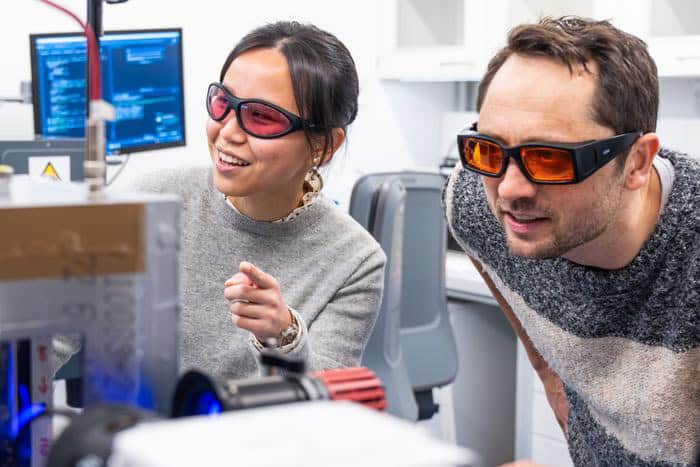
Researchers at the Institute of Science and Technology Austria (ISTA) have achieved a significant breakthrough in the realm of acoustic levitation. Their innovative approach addresses a longstanding challenge in this field: the tendency of multiple levitated objects to clump together, a phenomenon known as “acoustic collapse.” By harnessing a combination of attractive acoustic forces and repulsive electrostatic forces, the physicists have successfully demonstrated the ability to levitate multiple objects while maintaining their separation.
Acoustic levitation utilizes sound waves to lift small particles, ranging in size from tens of microns to millimeters, into the air. This technique relies on the momentum transferred to the particles by sound waves as they scatter off their surfaces. While effective for single particles, previous attempts at levitating multiple objects resulted in aggregation due to the attractive interactions created by the collective scattering of acoustic forces.
To tackle this issue, the team, led by Scott Waitukaitis, implemented a method that combines these acoustic forces with a tunable repulsive electrostatic force. This dual-force system enabled the researchers to counteract the clumping tendency effectively.
Innovative Methodology for Multiple Object Levitation
The experimental process began with the levitation of a single silver-coated poly(methyl methacrylate) (PMMA) microsphere, measuring between 250 and 300 micrometers in diameter. The microsphere was positioned above a reflector plate coated with a transparent and conductive layer of indium tin oxide (ITO). To prepare the particle for levitation, it was allowed to rest on the ITO plate while the acoustic field was turned off, during which a high-voltage direct current (DC) potential was applied. This setup facilitated a capacitive build-up of charge on the particle. The amount of charge was determined based on Maxwell’s solutions for two conductive spheres in contact.
Once charged, the acoustic field was activated, followed by the introduction of the electric field after a brief interval of just 10 milliseconds. This precise timing allowed either field to propel the particle towards the center of the levitation setup. After the electric field was switched off, the particle remained stably levitated in the trap, with its charge determined by theoretical approximations.
The method proved effective not only for single particles but also for multiple particles, enabling the researchers to load them into the trap with high efficiency. They could adjust the charge as needed, limited only by the breakdown voltage of the surrounding air. This flexibility allowed for the levitation of particles separately or their aggregation into a denser form, even creating hybrid states that combined both configurations.
Applications and Future Directions
The research team described a particularly exciting moment during their experiments when the compact parts of the hybrid structures began to rotate spontaneously, while the expanded components oscillated in response. Sue Shi, a PhD student at ISTA and the lead author of the study published in PNAS, remarked that this observation marked the first instance of such acoustically and electrostatically coupled interactions in an acoustically levitated system.
The implications of this work extend beyond the laboratory. The technique opens doors to potential applications in fields such as materials science, micro-robotics, and even mid-air chemical synthesis. Shi noted that the ability to study non-reciprocal effects contributing to the oscillations and rotations of particles could enhance the understanding of more complex interactions in various systems.
This innovative research signifies a major advancement in the field of acoustic levitation, with the potential to revolutionize how scientists manipulate small objects in three-dimensional space. As this technology evolves, it may lead to groundbreaking applications that could reshape material handling and synthesis processes across various industries.

Moyes Faces Referee Controversy Ahead of Everton vs Chelsea Clash

Man Hospitalised After Assault Outside Shop in Sandwell

Fred MacAulay and Ally McCoist Reunite for Special World Cup Show

NoOnes Targets $1 Trillion Gift Card Market to Enhance Crypto Access

Beloved Actor Matt Clark Passes Away at 89, Fans Mourn Loss

Discover How Milk Thistle Supplements Enhance Liver Health

Irish Community Care Celebrates 60 Years of Support in Liverpool

New Affordable Housing Development Planned for Crawley Site

Millions of Parking Tickets Issued Amid Calls for Reform

Claire Tomlinson Bids Farewell to Sky Sports After 27 Years

Iconic 90s TV Show House Hits Market for £1.1 Million

Nathan Cleary’s Family Celebrates Engagement Amid Romance Rumors

Tributes Flow for Kerry Gentle, Beloved RNLI Volunteer and Artist

Milk Bank Urges Mothers to Donate for Premature Babies’ Health

Shoppers Flock to Discounted Neck Pillow on Amazon for Travel Comfort

Alessia Russo Signs Long-Term Deal with Arsenal Ahead of WSL Season

Nuneaton Town FC Advances Plans for New Stadium in Stockingford

Exploring England’s Cathedrals: A Journey Through History and Architecture
-
 Lifestyle8 months ago
Claire Tomlinson Bids Farewell to Sky Sports After 27 Years
-
 Entertainment11 months ago
Iconic 90s TV Show House Hits Market for £1.1 Million
-
 Sports1 year ago
Nathan Cleary’s Family Celebrates Engagement Amid Romance Rumors
-
 Lifestyle8 months ago
Tributes Flow for Kerry Gentle, Beloved RNLI Volunteer and Artist
-
 Lifestyle1 year ago
Milk Bank Urges Mothers to Donate for Premature Babies’ Health
-
 Lifestyle1 year ago
Shoppers Flock to Discounted Neck Pillow on Amazon for Travel Comfort
-
 Sports12 months ago
Alessia Russo Signs Long-Term Deal with Arsenal Ahead of WSL Season
-
 Sports9 months ago
Nuneaton Town FC Advances Plans for New Stadium in Stockingford
-
 Lifestyle1 year ago
Exploring England’s Cathedrals: A Journey Through History and Architecture
-

 Politics1 year ago
Museums Body Critiques EHRC Proposals on Gender Facilities
-

 Business1 year ago
Trump Visits Europe: Business, Politics, or Leisure?
-

 Lifestyle1 year ago
Japanese Teen Sorato Shimizu Breaks U18 100m Record in 10 Seconds