
Science
Physicist Controls Spin Waves’ Frequency Up to 40% at Room Temp

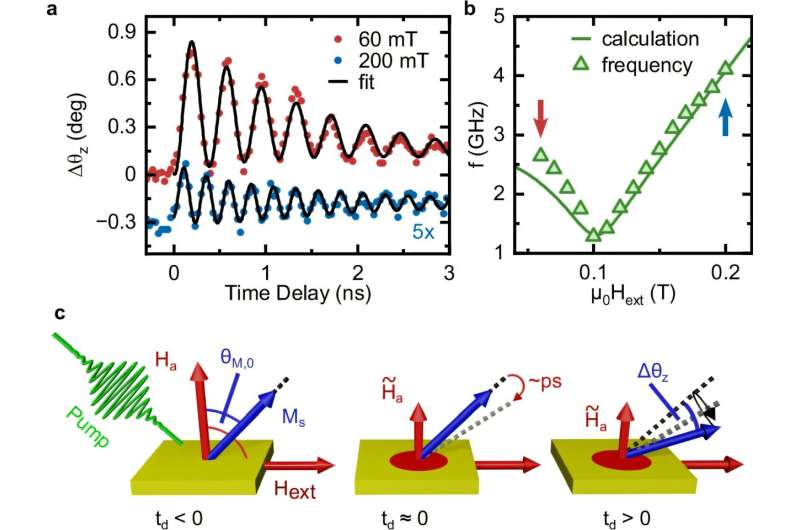
Physicist Davide Bossini from the University of Konstanz has successfully demonstrated a groundbreaking method to alter the frequency of magnetic oscillations in materials by as much as 40%, using standard devices at room temperature. This innovation marks a significant advancement in the control of collective magnetic oscillations known as magnons, which are crucial for future data storage technologies.
In his research, published on January 14, 2026, in the journal Nature Communications, Bossini highlights the potential of using light to manipulate these oscillations. He has previously explored the interaction between light and magnons, leading him to discover how to modify the “magnetic DNA” of materials. The latest findings illustrate that frequencies can be adjusted almost instantaneously through the application of a weak magnetic field and intense laser pulses.
Significance of the Research
The ability to control the frequency of magnetic oscillations has profound implications for the realm of data storage. Currently, the majority of digital data in the cloud relies on magnetic storage methods. By tuning the frequency of spin waves, it becomes possible to enhance the rate of data writing and transfer significantly. Bossini’s method opens the door to future technologies that could revolutionize how data is stored and communicated.
Bossini emphasizes the practicality of his approach, stating, “We don’t need a self-developed custom laser.” Instead, his team utilized a commercially available laser system along with conventional permanent magnets to generate the required magnetic field. Remarkably, all experiments were conducted at room temperature, a notable contrast to the typical low-temperature conditions of 80 degrees Kelvin (-193.15 degrees Celsius) used in similar studies.
Collaboration and Methodology
The study involved collaboration with scientists from several reputable institutions, including ETH Zurich, RPTU University Kaiserslautern-Landau, and two research teams from Italy at the Polytechnic University of Bari and the University of Messina. This collaborative effort ensured a comprehensive understanding of the method’s effectiveness, with systematic theoretical and experimental evaluations conducted to confirm the results.
The sample materials utilized in the experiments, which are 20 nanometers thick, are deemed suitable for computer chips, providing a practical application for this technology. The research not only advances the scientific understanding of magnetic oscillations but also lays the groundwork for innovative approaches to data storage and transfer.
This pioneering work by Bossini and his team signifies an important step forward in the field of spintronics, with potential applications that could reshape the future of digital data management.

Moyes Faces Referee Controversy Ahead of Everton vs Chelsea Clash

Man Hospitalised After Assault Outside Shop in Sandwell

Fred MacAulay and Ally McCoist Reunite for Special World Cup Show

NoOnes Targets $1 Trillion Gift Card Market to Enhance Crypto Access

Beloved Actor Matt Clark Passes Away at 89, Fans Mourn Loss

Discover How Milk Thistle Supplements Enhance Liver Health

Irish Community Care Celebrates 60 Years of Support in Liverpool

New Affordable Housing Development Planned for Crawley Site

Millions of Parking Tickets Issued Amid Calls for Reform

Claire Tomlinson Bids Farewell to Sky Sports After 27 Years

Iconic 90s TV Show House Hits Market for £1.1 Million

Tributes Flow for Kerry Gentle, Beloved RNLI Volunteer and Artist

Nathan Cleary’s Family Celebrates Engagement Amid Romance Rumors

Milk Bank Urges Mothers to Donate for Premature Babies’ Health

Shoppers Flock to Discounted Neck Pillow on Amazon for Travel Comfort

Alessia Russo Signs Long-Term Deal with Arsenal Ahead of WSL Season

Nuneaton Town FC Advances Plans for New Stadium in Stockingford

Museums Body Critiques EHRC Proposals on Gender Facilities
-
 Lifestyle6 months ago
Claire Tomlinson Bids Farewell to Sky Sports After 27 Years
-
 Entertainment9 months ago
Iconic 90s TV Show House Hits Market for £1.1 Million
-
 Lifestyle6 months ago
Tributes Flow for Kerry Gentle, Beloved RNLI Volunteer and Artist
-
 Sports11 months ago
Nathan Cleary’s Family Celebrates Engagement Amid Romance Rumors
-
 Lifestyle11 months ago
Milk Bank Urges Mothers to Donate for Premature Babies’ Health
-
 Lifestyle11 months ago
Shoppers Flock to Discounted Neck Pillow on Amazon for Travel Comfort
-
 Sports10 months ago
Alessia Russo Signs Long-Term Deal with Arsenal Ahead of WSL Season
-
 Sports8 months ago
Nuneaton Town FC Advances Plans for New Stadium in Stockingford
-
 Politics11 months ago
Museums Body Critiques EHRC Proposals on Gender Facilities
-

 Lifestyle11 months ago
Exploring England’s Cathedrals: A Journey Through History and Architecture
-

 Business11 months ago
Trump Visits Europe: Business, Politics, or Leisure?
-

 Lifestyle11 months ago
Japanese Teen Sorato Shimizu Breaks U18 100m Record in 10 Seconds