
Science
Lunar Samples Illuminate Differences Between Moon’s Sides

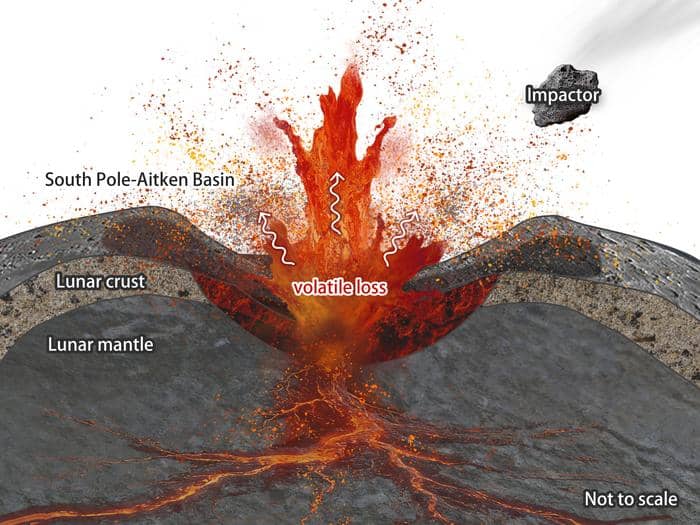
Research on lunar samples returned by China’s Chang’e-6 mission has provided valuable insights into the chemical differences between the near and far sides of the Moon. These findings suggest that the disparities in magmatic activity and crustal thickness may be linked to a significant meteorite impact that formed the South Pole-Aitken Basin (SPA), one of the Moon’s largest impact craters.
The study, conducted by scientists at the Chinese Academy of Sciences (CAS) in Beijing, focused on four samples obtained from the SPA. By measuring the isotopes of iron and potassium, researchers determined that the variations in the Moon’s composition likely result from the enormous impact that created this basin. The SPA is estimated to be between 4.2 and 4.3 billion years old and spans approximately 2,500 kilometers, making it one of the oldest known craters in the solar system.
China’s lunar exploration efforts began in earnest in 2007 with the launch of Chang’e-1. The program has since achieved notable milestones, including the successful landing of Chang’e-4 on the far side of the Moon in 2019. This mission marked the first time a spacecraft touched down in the SPA’s Von Kármán crater. Following this, Chang’e-5 returned 1.7 kilograms of samples from the near side in December 2020, the first lunar samples to reach Earth in nearly half a century. The Chang’e-6 mission, launched on May 3, 2024, has now added samples from the far side to the collection.
Researchers found that the ratio of potassium-41 to potassium-39 was higher in samples from the SPA compared to those collected from the near side by Chang’e-5 and NASA’s Apollo missions. According to study leader Heng-Ci Tian, this specific isotope ratio serves as evidence of the conditions created by the impact event. He explained that the extreme temperatures and pressures during the collision caused many volatile elements, including potassium, to escape into space.
“Since the lighter potassium-39 isotope would more readily evaporate than the heavier potassium-41 isotope, the impact produced this greater ratio of potassium-41 to potassium-39,” Tian noted. This hypothesis is further supported by earlier findings indicating that the far side’s mantle contains less water than that of the near side.
In order to reach this conclusion, the CAS researchers rigorously evaluated alternative explanations. They considered whether cosmic ray irradiation could have altered the isotopic ratios or if volcanic processes had changed the composition of the basaltic rocks. They also examined the potential influence of meteorite contamination. Ultimately, the researchers determined that these factors had negligible effects on the samples.
Tian emphasized that their findings represent the first evidence of how massive impact events can volatilize materials deep within the Moon. The implications of this research extend beyond the immediate findings, suggesting that such impacts significantly affect the Moon’s crust and mantle composition. The scarcity of volatiles on the far side could explain the noticeable absence of volcanic plains, or maria, which are prevalent on the near side.
“The loss of moderately volatile elements—and likely also highly volatile elements—would have suppressed magma generation and volcanic eruptions on the far side,” Tian explained. “We therefore propose that the SPA impact contributed, at least partially, to the observed hemispheric asymmetry in volcanic distribution.”
The researchers encountered challenges during their analysis, particularly due to the fine-grained nature of the Chang’e-6 samples. To address this, they developed an ultra-low-consumption potassium isotope analytical protocol, enabling them to make high-precision measurements at the milligram level.
While the current results are preliminary, the team plans to analyze additional isotopes of moderately volatile elements to further substantiate their conclusions. They also aim to combine these findings with numerical modeling to assess the global-scale effects of the SPA impact.
The results of this significant research are documented in the Proceedings of the National Academy of Sciences, marking an important advancement in our understanding of lunar geology and the historical impacts that have shaped the Moon’s surface.

Moyes Faces Referee Controversy Ahead of Everton vs Chelsea Clash

Man Hospitalised After Assault Outside Shop in Sandwell

Fred MacAulay and Ally McCoist Reunite for Special World Cup Show

NoOnes Targets $1 Trillion Gift Card Market to Enhance Crypto Access

Beloved Actor Matt Clark Passes Away at 89, Fans Mourn Loss

Discover How Milk Thistle Supplements Enhance Liver Health

Irish Community Care Celebrates 60 Years of Support in Liverpool

New Affordable Housing Development Planned for Crawley Site

Millions of Parking Tickets Issued Amid Calls for Reform

Claire Tomlinson Bids Farewell to Sky Sports After 27 Years

Iconic 90s TV Show House Hits Market for £1.1 Million

Tributes Flow for Kerry Gentle, Beloved RNLI Volunteer and Artist

Nathan Cleary’s Family Celebrates Engagement Amid Romance Rumors

Milk Bank Urges Mothers to Donate for Premature Babies’ Health

Shoppers Flock to Discounted Neck Pillow on Amazon for Travel Comfort

Alessia Russo Signs Long-Term Deal with Arsenal Ahead of WSL Season

Nuneaton Town FC Advances Plans for New Stadium in Stockingford

Museums Body Critiques EHRC Proposals on Gender Facilities
-
 Lifestyle6 months ago
Claire Tomlinson Bids Farewell to Sky Sports After 27 Years
-
 Entertainment9 months ago
Iconic 90s TV Show House Hits Market for £1.1 Million
-
 Lifestyle6 months ago
Tributes Flow for Kerry Gentle, Beloved RNLI Volunteer and Artist
-
 Sports11 months ago
Nathan Cleary’s Family Celebrates Engagement Amid Romance Rumors
-
 Lifestyle11 months ago
Milk Bank Urges Mothers to Donate for Premature Babies’ Health
-
 Lifestyle11 months ago
Shoppers Flock to Discounted Neck Pillow on Amazon for Travel Comfort
-
 Sports10 months ago
Alessia Russo Signs Long-Term Deal with Arsenal Ahead of WSL Season
-
 Sports8 months ago
Nuneaton Town FC Advances Plans for New Stadium in Stockingford
-
 Politics11 months ago
Museums Body Critiques EHRC Proposals on Gender Facilities
-

 Lifestyle11 months ago
Exploring England’s Cathedrals: A Journey Through History and Architecture
-

 Business11 months ago
Trump Visits Europe: Business, Politics, or Leisure?
-

 Lifestyle11 months ago
Japanese Teen Sorato Shimizu Breaks U18 100m Record in 10 Seconds