
Health
Fitness App Boosts Retention and Revenue with New Strategies

A subscription fitness app has successfully reduced early customer churn by implementing a new onboarding strategy, which has significantly improved its financial outlook. By analysing retention data, the app’s product team discovered that members who completed fewer than three workouts within their first two weeks had an 82 percent likelihood of cancelling before reaching the third month. In response, the team redesigned the onboarding process to include a guided seven-day challenge, daily push notifications, personalised workout recommendations, and congratulatory emails after the fifth session. This intervention resulted in a 31 percent reduction in early-stage churn and increased the average customer lifetime from 5.4 months to 8.1 months, leading to an estimated additional annual recurring revenue of $14.7 million.
The Growing Importance of Customer Retention
The rising costs of acquiring new customers have made retention a top priority for businesses. According to Profitwell, customer acquisition costs have surged by 222 percent over the past decade. This economic shift has prompted many organisations to focus on retention, as research from Bain and Company indicates that a mere 5 percent increase in customer retention rates can boost profits by 25 to 95 percent. Furthermore, a report by Harvard Business Review highlights that acquiring a new customer costs five to seven times more than retaining an existing one. Customers who return contribute 67 percent more in spending compared to first-time buyers.
The global customer retention management market is expected to grow from $7.2 billion in 2024 to $15.6 billion by 2029, according to Fortune Business Insights. This growth reflects the increasing sophistication of retention technology and the strategic focus companies place on reducing churn while maximising customer lifetime value.
Components of Retention Technology
Modern customer retention technology encompasses several layers, beginning with data collection and analysis. The foundational layer includes customer data platforms that consolidate behavioural, transactional, and engagement data into comprehensive profiles. This unified view allows businesses to address customer needs more effectively by eliminating fragmented insights.
The analytics layer utilises predictive analytics to identify at-risk customers before they churn. Churn prediction models analyse various patterns, such as declining engagement frequency and increased support requests. Advanced models incorporate external factors, including competitive promotions and economic indicators, to generate real-time churn probability scores.
The orchestration layer connects these predictions to automated interventions through customer journey orchestration platforms. When a customer’s churn score exceeds a set threshold, the system triggers tailored retention workflows. For instance, a price-sensitive customer may receive a discount offer, while one dissatisfied with features may get educational content highlighting underutilised capabilities.
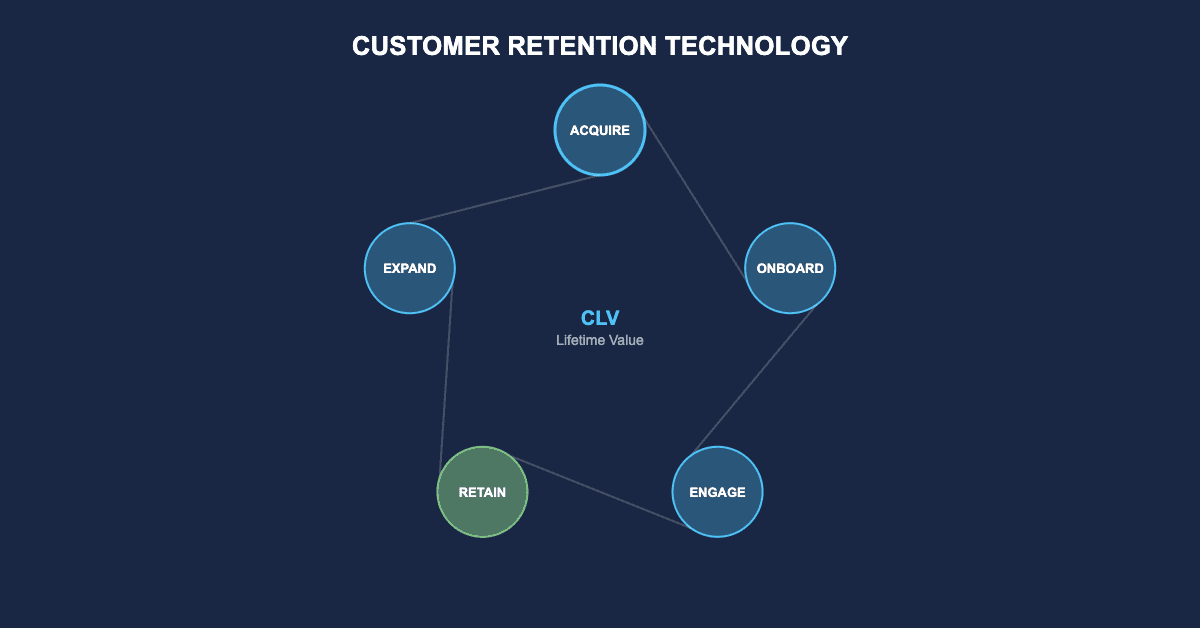
Effective retention strategies vary across the customer lifecycle. Onboarding represents a significant opportunity, as customers who engage successfully at the outset exhibit higher long-term retention rates. Platforms like Appcues, Pendo, and WalkMe assist new customers in reaching activation milestones while tracking their progress against benchmarks.
Mid-lifecycle retention efforts focus on enhancing engagement and expanding customer relationships. Cross-sell and upsell engines powered by recommendation algorithms pinpoint products and features likely to increase customer value. Additionally, email marketing automation tools deliver personalised content to educate customers about unused features and celebrate milestones.
Community building has emerged as a powerful retention strategy, with research from CMX showing that brands fostering active customer communities experience retention rates 18 to 25 percent higher than those that do not. Platforms like Khoros, Discourse, and Circle enable brands to create community experiences that strengthen customer relationships while gathering valuable data on preferences.
For customers showing signs of disengagement, late-lifecycle retention strategies involve personalised re-engagement emails or in-app messages highlighting recent improvements. If disengagement persists, more aggressive tactics, such as exclusive discounts or direct outreach from customer success managers, can address specific concerns.
Measurement and Future Trends
Measuring retention extends beyond simple churn rates to encompass a comprehensive set of metrics. Net revenue retention, which factors in expansions and contractions within the existing customer base, has become the gold standard for subscription businesses. Customer health scores that amalgamate multiple behavioural indicators provide early warning signals, allowing proactive intervention before customers disengage.
A/B testing of retention interventions offers empirical evidence for optimising retention programmes. Testing various offer types and messaging approaches against controlled groups helps identify which strategies genuinely reduce churn rather than merely accelerating discounts for customers likely to remain.
As retention technology evolves, the integration of artificial intelligence is expected to drive further advancements. AI-driven autonomous systems will continuously monitor customer health, predict churn with greater accuracy, and generate personalised intervention strategies. This shift will enable organisations to create tailored communications addressing individual customer concerns, rather than relying on broad segment-level templates.
Companies that invest in comprehensive retention technology stacks will build the necessary infrastructure to sustain competitive advantage in an environment where acquisition costs continue to rise. In this landscape, developing a loyal and expanding customer base is crucial for generating long-term returns.

Moyes Faces Referee Controversy Ahead of Everton vs Chelsea Clash

Man Hospitalised After Assault Outside Shop in Sandwell

Fred MacAulay and Ally McCoist Reunite for Special World Cup Show

NoOnes Targets $1 Trillion Gift Card Market to Enhance Crypto Access

Beloved Actor Matt Clark Passes Away at 89, Fans Mourn Loss

Discover How Milk Thistle Supplements Enhance Liver Health

Irish Community Care Celebrates 60 Years of Support in Liverpool

New Affordable Housing Development Planned for Crawley Site

Millions of Parking Tickets Issued Amid Calls for Reform

Claire Tomlinson Bids Farewell to Sky Sports After 27 Years

Iconic 90s TV Show House Hits Market for £1.1 Million

Tributes Flow for Kerry Gentle, Beloved RNLI Volunteer and Artist

Nathan Cleary’s Family Celebrates Engagement Amid Romance Rumors

Milk Bank Urges Mothers to Donate for Premature Babies’ Health

Shoppers Flock to Discounted Neck Pillow on Amazon for Travel Comfort

Alessia Russo Signs Long-Term Deal with Arsenal Ahead of WSL Season

Nuneaton Town FC Advances Plans for New Stadium in Stockingford

Museums Body Critiques EHRC Proposals on Gender Facilities
-
 Lifestyle6 months ago
Claire Tomlinson Bids Farewell to Sky Sports After 27 Years
-
 Entertainment9 months ago
Iconic 90s TV Show House Hits Market for £1.1 Million
-
 Lifestyle6 months ago
Tributes Flow for Kerry Gentle, Beloved RNLI Volunteer and Artist
-
 Sports11 months ago
Nathan Cleary’s Family Celebrates Engagement Amid Romance Rumors
-
 Lifestyle11 months ago
Milk Bank Urges Mothers to Donate for Premature Babies’ Health
-
 Lifestyle11 months ago
Shoppers Flock to Discounted Neck Pillow on Amazon for Travel Comfort
-
 Sports10 months ago
Alessia Russo Signs Long-Term Deal with Arsenal Ahead of WSL Season
-
 Sports8 months ago
Nuneaton Town FC Advances Plans for New Stadium in Stockingford
-
 Politics11 months ago
Museums Body Critiques EHRC Proposals on Gender Facilities
-

 Lifestyle11 months ago
Exploring England’s Cathedrals: A Journey Through History and Architecture
-

 Business11 months ago
Trump Visits Europe: Business, Politics, or Leisure?
-

 Lifestyle11 months ago
Japanese Teen Sorato Shimizu Breaks U18 100m Record in 10 Seconds