
Science
Astronomers Confirm 3I/ATLAS Is Not Returning to Earth

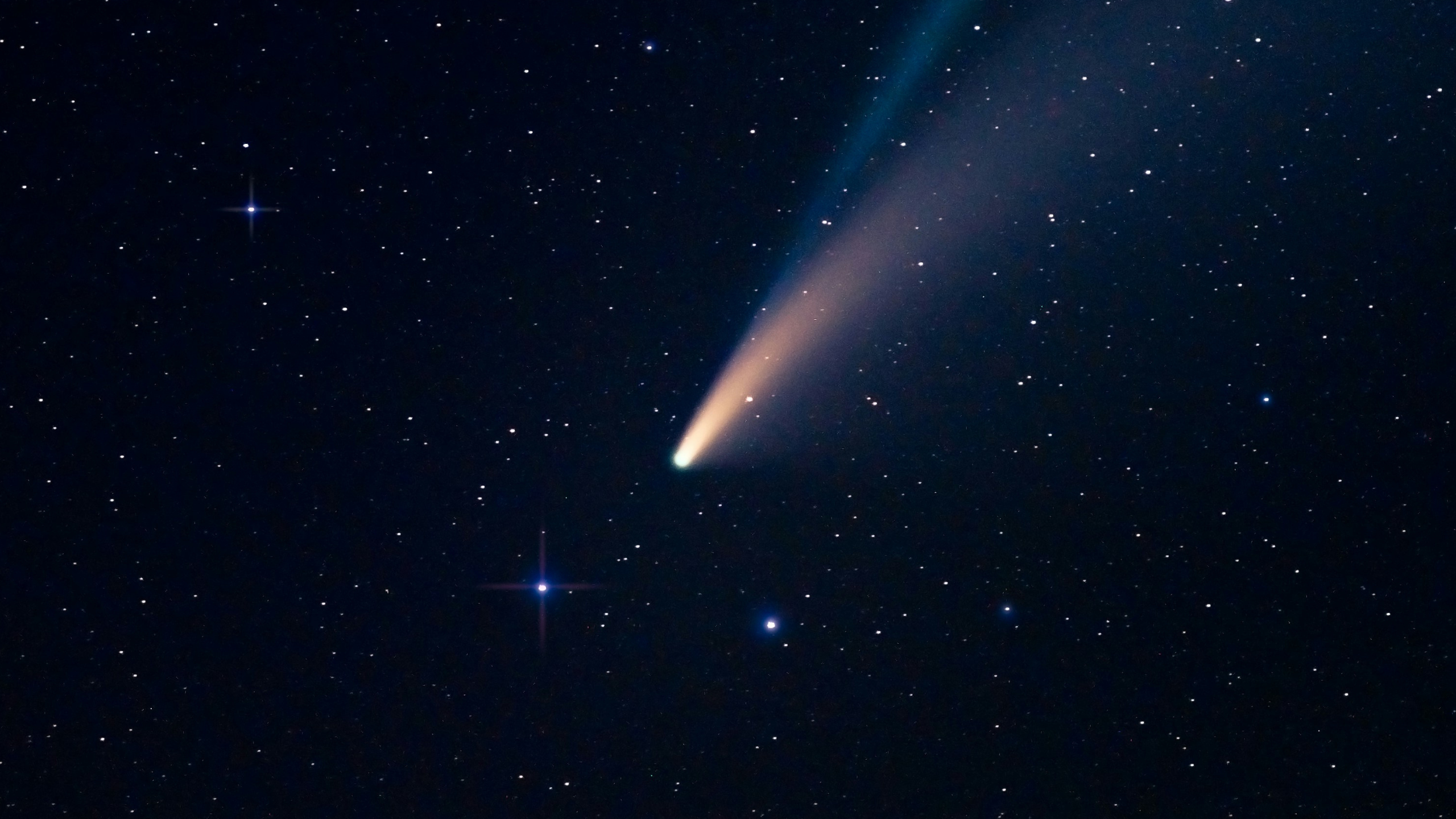
A rare interstellar object known as 3I/ATLAS has sparked both scientific interest and public concern due to conflicting claims about its path. Confirmed as the third known interstellar body to traverse our solar system, following ‘Oumuamua and 2I/Borisov, 3I/ATLAS has a hyperbolic trajectory, indicating that it originated from outside the solar system and will soon depart, never to return. There is no credible scientific evidence supporting the notion that it is on a collision course with Earth.
Identified on July 1, 2025, by the Asteroid Terrestrial-impact Last Alert System (ATLAS) and tracked by various observatories, including NASA, 3I/ATLAS demonstrates characteristics typical of interstellar objects. Its hyperbolic orbit confirms that it is not gravitationally bound to the Sun. Observations from NASA’s fleet of spacecraft, including the Hubble Space Telescope, James Webb Space Telescope, and others, have captured images of 3I/ATLAS as it travels through the inner solar system.
These images reveal a comet-like coma and tail composed primarily of gas and dust, consistent with icy bodies heated by the Sun. Importantly, scientists emphasize that 3I/ATLAS poses no threat to Earth. Its closest approach occurred on December 19, 2025, at a distance of approximately 1.8 astronomical units (AU), or about 170 million miles (270 million kilometers)—well outside Earth’s orbit.
Speculative theories about 3I/ATLAS have gained traction online, suggesting that the object might swing around Jupiter before heading back towards Earth. While these ideas are based on limited observations, they have attracted significant attention. High-resolution studies conducted by the James Webb Space Telescope indicate a coma dominated by carbon dioxide (CO2) alongside traces of water and carbon monoxide, revealing a unique chemical composition typical of primitive comets.
Polarimetric studies from ground-based telescopes have shown features not usually observed in Solar System comets, hinting at unusual surface textures. However, there is no evidence suggesting that 3I/ATLAS is exhibiting controlled or intelligent behavior. Despite the weight of scientific evidence, some narratives circulating online allege that 3I/ATLAS could represent alien technology or a hidden threat to Earth.
One prominent voice in this discourse is Avi Loeb, a Harvard astrophysicist, who has speculated about anomalies in the object’s behavior and suggested that NASA has withheld certain images from the public. He cited a specific image taken by the Mars Reconnaissance Orbiter in early October 2025 that was not publicly released despite requests. Nonetheless, these claims lack corroboration from primary scientific sources.
Experts in planetary science, along with statements from NASA, maintain that the trajectory and physical characteristics of 3I/ATLAS align with natural comet behavior, albeit with some unusual features. Other theories circulating on social media, including claims of pulsing signals and engineered structures, are unsupported by any verifiable measurements or peer-reviewed research.
Objects like 3I/ATLAS are exceedingly rare, and their observation invites both scientific fascination and imaginative speculation. As discussions proliferate on online forums, many users report perceived brightness changes or unusual visual features, but these accounts lack scientific context. Astronomers caution that variations in brightness can result from normal rotational and viewing geometry effects.
While some models suggest a small chance of 3I/ATLAS bending back toward Earth after swinging past Jupiter, this scenario remains speculative and not supported by substantial data.
Interstellar comets like 3I/ATLAS provide insights into the formation environments of other star systems.
The detailed spectroscopic and photometric data gathered will enhance our understanding of planetary system evolution and dust composition beyond our solar system.
Instead of posing an imminent threat, 3I/ATLAS represents an exceptional opportunity for scientific study, offering pristine materials shaped in a distant stellar nursery. As it continues its journey, 3I/ATLAS will exit the solar system, never to return.

Moyes Faces Referee Controversy Ahead of Everton vs Chelsea Clash

Man Hospitalised After Assault Outside Shop in Sandwell

Fred MacAulay and Ally McCoist Reunite for Special World Cup Show

NoOnes Targets $1 Trillion Gift Card Market to Enhance Crypto Access

Beloved Actor Matt Clark Passes Away at 89, Fans Mourn Loss

Discover How Milk Thistle Supplements Enhance Liver Health

Irish Community Care Celebrates 60 Years of Support in Liverpool

New Affordable Housing Development Planned for Crawley Site

Millions of Parking Tickets Issued Amid Calls for Reform

Claire Tomlinson Bids Farewell to Sky Sports After 27 Years

Iconic 90s TV Show House Hits Market for £1.1 Million

Nathan Cleary’s Family Celebrates Engagement Amid Romance Rumors

Tributes Flow for Kerry Gentle, Beloved RNLI Volunteer and Artist

Milk Bank Urges Mothers to Donate for Premature Babies’ Health

Shoppers Flock to Discounted Neck Pillow on Amazon for Travel Comfort

Alessia Russo Signs Long-Term Deal with Arsenal Ahead of WSL Season

Nuneaton Town FC Advances Plans for New Stadium in Stockingford

Exploring England’s Cathedrals: A Journey Through History and Architecture
-
 Lifestyle8 months ago
Claire Tomlinson Bids Farewell to Sky Sports After 27 Years
-
 Entertainment11 months ago
Iconic 90s TV Show House Hits Market for £1.1 Million
-
 Sports1 year ago
Nathan Cleary’s Family Celebrates Engagement Amid Romance Rumors
-
 Lifestyle8 months ago
Tributes Flow for Kerry Gentle, Beloved RNLI Volunteer and Artist
-
 Lifestyle1 year ago
Milk Bank Urges Mothers to Donate for Premature Babies’ Health
-
 Lifestyle1 year ago
Shoppers Flock to Discounted Neck Pillow on Amazon for Travel Comfort
-
 Sports12 months ago
Alessia Russo Signs Long-Term Deal with Arsenal Ahead of WSL Season
-
 Sports9 months ago
Nuneaton Town FC Advances Plans for New Stadium in Stockingford
-
 Lifestyle1 year ago
Exploring England’s Cathedrals: A Journey Through History and Architecture
-

 Politics1 year ago
Museums Body Critiques EHRC Proposals on Gender Facilities
-

 Business1 year ago
Trump Visits Europe: Business, Politics, or Leisure?
-

 Lifestyle1 year ago
Japanese Teen Sorato Shimizu Breaks U18 100m Record in 10 Seconds