
Science
Astronomers Puzzle Over 3I/ATLAS Jet Pointing Towards the Sun

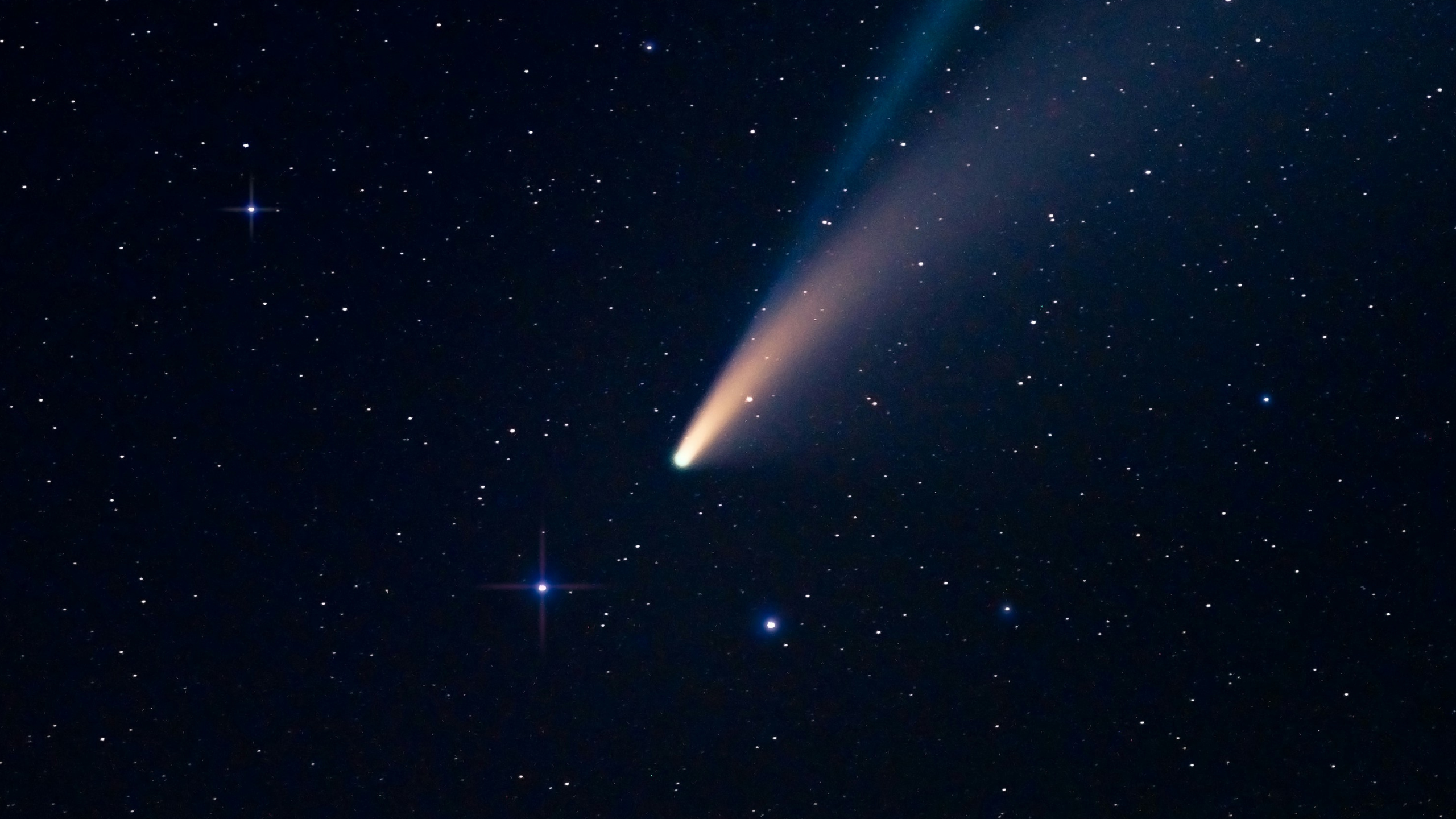
The interstellar object 3I/ATLAS has sparked considerable interest among astronomers since its discovery by the ATLAS telescope in July 2025 in Chile. Measuring an estimated 20-40 kilometers in diameter, 3I/ATLAS is on a hyperbolic trajectory, hurtling through space at over 50 kilometers per second. This velocity confirms its origin from outside the solar system, marking it as the third known interstellar object, following 1I/’Oumuamua in 2017 and 2I/Borisov in 2019. However, what sets 3I/ATLAS apart from its predecessors is a perplexing phenomenon—a jet directed toward the Sun.
Unusual Jet Sparks Scientific Debate
Comets typically exhibit tails that extend away from the Sun, propelled by solar radiation and solar wind. Yet, observations of 3I/ATLAS reveal a small jet oriented towards the Sun, with its nucleus located approximately 6,000 kilometers from the jet’s source. Avi Loeb, an astrophysicist from Harvard University, has raised questions about this behavior, suggesting it contradicts established cometary physics. In his analysis, Loeb noted that if 3I/ATLAS were a standard comet, the jet’s antitail could not produce gas streaming beyond 5,000 kilometers.
The scientific community remains divided on the implications of this anomaly. Some researchers propose that the jet’s peculiar behavior could result from unusual outgassing patterns, possibly linked to the object’s unique composition. This has led to speculation that the orientation and strength of the jet might indicate new processes occurring in interstellar comets, which have yet to be fully understood.
Loeb has documented eight distinct anomalies related to 3I/ATLAS, including the jet itself, its trajectory, and its spectral signatures. Despite his findings, many mainstream astronomers advocate caution, emphasizing the need for further data before reaching definitive conclusions.
New Insights from Observations
Images captured by the Two-Meter Twin Telescope in the Canary Islands in August 2025 clearly depict the jet extending towards the Sun. A composite analysis of 159 images illustrated a purple jet, contrasting with the expected yellow line indicating a conventional comet tail. Additional information from the European Space Agency’s XMM-Newton spacecraft revealed the emission of low-energy X-rays as gases from 3I/ATLAS interact with the solar wind. This observation supports the notion that the object is actively outgassing, albeit in a manner that current models do not fully explain.
The anomalies associated with 3I/ATLAS highlight the difficulties scientists face when studying interstellar objects. Each encounter represents a rare opportunity to test hypotheses regarding planetary system formation and the behavior of bodies in the icy regions of outer space. The sunward jet, in particular, raises significant questions about the composition and internal structure of 3I/ATLAS. If the jet is driven by substances atypical for solar system comets, it may provide insights into the diversity of interstellar matter. Conversely, if the jet’s direction results from rotational dynamics or other forces, it could enhance our understanding of cometary physics.
While some have speculated about a non-natural origin for 3I/ATLAS, the prevailing scientific stance remains skeptical. Astronomers stress that unusual behavior does not necessarily signal extraordinary explanations. Instead, they advocate for the accumulation of more data as 3I/ATLAS approaches its perihelion and moves further from the solar system. Loeb himself acknowledges that, as a comet, the jet and antitail of 3I/ATLAS should not produce gas streaming beyond 5,000 kilometers. This reinforces the importance of comparing traditional models with emerging evidence rather than hastily drawing conclusions.
The case of 3I/ATLAS illustrates that interstellar visitors can challenge existing astronomical frameworks. Its sunward jet presents an apparent anomaly that could clarify its true nature, whether as a comet with unique traits or as part of a broader set of interstellar objects that remain inadequately understood. Currently, the scientific community continues to observe and study 3I/ATLAS, recognizing that each interstellar encounter enhances our understanding of the cosmos.

Moyes Faces Referee Controversy Ahead of Everton vs Chelsea Clash

Man Hospitalised After Assault Outside Shop in Sandwell

Fred MacAulay and Ally McCoist Reunite for Special World Cup Show

NoOnes Targets $1 Trillion Gift Card Market to Enhance Crypto Access

Beloved Actor Matt Clark Passes Away at 89, Fans Mourn Loss

Discover How Milk Thistle Supplements Enhance Liver Health

Irish Community Care Celebrates 60 Years of Support in Liverpool

New Affordable Housing Development Planned for Crawley Site

Millions of Parking Tickets Issued Amid Calls for Reform

Claire Tomlinson Bids Farewell to Sky Sports After 27 Years

Iconic 90s TV Show House Hits Market for £1.1 Million

Nathan Cleary’s Family Celebrates Engagement Amid Romance Rumors

Tributes Flow for Kerry Gentle, Beloved RNLI Volunteer and Artist

Milk Bank Urges Mothers to Donate for Premature Babies’ Health

Shoppers Flock to Discounted Neck Pillow on Amazon for Travel Comfort

Alessia Russo Signs Long-Term Deal with Arsenal Ahead of WSL Season

Nuneaton Town FC Advances Plans for New Stadium in Stockingford

Exploring England’s Cathedrals: A Journey Through History and Architecture
-
 Lifestyle8 months ago
Claire Tomlinson Bids Farewell to Sky Sports After 27 Years
-
 Entertainment11 months ago
Iconic 90s TV Show House Hits Market for £1.1 Million
-
 Sports1 year ago
Nathan Cleary’s Family Celebrates Engagement Amid Romance Rumors
-
 Lifestyle8 months ago
Tributes Flow for Kerry Gentle, Beloved RNLI Volunteer and Artist
-
 Lifestyle1 year ago
Milk Bank Urges Mothers to Donate for Premature Babies’ Health
-
 Lifestyle1 year ago
Shoppers Flock to Discounted Neck Pillow on Amazon for Travel Comfort
-
 Sports12 months ago
Alessia Russo Signs Long-Term Deal with Arsenal Ahead of WSL Season
-
 Sports9 months ago
Nuneaton Town FC Advances Plans for New Stadium in Stockingford
-
 Lifestyle1 year ago
Exploring England’s Cathedrals: A Journey Through History and Architecture
-

 Politics1 year ago
Museums Body Critiques EHRC Proposals on Gender Facilities
-

 Business1 year ago
Trump Visits Europe: Business, Politics, or Leisure?
-

 Lifestyle1 year ago
Japanese Teen Sorato Shimizu Breaks U18 100m Record in 10 Seconds