
Science
Comet 3I/ATLAS Reveals Secrets of Distant Star Systems

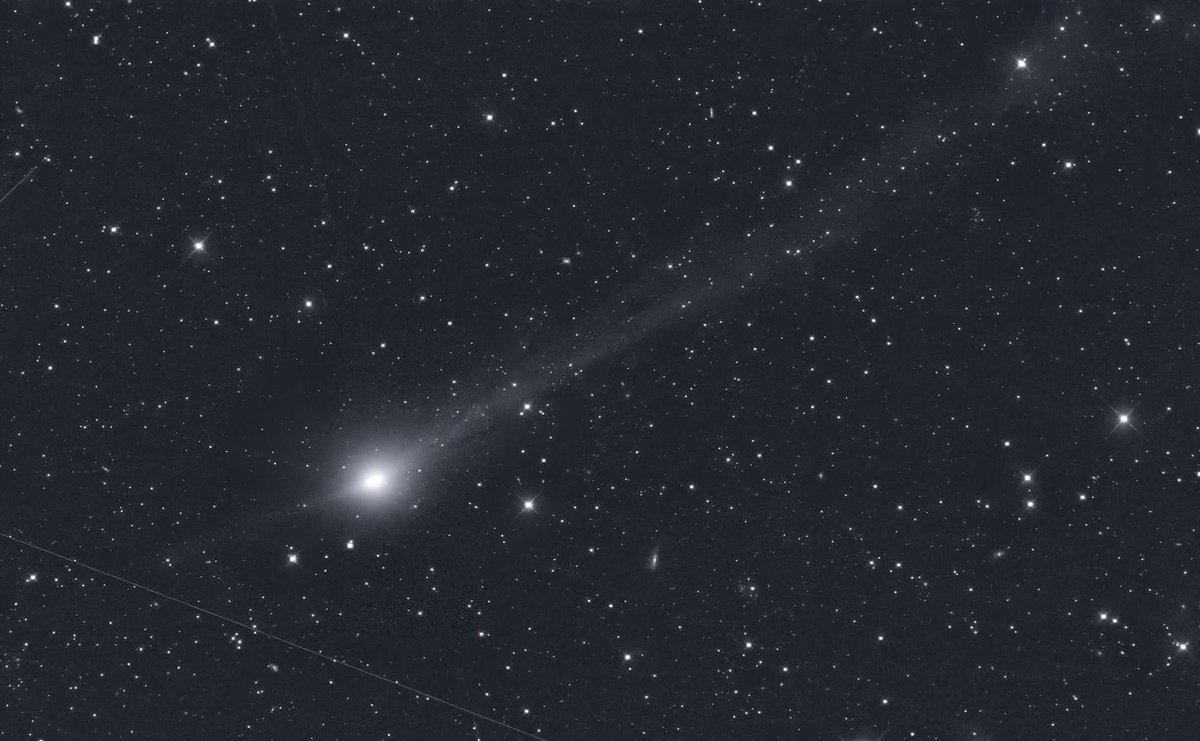
A remarkable interstellar visitor, Comet 3I/ATLAS, has unveiled new insights into the chemical composition of celestial bodies beyond our solar system. After its closest approach to Earth, this comet has provided scientists with a unique opportunity to study its CO2-rich coma, offering clues about the material formed around distant stars. Discovered by NASA’s ATLAS survey telescope in Chile, 3I/ATLAS is only the third confirmed interstellar object to enter our solar system.
The comet’s hyperbolic trajectory, reaching speeds of over 57 km/s, ensures that it will not remain bound to the Sun, making this a fleeting opportunity for research. The most significant findings emerged from infrared observations made by the James Webb Space Telescope (JWST), which detected a distinct CO2 signature. This suggests that 3I/ATLAS has a composition markedly different from typical solar-system comets, which are usually rich in water. Instead, the higher presence of carbon dioxide indicates a diversity of chemical environments in other planetary systems.
New Insights from Advanced Observations
The CO2-rich coma of Comet 3I/ATLAS serves as a rare sample of extrasolar material. By analysing its chemical fingerprint, astronomers can infer conditions in the comet’s original star system. Such insights could refine models of planetary formation, particularly regarding the distribution of volatile compounds that are essential for the emergence of life.
NASA’s Europa Clipper mission contributed additional data, capturing a unique ultraviolet perspective of 3I/ATLAS using its Ultraviolet Spectrograph (Europa-UVS). Observations were conducted when Earth and Mars had limited visibility of the comet. According to ScienceDaily, the Europa-UVS can “detect fundamental transitions that show gas release and molecular breakup.” This capability allowed scientists to observe gases escaping from the comet, including the breakdown of water molecules into hydrogen and oxygen atoms.
These ultraviolet measurements also enabled researchers to map the comet’s dust and plasma tails from a novel angle, revealing outgassing patterns shortly after its perihelion. The data helped determine the speed and density of the gases released, which appear to interact significantly with solar radiation.
The European Space Agency’s JUICE mission, equipped with complementary ultraviolet capabilities, is expected to aid in reconstructing the comet’s tail structure in three dimensions. This will enhance understanding of its activity and provide further clues about the forces shaping interstellar comets.
Challenges of Observation and International Collaboration
Observing 3I/ATLAS from Earth posed significant challenges, especially as the comet approached the Sun. The Parker Solar Probe stepped in to fill the observational gap, capturing daily images from October 18 to November 5, 2025. Using its WISPR camera, the probe navigated the intense solar glare to track the comet’s tail and dust emissions. NASA remarked that these images provide a critical time series during a period when ground-based tracking was not feasible.
The close proximity to the Sun required intricate spacecraft maneuvers and sophisticated image processing to filter out coronal brightness. The resulting data illustrate how the comet’s dust and gas interact with solar wind, providing researchers with a rare glimpse into processes that may be common in other star systems but are seldom observable in real time.
X-ray observatories also contributed to the study of 3I/ATLAS. The XMM-Newton satellite from ESA observed the comet on December 3, 2025, followed by Japan’s XRISM mission, which conducted observations from November 26 to 28, 2025. These observations revealed X-ray emissions extending hundreds of thousands of kilometers from the nucleus, indicating interactions between solar-wind ions and neutral gases in the comet’s coma.
For amateur astronomers, 3I/ATLAS remains a challenging target, with an estimated magnitude of 12.8 and currently located near the constellation Leo. Although faint, the comet continues to present valuable scientific opportunities. Its passage underscores the importance of international collaboration in space exploration, as data from multiple spacecraft and observatories are combined to create a comprehensive understanding of this intriguing interstellar visitor.

Moyes Faces Referee Controversy Ahead of Everton vs Chelsea Clash

Man Hospitalised After Assault Outside Shop in Sandwell

Fred MacAulay and Ally McCoist Reunite for Special World Cup Show

NoOnes Targets $1 Trillion Gift Card Market to Enhance Crypto Access

Beloved Actor Matt Clark Passes Away at 89, Fans Mourn Loss

Discover How Milk Thistle Supplements Enhance Liver Health

Irish Community Care Celebrates 60 Years of Support in Liverpool

New Affordable Housing Development Planned for Crawley Site

Millions of Parking Tickets Issued Amid Calls for Reform

Claire Tomlinson Bids Farewell to Sky Sports After 27 Years

Iconic 90s TV Show House Hits Market for £1.1 Million

Nathan Cleary’s Family Celebrates Engagement Amid Romance Rumors

Tributes Flow for Kerry Gentle, Beloved RNLI Volunteer and Artist

Milk Bank Urges Mothers to Donate for Premature Babies’ Health

Shoppers Flock to Discounted Neck Pillow on Amazon for Travel Comfort

Alessia Russo Signs Long-Term Deal with Arsenal Ahead of WSL Season

Nuneaton Town FC Advances Plans for New Stadium in Stockingford

Exploring England’s Cathedrals: A Journey Through History and Architecture
-
 Lifestyle8 months ago
Claire Tomlinson Bids Farewell to Sky Sports After 27 Years
-
 Entertainment11 months ago
Iconic 90s TV Show House Hits Market for £1.1 Million
-
 Sports1 year ago
Nathan Cleary’s Family Celebrates Engagement Amid Romance Rumors
-
 Lifestyle8 months ago
Tributes Flow for Kerry Gentle, Beloved RNLI Volunteer and Artist
-
 Lifestyle1 year ago
Milk Bank Urges Mothers to Donate for Premature Babies’ Health
-
 Lifestyle1 year ago
Shoppers Flock to Discounted Neck Pillow on Amazon for Travel Comfort
-
 Sports12 months ago
Alessia Russo Signs Long-Term Deal with Arsenal Ahead of WSL Season
-
 Sports9 months ago
Nuneaton Town FC Advances Plans for New Stadium in Stockingford
-
 Lifestyle1 year ago
Exploring England’s Cathedrals: A Journey Through History and Architecture
-

 Politics1 year ago
Museums Body Critiques EHRC Proposals on Gender Facilities
-

 Business1 year ago
Trump Visits Europe: Business, Politics, or Leisure?
-

 Lifestyle1 year ago
Japanese Teen Sorato Shimizu Breaks U18 100m Record in 10 Seconds