
Science
ESA’s Juice Unveils Fascinating Insights on Comet 3I/ATLAS

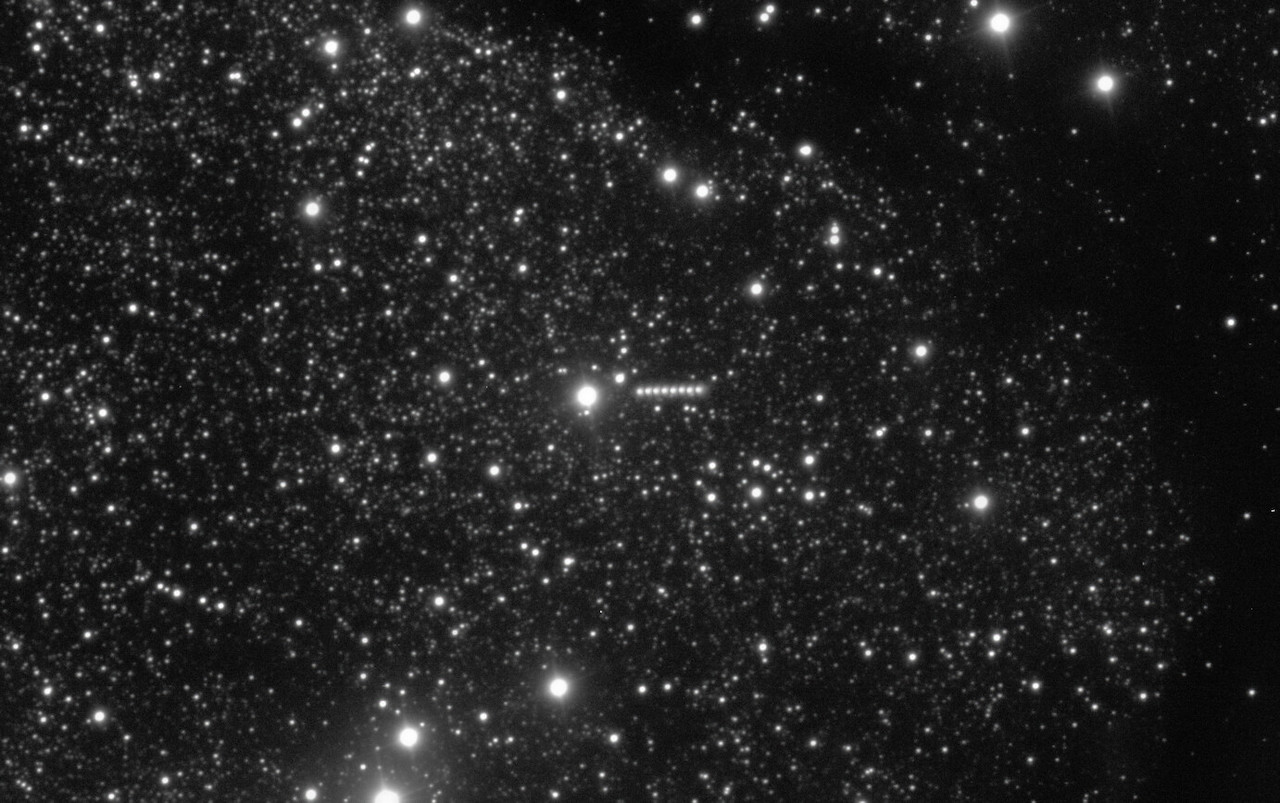
A rare astronomical event has unfolded, as the European Space Agency’s (ESA) Jupiter Icy Moons Explorer (Juice) encountered the interstellar comet 3I/ATLAS during its journey through the Solar System. This unexpected interaction has provided scientists with their first close-up observation of a highly active celestial body originating from beyond our stellar neighborhood.
Juice, launched in 2023, is on a lengthy eight-year mission to study Jupiter and its icy moons, such as Ganymede and Europa. The spacecraft’s encounter with 3I/ATLAS, first identified by the ATLAS (Asteroid Terrestrial-impact Last Alert System) telescope network on July 1, 2025, marked a unique opportunity for bonus scientific exploration.
Comet 3I/ATLAS is only the third interstellar object ever discovered, and astronomers are eager to uncover its composition and origins. The object’s interstellar status was confirmed by its high orbital eccentricity, estimated at approximately 6.139, indicating that it is not bound to the Sun and has traveled from another star system.
During a critical observation period in November 2025, Juice utilized five scientific instruments—including JANUS, MAJIS, UVS, SWI, and PEP—to gather data on the comet’s behavior and material composition. Notably, the spacecraft observed the comet’s closest approach on November 4, at a distance of around 66 million kilometers. This moment followed the comet’s perihelion, or closest point to the Sun, which occurred on October 29, 2025.
The Juice team made an unconventional decision to download a small portion of an image from the spacecraft’s Navigation Camera (NavCam). This initial low-resolution image provided a glimpse of the comet’s active state. It clearly showed the comet’s coma—a glowing halo of gas—and distinct features, including a plasma tail and a fainter dust tail.
The visibility of these features confirmed scientists’ predictions that they had captured the comet during a peak outgassing phase. According to the Juice team, the comet was “surrounded by signs of activity,” which heightened excitement for further analysis.
The delay in receiving comprehensive data from the mission results from a tactical maneuver designed to protect the spacecraft. Juice is currently using its high-gain antenna as a heat shield against solar radiation, leaving only a smaller medium-gain antenna to transmit data back to Earth at a reduced rate. The full data set from the five scientific instruments is expected to be available on February 18 and 20, 2026.
Scientists anticipate that the detailed observations will reveal clearer signs of the comet’s activity. The data will include high-resolution optical images from JANUS, along with spectrometry data from MAJIS and UVS, composition data from SWI, and particle data from PEP. Collectively, these measurements aim to uncover the unique chemical makeup of this extraordinary interstellar wanderer.
The preliminary findings from the NavCam underscore the significance of the encounter with 3I/ATLAS, which is shedding material and exhibiting an active state far from its origin. This rare rendezvous represents a critical opportunity to explore the ancient chemistry of another star system and could enhance our understanding of planetary formation across the galaxy. As scientists await the upcoming data, the Juice mission promises to unlock secrets that have remained hidden until now.

Moyes Faces Referee Controversy Ahead of Everton vs Chelsea Clash

Man Hospitalised After Assault Outside Shop in Sandwell

Fred MacAulay and Ally McCoist Reunite for Special World Cup Show

NoOnes Targets $1 Trillion Gift Card Market to Enhance Crypto Access

Beloved Actor Matt Clark Passes Away at 89, Fans Mourn Loss

Discover How Milk Thistle Supplements Enhance Liver Health

Irish Community Care Celebrates 60 Years of Support in Liverpool

New Affordable Housing Development Planned for Crawley Site

Millions of Parking Tickets Issued Amid Calls for Reform

Claire Tomlinson Bids Farewell to Sky Sports After 27 Years

Iconic 90s TV Show House Hits Market for £1.1 Million

Nathan Cleary’s Family Celebrates Engagement Amid Romance Rumors

Tributes Flow for Kerry Gentle, Beloved RNLI Volunteer and Artist

Milk Bank Urges Mothers to Donate for Premature Babies’ Health

Shoppers Flock to Discounted Neck Pillow on Amazon for Travel Comfort

Alessia Russo Signs Long-Term Deal with Arsenal Ahead of WSL Season

Nuneaton Town FC Advances Plans for New Stadium in Stockingford

Exploring England’s Cathedrals: A Journey Through History and Architecture
-
 Lifestyle8 months ago
Claire Tomlinson Bids Farewell to Sky Sports After 27 Years
-
 Entertainment11 months ago
Iconic 90s TV Show House Hits Market for £1.1 Million
-
 Sports1 year ago
Nathan Cleary’s Family Celebrates Engagement Amid Romance Rumors
-
 Lifestyle8 months ago
Tributes Flow for Kerry Gentle, Beloved RNLI Volunteer and Artist
-
 Lifestyle1 year ago
Milk Bank Urges Mothers to Donate for Premature Babies’ Health
-
 Lifestyle1 year ago
Shoppers Flock to Discounted Neck Pillow on Amazon for Travel Comfort
-
 Sports12 months ago
Alessia Russo Signs Long-Term Deal with Arsenal Ahead of WSL Season
-
 Sports9 months ago
Nuneaton Town FC Advances Plans for New Stadium in Stockingford
-
 Lifestyle1 year ago
Exploring England’s Cathedrals: A Journey Through History and Architecture
-

 Politics1 year ago
Museums Body Critiques EHRC Proposals on Gender Facilities
-

 Business1 year ago
Trump Visits Europe: Business, Politics, or Leisure?
-

 Lifestyle1 year ago
Japanese Teen Sorato Shimizu Breaks U18 100m Record in 10 Seconds