
Science
Korean Mathematician Solves 60-Year-Old Moving Sofa Problem

A breakthrough in geometry has occurred as Dr. Baek Jin Eon, a mathematician from South Korea, solved the long-standing “moving sofa problem.” This mathematical challenge, which has puzzled researchers for nearly 60 years, addresses the question of the largest two-dimensional shape that can navigate a right-angled corridor of fixed width. Dr. Baek’s proof eliminates the possibility of any larger shape than the one proposed by mathematician Joseph Gerver in 1992.
Understanding the Moving Sofa Problem
The moving sofa problem, first posed in 1966, asks for the shape with the maximum area that can be transported through an L-shaped corridor of width one. Although the question seems simple to visualize, it has eluded definitive proof for decades. Gerver’s proposal, known as Gerver’s sofa, represented a complex curved shape that was thought to be optimal, yet no one had been able to establish that a larger shape could not exist—until now.
After seven years of rigorous research, Dr. Baek published his 119-page proof on the preprint server arXiv in late 2024. His findings assert that “no sofa wider than Gerver’s sofa can exist.” Uniquely, Dr. Baek achieved this milestone without relying on large-scale computer simulations, a method many previous researchers had employed.
A Journey of Discovery
Describing his extensive research process, Dr. Baek likened it to a cycle of hope and disappointment. “You keep holding on to hope, then breaking it, and moving forward by picking up ideas from the ashes,” he said. His approach reflects a deep commitment to logical reasoning, which ultimately led to the resolution of this geometric puzzle.
His work has garnered significant attention, earning a place in Scientific American’s “Top 10 Math Discoveries of 2025.” The magazine noted the surprising aspect of Dr. Baek’s solution: it does not depend on computers at all. His proof is currently undergoing peer review at the Annals of Mathematics, one of the field’s most esteemed journals, with high confidence in its validity among mathematical experts.
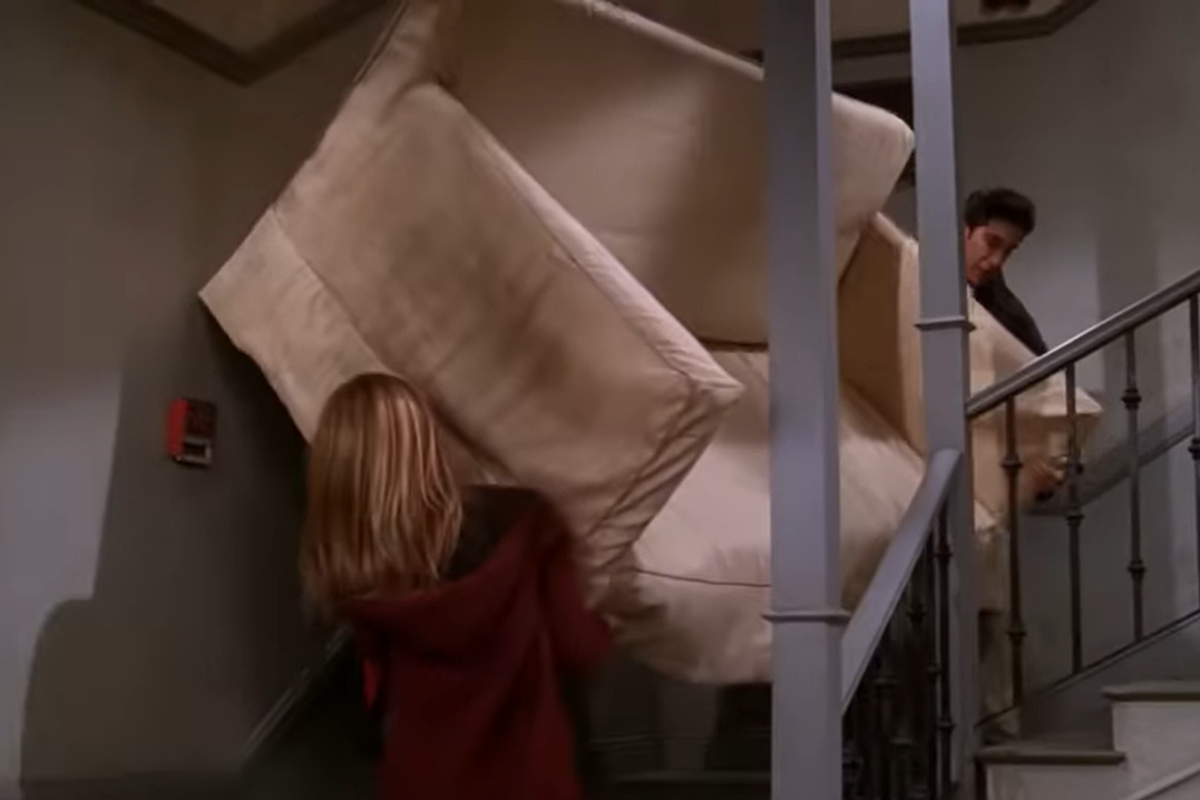
The moving sofa problem has become a cultural touchstone as well as an academic challenge, notably referenced in the popular US sitcom Friends, where characters famously struggle to maneuver a sofa up a staircase. Scientific American humorously remarked that explaining the “Pivot!” shouted by Ross Geller would require a lengthy paper, much like Dr. Baek’s extensive proof.
Dr. Baek began his exploration of the moving sofa problem during his mandatory military service as a research specialist. He continued his work during his doctoral studies in the United States and later as a postdoctoral researcher in South Korea. In recognition of his potential, he was selected last year for the June E. Huh Fellow programme, which supports promising mathematicians under the age of 39.
Currently, Dr. Baek is pursuing further research in optimization problems and challenges within combinatorial geometry. His successful resolution of the moving sofa problem marks a significant milestone in mathematical history and showcases the potential of human ingenuity in tackling complex problems.

Moyes Faces Referee Controversy Ahead of Everton vs Chelsea Clash

Man Hospitalised After Assault Outside Shop in Sandwell

Fred MacAulay and Ally McCoist Reunite for Special World Cup Show

NoOnes Targets $1 Trillion Gift Card Market to Enhance Crypto Access

Beloved Actor Matt Clark Passes Away at 89, Fans Mourn Loss

Discover How Milk Thistle Supplements Enhance Liver Health

Irish Community Care Celebrates 60 Years of Support in Liverpool

New Affordable Housing Development Planned for Crawley Site

Millions of Parking Tickets Issued Amid Calls for Reform

Claire Tomlinson Bids Farewell to Sky Sports After 27 Years

Iconic 90s TV Show House Hits Market for £1.1 Million

Nathan Cleary’s Family Celebrates Engagement Amid Romance Rumors

Tributes Flow for Kerry Gentle, Beloved RNLI Volunteer and Artist

Milk Bank Urges Mothers to Donate for Premature Babies’ Health

Shoppers Flock to Discounted Neck Pillow on Amazon for Travel Comfort

Alessia Russo Signs Long-Term Deal with Arsenal Ahead of WSL Season

Nuneaton Town FC Advances Plans for New Stadium in Stockingford

Exploring England’s Cathedrals: A Journey Through History and Architecture
-
 Lifestyle8 months ago
Claire Tomlinson Bids Farewell to Sky Sports After 27 Years
-
 Entertainment11 months ago
Iconic 90s TV Show House Hits Market for £1.1 Million
-
 Sports1 year ago
Nathan Cleary’s Family Celebrates Engagement Amid Romance Rumors
-
 Lifestyle8 months ago
Tributes Flow for Kerry Gentle, Beloved RNLI Volunteer and Artist
-
 Lifestyle1 year ago
Milk Bank Urges Mothers to Donate for Premature Babies’ Health
-
 Lifestyle1 year ago
Shoppers Flock to Discounted Neck Pillow on Amazon for Travel Comfort
-
 Sports12 months ago
Alessia Russo Signs Long-Term Deal with Arsenal Ahead of WSL Season
-
 Sports9 months ago
Nuneaton Town FC Advances Plans for New Stadium in Stockingford
-
 Lifestyle1 year ago
Exploring England’s Cathedrals: A Journey Through History and Architecture
-

 Politics1 year ago
Museums Body Critiques EHRC Proposals on Gender Facilities
-

 Business1 year ago
Trump Visits Europe: Business, Politics, or Leisure?
-

 Lifestyle1 year ago
Japanese Teen Sorato Shimizu Breaks U18 100m Record in 10 Seconds