
Science
Mysterious Comet 3I/ATLAS Approaches Jupiter, Sparks Debate

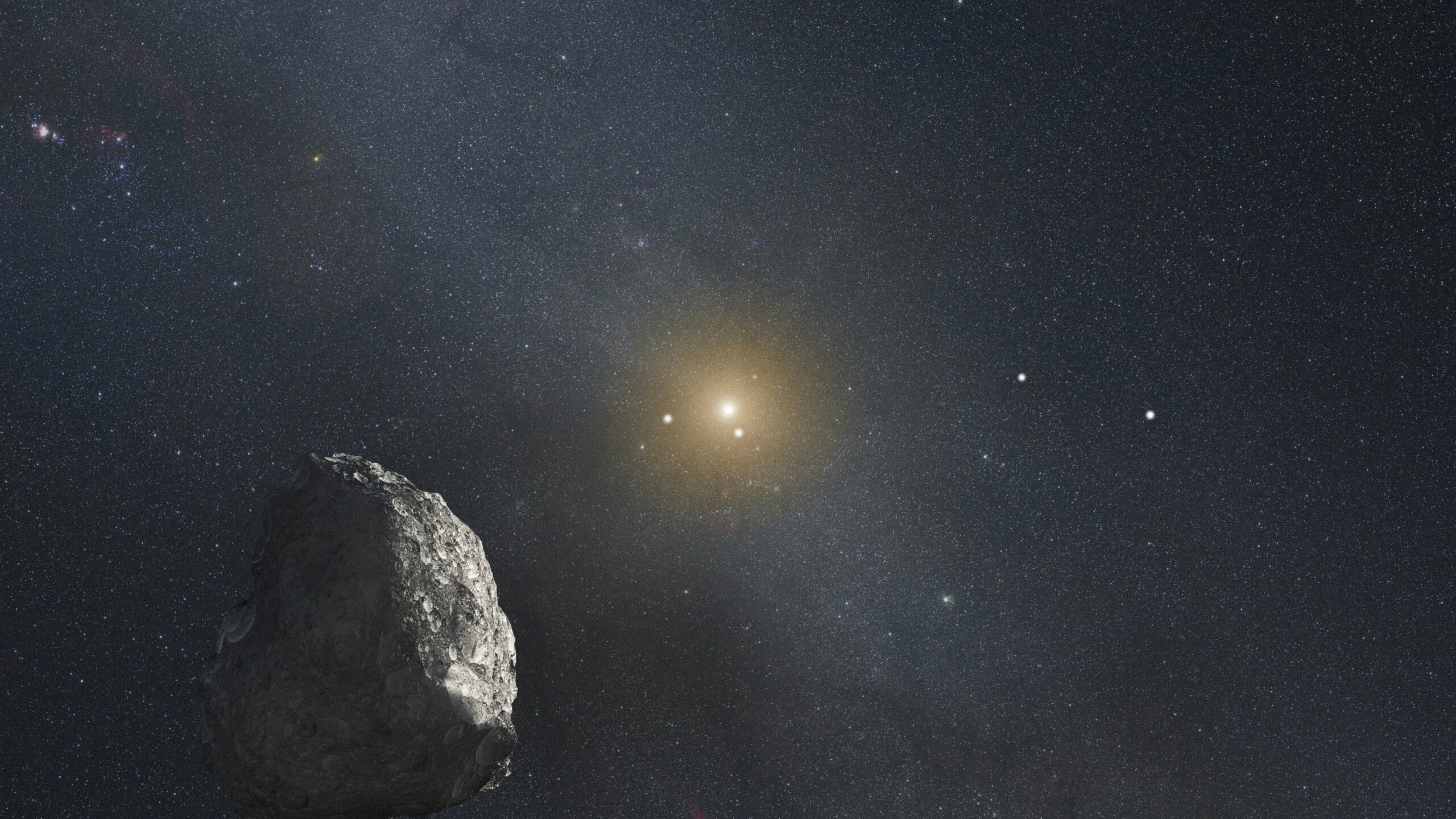
A remarkable interstellar visitor, designated 3I/ATLAS, is racing towards Jupiter, captivating scientists with its unconventional behavior. This object, which is only the third confirmed interstellar body detected, is generating significant discussion within the scientific community as it challenges established cometary physics. Observations from multiple space observatories have produced an extensive array of data, revealing complexities about its energy and composition that remain largely unexplained.
NASA officially classified 3I/ATLAS as a comet after its discovery by the Asteroid Terrestrial-impact Last Alert System (ATLAS) in Chile on July 1, 2025. The object’s hyperbolic trajectory confirms its origin beyond our solar system, sharing this characteristic with previous interstellar visitors, ‘Oumuamua and 2I/Borisov. Currently, 3I/ATLAS is travelling at extraordinary speeds, exceeding 130,000 miles (approximately 209,000 kilometres) per hour, as it approaches Jupiter’s orbit in spring 2026.
Unprecedented Observations and Unique Chemistry
Recent data from NASA’s heliophysics missions, including STEREO-A and SOHO, have captured visible-light images of 3I/ATLAS, countering initial assumptions that the comet would be too faint to observe. Additionally, angled observations from NASA’s Lucy spacecraft and the European Space Agency’s (ESA) JUICE probe have enhanced our understanding of the comet’s coma and tail across various wavelengths.
3I/ATLAS displays a distinctive chemical signature, exhibiting high levels of carbon dioxide and nickel, along with an unusual CO2 to water vapor ratio not typically seen in other comets. Infrared data collected by the James Webb Space Telescope indicates that the coma includes not only CO2 and water ice but also carbon monoxide and other volatile compounds. Ground-based telescopes have also detected emissions of nickel and cyanide gas, suggesting atypical formation conditions in its progenitor system.
Observations from July to September 2025 revealed wobbling jets emanating from the comet’s coma, indicative of non-uniform outgassing activity that may be related to its rotation or structural asymmetries. Researchers tracking these jet structures reported variations in direction and intensity, characteristics not commonly observed in solar system comets.
Scientific Implications and Ongoing Debate
While the prevailing evidence supports a natural origin for 3I/ATLAS, its unusual features have sparked discussions among scientists. NASA and leading astronomers assert that the object’s observed dynamics, composition, and trajectory align with established cometary physics, influenced by its proximity to the Sun.
In contrast, some prominent figures, such as Harvard astrophysicist Avi Loeb, have suggested alternative interpretations. Loeb has argued that specific alignments and brightness characteristics of 3I/ATLAS might be statistically improbable for a natural comet, warranting further investigation. His views delve into the classification of interstellar bodies and the potential implications if such objects display previously undocumented dynamics, although these alternative interpretations have not gained widespread acceptance within the peer-reviewed research community.
As 3I/ATLAS continues its outbound journey, it is expected to make its closest approach to Jupiter on March 16, 2026. This alignment presents a significant opportunity for both spacecraft and Earth-based telescopes to observe how an interstellar object interacts with Jupiter’s immense gravity and particle environment. Researchers are optimistic that instruments aboard NASA’s Juno spacecraft, alongside additional monitoring from observatories in Earth’s orbit, will shed light on the comet’s structure and behavior during this critical phase.
As 3I/ATLAS moves further into interstellar space, its legacy will not be defined solely by mystery, but also by the valuable data it contributes to our understanding of planetary formation and the composition of distant star systems. While officially classified as a comet, its passage through our solar system is poised to push the boundaries of scientific knowledge regarding interstellar visitors.

Moyes Faces Referee Controversy Ahead of Everton vs Chelsea Clash

Man Hospitalised After Assault Outside Shop in Sandwell

Fred MacAulay and Ally McCoist Reunite for Special World Cup Show

NoOnes Targets $1 Trillion Gift Card Market to Enhance Crypto Access

Beloved Actor Matt Clark Passes Away at 89, Fans Mourn Loss

Discover How Milk Thistle Supplements Enhance Liver Health

Irish Community Care Celebrates 60 Years of Support in Liverpool

New Affordable Housing Development Planned for Crawley Site

Millions of Parking Tickets Issued Amid Calls for Reform

Claire Tomlinson Bids Farewell to Sky Sports After 27 Years

Iconic 90s TV Show House Hits Market for £1.1 Million

Tributes Flow for Kerry Gentle, Beloved RNLI Volunteer and Artist

Nathan Cleary’s Family Celebrates Engagement Amid Romance Rumors

Milk Bank Urges Mothers to Donate for Premature Babies’ Health

Shoppers Flock to Discounted Neck Pillow on Amazon for Travel Comfort

Alessia Russo Signs Long-Term Deal with Arsenal Ahead of WSL Season

Nuneaton Town FC Advances Plans for New Stadium in Stockingford

Museums Body Critiques EHRC Proposals on Gender Facilities
-
 Lifestyle6 months ago
Claire Tomlinson Bids Farewell to Sky Sports After 27 Years
-
 Entertainment9 months ago
Iconic 90s TV Show House Hits Market for £1.1 Million
-
 Lifestyle6 months ago
Tributes Flow for Kerry Gentle, Beloved RNLI Volunteer and Artist
-
 Sports11 months ago
Nathan Cleary’s Family Celebrates Engagement Amid Romance Rumors
-
 Lifestyle11 months ago
Milk Bank Urges Mothers to Donate for Premature Babies’ Health
-
 Lifestyle11 months ago
Shoppers Flock to Discounted Neck Pillow on Amazon for Travel Comfort
-
 Sports10 months ago
Alessia Russo Signs Long-Term Deal with Arsenal Ahead of WSL Season
-
 Sports8 months ago
Nuneaton Town FC Advances Plans for New Stadium in Stockingford
-
 Politics11 months ago
Museums Body Critiques EHRC Proposals on Gender Facilities
-

 Lifestyle11 months ago
Exploring England’s Cathedrals: A Journey Through History and Architecture
-

 Business11 months ago
Trump Visits Europe: Business, Politics, or Leisure?
-

 Lifestyle11 months ago
Japanese Teen Sorato Shimizu Breaks U18 100m Record in 10 Seconds