
Science
New Sensor Revolutionizes Helium Leak Detection with Topological Material

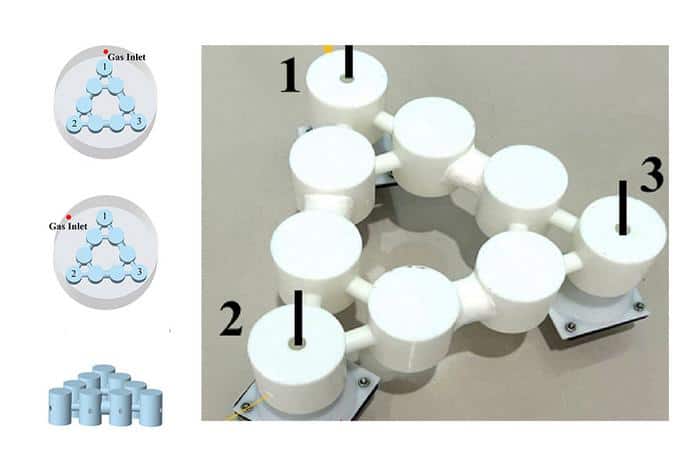
A team of acoustic scientists from Nanjing University in China has developed a groundbreaking sensor that detects helium leaks by analyzing sound wave propagation through topological materials. This innovative device offers a chemical-free solution to an issue faced across various industries, including aerospace, semiconductor manufacturing, and medical applications.
The new sensor operates effectively at extremely low temperatures, making it a significant advancement over traditional leak-detection methods. Conventional devices often rely on chemical reactions or are hindered by sensitivity to environmental conditions. In contrast, this sensor’s design allows it to remain stable and maintain accuracy in diverse settings.
The research, published in Applied Physics Letters, outlines how the sensor comprises nine cylinders arranged in three sub-triangles, connected by tubes that allow air to enter. This unique configuration forms a two-dimensional structure known as a “kagome” lattice, a type of topological material recognized for its ability to maintain stability in the presence of small defects.
To test the sensor, researchers placed speakers beneath the corners of the structure, emitting sound waves that cause the gas within to vibrate at a designated resonance frequency. When the air was replaced with helium, the speed of sound waves increased, resulting in a measurable shift in vibration frequency. This shift allows for precise calculations of helium concentrations within the device.
According to Li Fan, the lead researcher, the sensor’s effectiveness stems from its sensitivity to the gas’s properties, which directly affect the interface and corner states of the material. This presents several advantages over traditional gas sensors.
First, because it does not rely on chemical interactions, the sensor is perfectly suited for detecting inert gases like helium. Second, its robustness against external conditions enables it to function at low temperatures without compromising performance. Third, the sensor maintains a consistent sensitivity to helium, eliminating the need for frequent recalibration. Lastly, it quickly detects frequency changes and returns to baseline levels once helium concentrations decrease.
The sensor also offers a unique spatial sensing capability, identifying the direction of a gas leak. As helium fills the device, the corner closest to the source is impacted first, allowing each corner to serve as an independent sensing point, a feature that is often lacking in traditional detectors.
Helium leak detection is crucial in semiconductor manufacturing, where helium is used for cooling, and in medical imaging systems that operate at liquid helium temperatures. “We believe our work opens an avenue for inert gas detection using a simple device and demonstrates a practical application for two-dimensional acoustic topological materials,” Fan said.
While initially designed for helium detection, the researchers are optimistic that the same principles could be adapted for detecting other gases, such as hydrogen. Encouraged by their preliminary results, Fan and his team plan to extend their fabrication techniques to create three-dimensional acoustic topological structures.
These advancements could enable the orientation of corner points in three-dimensional space, enhancing the sensor’s capabilities. Ultimately, the goal is to develop a portable version of the system that can be deployed in real-world environments without the need for complex supporting equipment, making it more accessible for a variety of applications.

Moyes Faces Referee Controversy Ahead of Everton vs Chelsea Clash

Man Hospitalised After Assault Outside Shop in Sandwell

Fred MacAulay and Ally McCoist Reunite for Special World Cup Show

NoOnes Targets $1 Trillion Gift Card Market to Enhance Crypto Access

Beloved Actor Matt Clark Passes Away at 89, Fans Mourn Loss

Discover How Milk Thistle Supplements Enhance Liver Health

Irish Community Care Celebrates 60 Years of Support in Liverpool

New Affordable Housing Development Planned for Crawley Site

Millions of Parking Tickets Issued Amid Calls for Reform

Claire Tomlinson Bids Farewell to Sky Sports After 27 Years

Iconic 90s TV Show House Hits Market for £1.1 Million

Nathan Cleary’s Family Celebrates Engagement Amid Romance Rumors

Tributes Flow for Kerry Gentle, Beloved RNLI Volunteer and Artist

Milk Bank Urges Mothers to Donate for Premature Babies’ Health

Shoppers Flock to Discounted Neck Pillow on Amazon for Travel Comfort

Alessia Russo Signs Long-Term Deal with Arsenal Ahead of WSL Season

Nuneaton Town FC Advances Plans for New Stadium in Stockingford

Exploring England’s Cathedrals: A Journey Through History and Architecture
-
 Lifestyle8 months ago
Claire Tomlinson Bids Farewell to Sky Sports After 27 Years
-
 Entertainment11 months ago
Iconic 90s TV Show House Hits Market for £1.1 Million
-
 Sports1 year ago
Nathan Cleary’s Family Celebrates Engagement Amid Romance Rumors
-
 Lifestyle8 months ago
Tributes Flow for Kerry Gentle, Beloved RNLI Volunteer and Artist
-
 Lifestyle1 year ago
Milk Bank Urges Mothers to Donate for Premature Babies’ Health
-
 Lifestyle1 year ago
Shoppers Flock to Discounted Neck Pillow on Amazon for Travel Comfort
-
 Sports12 months ago
Alessia Russo Signs Long-Term Deal with Arsenal Ahead of WSL Season
-
 Sports9 months ago
Nuneaton Town FC Advances Plans for New Stadium in Stockingford
-
 Lifestyle1 year ago
Exploring England’s Cathedrals: A Journey Through History and Architecture
-

 Politics1 year ago
Museums Body Critiques EHRC Proposals on Gender Facilities
-

 Business1 year ago
Trump Visits Europe: Business, Politics, or Leisure?
-

 Lifestyle1 year ago
Japanese Teen Sorato Shimizu Breaks U18 100m Record in 10 Seconds