
Science
Scientists Discover Life’s Building Blocks on Asteroid Bennu

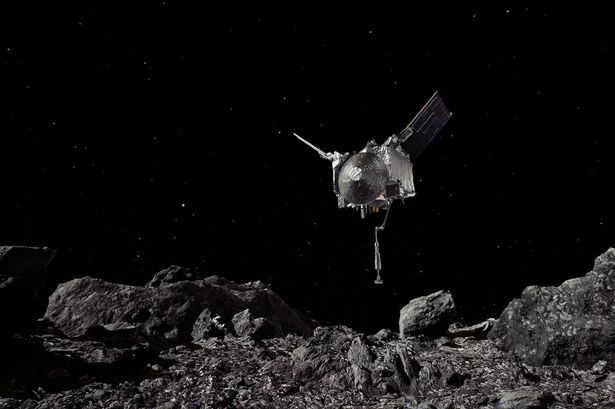
Recent discoveries from samples retrieved from the asteroid Bennu have revealed the presence of significant components believed to be essential for life. Scientists confirmed that these findings could alter our understanding of life’s origins in the universe. The samples, collected by a spacecraft that traveled 63 million kilometers (approximately 39 million miles) to reach Earth, included indicators of ancient water and a previously unknown substance described as “space gum.”
Groundbreaking Findings from Bennu’s Samples
In a detailed analysis, researchers from Tohoku University in Japan discovered sugars crucial for life within the rock. This marks the first instance where such sugars have been identified in an extraterrestrial sample. Notably, NASA scientists found a flexible, gum-like material on Bennu, a substance unlike anything previously observed in our solar system.
Space communications expert Alexandra Doten took to social media platform TikTok to explain the significance of these findings, stating, “They found some truly insane things.” She elaborated that the high carbon content and water present in the sample suggest the asteroid may contain the building blocks for life. Furthermore, Bennu is rich in nitrogen and organic compounds, along with serpentine minerals, which resemble rocks found in Earth’s mid-ocean ridges.
“Scientists think this asteroid is a chunk of an ancient water world that has been traveling through space for billions of years,” Doten noted, highlighting the potential implications for our understanding of life beyond Earth.
Implications for the Origins of Life
Among the notable discoveries, scientists identified 14 of the 20 amino acids that Earth-based life uses to form proteins. Additionally, all five nucleotide bases that make up DNA and RNA were detected on the asteroid. Recently, researchers also found sugars critical for biological processes, specifically ribose and glucose. Ribose is a key component of RNA, which suggests that Bennu may contain all necessary elements to form RNA.
Doten emphasized the significance of this finding, stating, “This has huge implications – it could imply that RNA is more prevalent in the universe and could be the dominant form of early life.”
A separate study published in the journal Natural Astronomy detailed the gum-like substance found on Bennu. Led by Scott Sandford at NASA’s Ames Research Center in California and Zack Gainsforth from the University of California, this research described the substance as pliable, akin to chewing gum or soft plastic. However, exposure to radiation caused it to become brittle, resembling a lawn chair left out in the sun for too long.
Furthermore, a third study from the same journal, led by Ann Nguyen from NASA’s Johnson Space Center in Houston, revealed an unexpectedly high amount of dust on Bennu, originating from supernova explosions that predate our solar system.
As scientists continue to analyze the samples from Bennu, the implications for understanding life on Earth and beyond are becoming increasingly profound. The discoveries not only provide insights into the building blocks of life but also raise intriguing questions about the existence of life elsewhere in the cosmos.

Moyes Faces Referee Controversy Ahead of Everton vs Chelsea Clash

Man Hospitalised After Assault Outside Shop in Sandwell

Fred MacAulay and Ally McCoist Reunite for Special World Cup Show

NoOnes Targets $1 Trillion Gift Card Market to Enhance Crypto Access

Beloved Actor Matt Clark Passes Away at 89, Fans Mourn Loss

Discover How Milk Thistle Supplements Enhance Liver Health

Irish Community Care Celebrates 60 Years of Support in Liverpool

New Affordable Housing Development Planned for Crawley Site

Millions of Parking Tickets Issued Amid Calls for Reform

Claire Tomlinson Bids Farewell to Sky Sports After 27 Years

Iconic 90s TV Show House Hits Market for £1.1 Million

Nathan Cleary’s Family Celebrates Engagement Amid Romance Rumors

Tributes Flow for Kerry Gentle, Beloved RNLI Volunteer and Artist

Milk Bank Urges Mothers to Donate for Premature Babies’ Health

Shoppers Flock to Discounted Neck Pillow on Amazon for Travel Comfort

Alessia Russo Signs Long-Term Deal with Arsenal Ahead of WSL Season

Nuneaton Town FC Advances Plans for New Stadium in Stockingford

Exploring England’s Cathedrals: A Journey Through History and Architecture
-
 Lifestyle8 months ago
Claire Tomlinson Bids Farewell to Sky Sports After 27 Years
-
 Entertainment11 months ago
Iconic 90s TV Show House Hits Market for £1.1 Million
-
 Sports1 year ago
Nathan Cleary’s Family Celebrates Engagement Amid Romance Rumors
-
 Lifestyle8 months ago
Tributes Flow for Kerry Gentle, Beloved RNLI Volunteer and Artist
-
 Lifestyle1 year ago
Milk Bank Urges Mothers to Donate for Premature Babies’ Health
-
 Lifestyle1 year ago
Shoppers Flock to Discounted Neck Pillow on Amazon for Travel Comfort
-
 Sports12 months ago
Alessia Russo Signs Long-Term Deal with Arsenal Ahead of WSL Season
-
 Sports9 months ago
Nuneaton Town FC Advances Plans for New Stadium in Stockingford
-
 Lifestyle1 year ago
Exploring England’s Cathedrals: A Journey Through History and Architecture
-

 Politics1 year ago
Museums Body Critiques EHRC Proposals on Gender Facilities
-

 Business1 year ago
Trump Visits Europe: Business, Politics, or Leisure?
-

 Lifestyle1 year ago
Japanese Teen Sorato Shimizu Breaks U18 100m Record in 10 Seconds