
Science
Webb Telescope Reveals Secrets of the Butterfly Nebula’s Glow

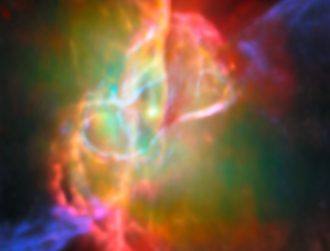
The James Webb Space Telescope has made significant strides in understanding the Butterfly Nebula, a stunning celestial object located approximately 3,400 light-years away in the constellation Scorpius. For the first time, scientists have pinpointed the location of the nebula’s central star, uncovering new details that enhance our comprehension of this well-studied planetary nebula.
Previously regarded as a mere visual phenomenon, the Butterfly Nebula presents a complex structure shaped like a torus, with two lobes extending outward, reminiscent of butterfly wings. This unique morphology is typical of bipolar nebulae, which form when stars with masses between 0.8 and 8 times the mass of the Sun expel most of their material at the end of their life cycles. These nebulae are notably short-lived, persisting for only around 20,000 years in cosmic terms.
New Imaging Techniques Illuminate Stellar Secrets
Utilizing the Mid-InfraRed Instrument (MIRI), Webb’s latest observations provide a detailed view of the nebula’s core. The instrument captures images across various wavelengths simultaneously, revealing how the nebula’s appearance shifts with different light. The research team augmented Webb’s data with findings from the Atacama Large Millimeter/submillimeter Array, identifying nearly 200 spectral lines. Each line offers insights into the atoms and molecules present within the nebula.
One of the most remarkable discoveries pertains to the central star, which features a previously undetected heat dust cloud surrounding it. This cloud emits a bright glow at mid-infrared wavelengths, thanks to the star’s extreme temperature of 220,000 Kelvin. This temperature makes it one of the hottest known central stars within a planetary nebula in our galaxy. The intense energy from this stellar engine contributes to the nebula’s characteristic luminous display.
Additionally, Webb’s findings revealed the presence of carbon-based molecules called polycyclic aromatic hydrocarbons, or PAHs. These compounds, commonly found in substances such as campfire smoke and vehicle exhaust on Earth, might represent the first evidence of PAHs forming in an oxygen-rich planetary nebula.
Implications for Future Research
The implications of these discoveries extend beyond the Butterfly Nebula. Earlier this month, a study led by the University of St Andrews, utilizing data from the James Webb Space Telescope, suggested that free-floating planets could potentially create their own miniature planetary systems without needing a star to orbit. This groundbreaking research opens new avenues for understanding planetary formation and the dynamics of celestial bodies in the universe.
As the James Webb Space Telescope continues to unveil the mysteries of the cosmos, its contributions to astronomy and our understanding of nebulae like the Butterfly Nebula are invaluable. Scientists remain eager to explore further, as each new finding enhances our grasp of the intricate processes that govern the life and death of stars in our galaxy.

Moyes Faces Referee Controversy Ahead of Everton vs Chelsea Clash

Man Hospitalised After Assault Outside Shop in Sandwell

Fred MacAulay and Ally McCoist Reunite for Special World Cup Show

NoOnes Targets $1 Trillion Gift Card Market to Enhance Crypto Access

Beloved Actor Matt Clark Passes Away at 89, Fans Mourn Loss

Discover How Milk Thistle Supplements Enhance Liver Health

Irish Community Care Celebrates 60 Years of Support in Liverpool

New Affordable Housing Development Planned for Crawley Site

Millions of Parking Tickets Issued Amid Calls for Reform

Claire Tomlinson Bids Farewell to Sky Sports After 27 Years

Iconic 90s TV Show House Hits Market for £1.1 Million

Nathan Cleary’s Family Celebrates Engagement Amid Romance Rumors

Tributes Flow for Kerry Gentle, Beloved RNLI Volunteer and Artist

Milk Bank Urges Mothers to Donate for Premature Babies’ Health

Shoppers Flock to Discounted Neck Pillow on Amazon for Travel Comfort

Alessia Russo Signs Long-Term Deal with Arsenal Ahead of WSL Season

Nuneaton Town FC Advances Plans for New Stadium in Stockingford

Exploring England’s Cathedrals: A Journey Through History and Architecture
-
 Lifestyle8 months ago
Claire Tomlinson Bids Farewell to Sky Sports After 27 Years
-
 Entertainment11 months ago
Iconic 90s TV Show House Hits Market for £1.1 Million
-
 Sports1 year ago
Nathan Cleary’s Family Celebrates Engagement Amid Romance Rumors
-
 Lifestyle8 months ago
Tributes Flow for Kerry Gentle, Beloved RNLI Volunteer and Artist
-
 Lifestyle1 year ago
Milk Bank Urges Mothers to Donate for Premature Babies’ Health
-
 Lifestyle1 year ago
Shoppers Flock to Discounted Neck Pillow on Amazon for Travel Comfort
-
 Sports12 months ago
Alessia Russo Signs Long-Term Deal with Arsenal Ahead of WSL Season
-
 Sports9 months ago
Nuneaton Town FC Advances Plans for New Stadium in Stockingford
-
 Lifestyle1 year ago
Exploring England’s Cathedrals: A Journey Through History and Architecture
-

 Politics1 year ago
Museums Body Critiques EHRC Proposals on Gender Facilities
-

 Business1 year ago
Trump Visits Europe: Business, Politics, or Leisure?
-

 Lifestyle1 year ago
Japanese Teen Sorato Shimizu Breaks U18 100m Record in 10 Seconds