
Top Stories
Hubble Captures Astonishing Jet Activity from Interstellar Comet 3I/ATLAS

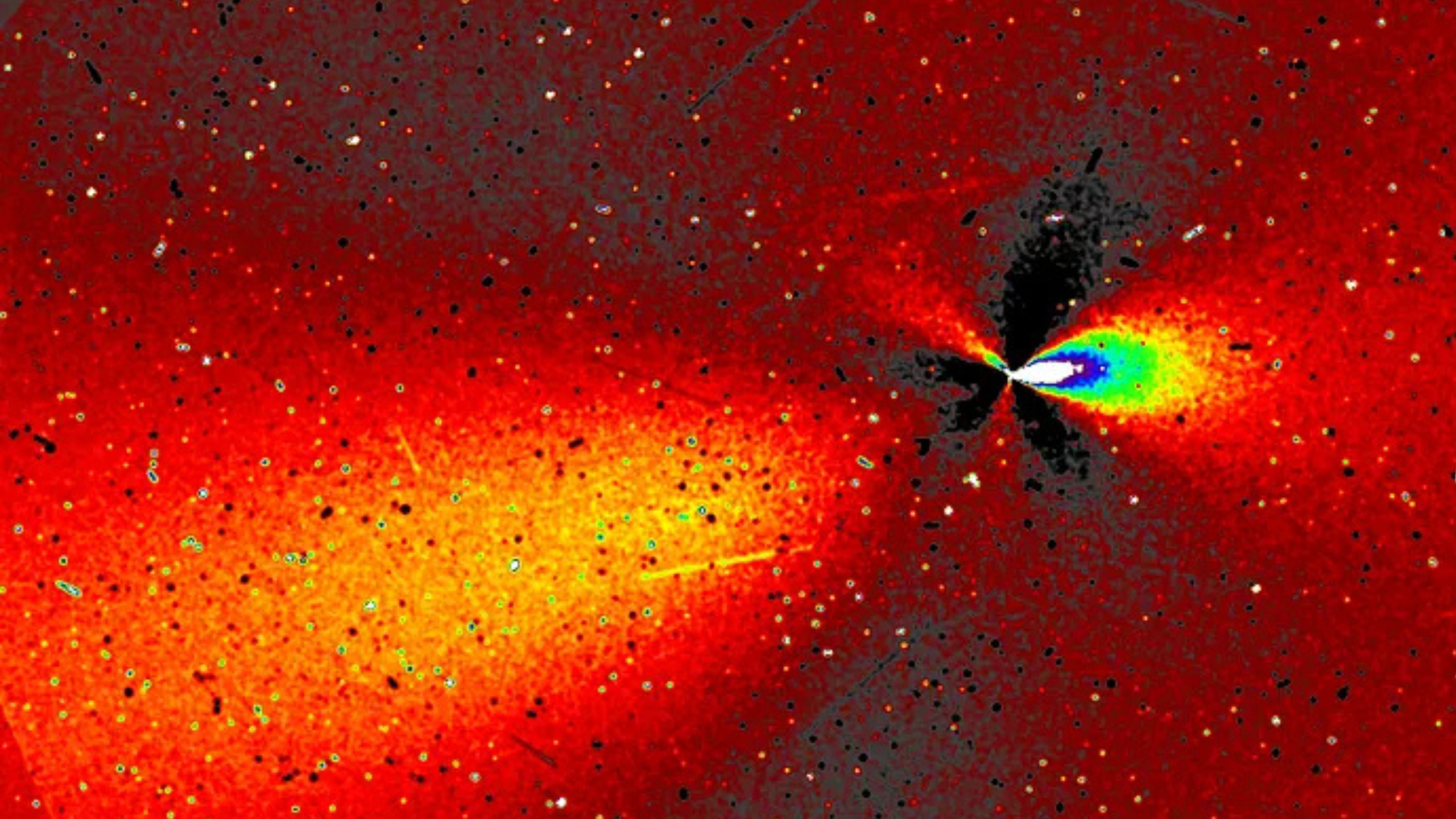
The Hubble Space Telescope has made a groundbreaking discovery, capturing extraordinary jet activity from the interstellar comet known as 3I/ATLAS. Observations challenge established models of cometary physics and raise new questions about this unusual visitor from beyond the Solar System. Discovered on July 1, 2025, by the Asteroid Terrestrial-impact Last Alert System (ATLAS), 3I/ATLAS is only the third confirmed interstellar object ever observed, prompting intense scientific scrutiny.
Initial expectations suggested 3I/ATLAS would behave similarly to conventional comets, which are icy bodies that emit gas and dust as they approach the Sun. However, Hubble’s findings reveal a far more complex scenario. The telescope’s observations, made public on August 7, 2025, show that the comet was approximately 365 million kilometres from Earth on July 21, 2025. This distance allowed for detailed imaging, which captured a teardrop-shaped cloud of gas and dust streaming from the object’s icy nucleus.
Measurements indicate that the nucleus could vary significantly in size, ranging from as small as 320 metres to as large as 5.6 kilometres. This uncertainty reflects the challenges of observing such distant celestial objects. Notably, Hubble detected a plume of material ejected from the sunward side of 3I/ATLAS, consistent with sublimation—the process where ices turn directly into gas due to solar heating.
While typical comets exhibit tails that stream away from the Sun, 3I/ATLAS presents a faint and unusually structured tail. The comet is moving at an unprecedented speed of approximately 210,000 km/h, marking it as the fastest recorded visitor to the Solar System, suggesting it has been drifting through interstellar space for billions of years before its encounter with our star.
Unprecedented Observations Challenge Scientific Understanding
The behavior of 3I/ATLAS is not only comet-like but also defies traditional cometary models. Observations from Hubble and other telescopes have documented significant jets of gas and dust erupting from the object. While such activity is expected to increase as the comet approaches perihelion—the point of closest approach to the Sun—the scale and persistence of these jets have surprised researchers.
Hubble’s data show that these jets are sustained and maintain their coherence over extended periods, a phenomenon not typically seen in most comet models. In contrast, traditional comet jets tend to disperse rapidly due to rotation and solar forces. The sustained jets from 3I/ATLAS prompt further investigation into the mechanisms behind this activity.
The James Webb Space Telescope (JWST) has also played a vital role in this research. Infrared spectroscopy conducted on August 6, 2025, revealed that the comet’s coma—the nebulous envelope of gas and dust surrounding the nucleus—is predominantly composed of carbon dioxide (CO2). This finding is significant as it differs from typical Solar System comets, which usually exhibit water (H2O) as the dominant outgassing signature. The elevated CO2 to H2O ratios recorded are among the highest ever noted for a comet, suggesting 3I/ATLAS may have formed in an environment quite different from that of our Solar System.
Scientific Implications and Future Research Directions
The unique characteristics of 3I/ATLAS have ignited debate among scientists regarding the interpretation of these observations. While there is a consensus that the object is a natural interstellar body, the underlying mechanisms driving its sustained jet activity and distinctive composition remain contentious topics of research. Some astrophysicists argue that the high carbon dioxide content points to formation in a region of another star’s planetary system unlike our own. Others suggest that the jets, while extraordinary, could still align with natural processes that cometary science has yet to fully understand.
Hubble’s high-resolution imaging will be critical in furthering this research. By monitoring changes in 3I/ATLAS’s appearance over time, astronomers can refine their models of dust and gas emissions, enhancing their understanding of how interstellar objects interact with solar radiation.
International collaborations combining data from Hubble, JWST, and ground-based observatories are essential for addressing the remaining questions surrounding 3I/ATLAS. Each platform contributes unique observations: Hubble provides ultraviolet and optical data, JWST offers infrared spectroscopy, and terrestrial telescopes deliver broader temporal coverage.
As 3I/ATLAS continues its journey through the Solar System, astronomers are poised to monitor its evolution closely. Future observations planned for early 2026 aim to capture the comet’s post-perihelion behavior as it moves away from the Sun, allowing researchers to study how its activity diminishes over time. This data will be crucial for refining models of interstellar comet behavior and understanding their role in contributing information about environments beyond our Solar System.
The visit of 3I/ATLAS underscores the rare opportunity provided by interstellar objects, offering astronomers a direct glimpse into material formed around other stars and revealing processes that extend far beyond our own cosmic neighborhood.

Moyes Faces Referee Controversy Ahead of Everton vs Chelsea Clash

Man Hospitalised After Assault Outside Shop in Sandwell

Fred MacAulay and Ally McCoist Reunite for Special World Cup Show

NoOnes Targets $1 Trillion Gift Card Market to Enhance Crypto Access

Beloved Actor Matt Clark Passes Away at 89, Fans Mourn Loss

Discover How Milk Thistle Supplements Enhance Liver Health

Irish Community Care Celebrates 60 Years of Support in Liverpool

New Affordable Housing Development Planned for Crawley Site

Millions of Parking Tickets Issued Amid Calls for Reform

Claire Tomlinson Bids Farewell to Sky Sports After 27 Years

Iconic 90s TV Show House Hits Market for £1.1 Million

Tributes Flow for Kerry Gentle, Beloved RNLI Volunteer and Artist

Nathan Cleary’s Family Celebrates Engagement Amid Romance Rumors

Milk Bank Urges Mothers to Donate for Premature Babies’ Health

Shoppers Flock to Discounted Neck Pillow on Amazon for Travel Comfort

Alessia Russo Signs Long-Term Deal with Arsenal Ahead of WSL Season

Nuneaton Town FC Advances Plans for New Stadium in Stockingford

Museums Body Critiques EHRC Proposals on Gender Facilities
-
 Lifestyle6 months ago
Claire Tomlinson Bids Farewell to Sky Sports After 27 Years
-
 Entertainment9 months ago
Iconic 90s TV Show House Hits Market for £1.1 Million
-
 Lifestyle7 months ago
Tributes Flow for Kerry Gentle, Beloved RNLI Volunteer and Artist
-
 Sports11 months ago
Nathan Cleary’s Family Celebrates Engagement Amid Romance Rumors
-
 Lifestyle12 months ago
Milk Bank Urges Mothers to Donate for Premature Babies’ Health
-
 Lifestyle11 months ago
Shoppers Flock to Discounted Neck Pillow on Amazon for Travel Comfort
-
 Sports10 months ago
Alessia Russo Signs Long-Term Deal with Arsenal Ahead of WSL Season
-
 Sports8 months ago
Nuneaton Town FC Advances Plans for New Stadium in Stockingford
-
 Politics11 months ago
Museums Body Critiques EHRC Proposals on Gender Facilities
-

 Lifestyle11 months ago
Exploring England’s Cathedrals: A Journey Through History and Architecture
-

 Business11 months ago
Trump Visits Europe: Business, Politics, or Leisure?
-

 Lifestyle11 months ago
Japanese Teen Sorato Shimizu Breaks U18 100m Record in 10 Seconds