
Science
Harvard Physicist Unravels Mysteries of Alien Comet 3I/ATLAS

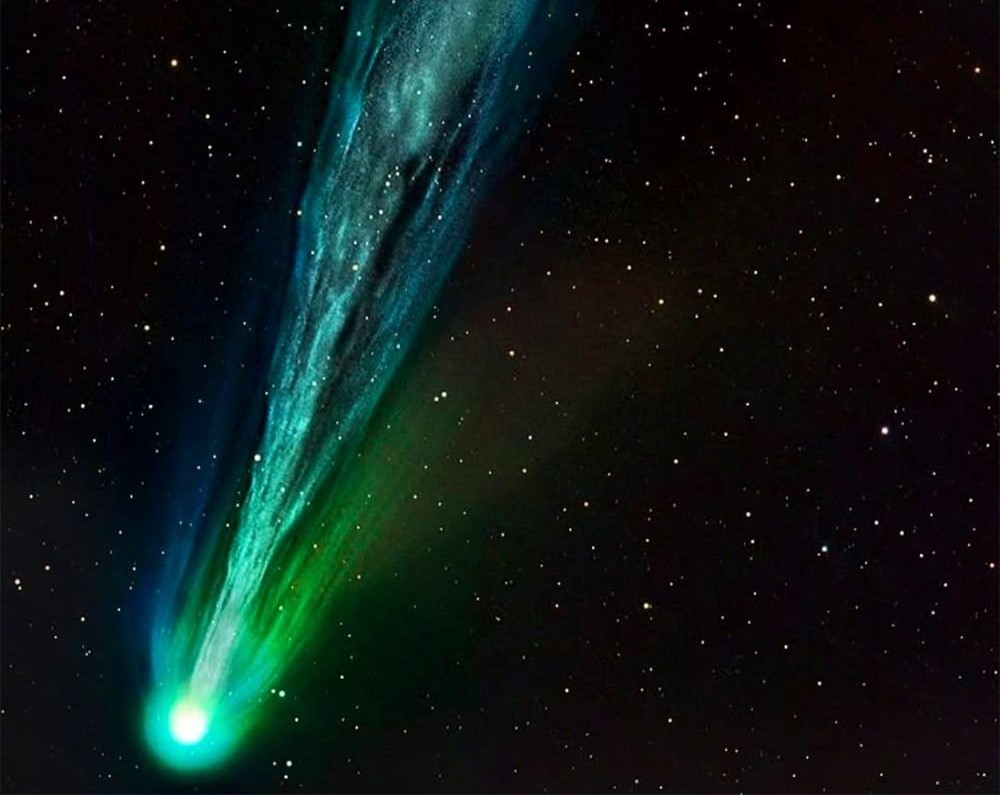
A fast-moving interstellar object, officially named 3I/ATLAS, is captivating astronomers as it approaches Earth, exhibiting a striking change in color that has sparked renewed discussions about its origins. The comet, which is set for its closest approach on December 19, 2025, has intrigued researchers due to its unexpected transition from a reddish hue to a vibrant green.
The comet is only the third known interstellar body to be identified in our solar system, according to NASA. Its unusual behavior has generated significant debate, particularly among scientists like Avi Loeb, a theoretical physicist at Harvard University. Loeb has been at the forefront of discussions concerning the potential for extraterrestrial technology, and he has raised questions about whether 3I/ATLAS is a purely natural phenomenon.
Loeb recently pointed out a dramatic change in the comet’s appearance after it passed perihelion, the point in its orbit closest to the Sun. Observations taken before this event, specifically on September 4, 2025, showed a red glow, typical of dust and rock in a comet’s tail. However, images captured after perihelion revealed a transformation, with the comet now radiating an eerie green hue.
In a detailed analysis shared on Medium, Loeb explained that the newer imagery involved exposures through four color filters: blue, green, orange, and red. He noted that the peak brightness was centered on 3I/ATLAS’s nucleus, with the glow surrounding the object shifting from dusty red to a vivid green. This color change may be attributed to the presence of diatomic carbon (C2) molecules, which emit green light.
Loeb elaborated on this shift, stating, “The change in colors from red to green means that the molecular composition of the plume of gas shed by 3I/ATLAS had changed near the Sun.” The intense heat from the Sun likely stripped away the outer layers of the comet, revealing different materials beneath the surface.
In addition to the color change, Loeb reported an unexpected glowing halo around the comet — a plume of gas that had not been previously observed. He suggested a possible connection to a burst of gamma rays detected around the time of 3I/ATLAS’s discovery, which was later followed by a supernova event. Loeb posited that this gamma-ray burst could coincide with the comet’s trajectory, occurring once per 670 years.
Despite the intriguing observations, most of the scientific community remains skeptical about non-natural explanations. Many researchers argue that while the changes in 3I/ATLAS’s color and composition are unusual, they do not imply the presence of alien technology or life. Instead, they emphasize that comets are naturally volatile objects, and the variations in color may be a result of their complex compositions reacting to solar heat.
As the astronomical community prepares for the crucial observation window on December 19, the excitement surrounding 3I/ATLAS continues to grow. This rare interstellar visitor presents a unique opportunity to study material from another star system, whether it is a typical icy comet or, as some suggest, a remnant of advanced extraterrestrial engineering.
The ongoing study of 3I/ATLAS not only highlights the mysteries of our universe but also underscores the importance of scientific inquiry in understanding the cosmos. As telescopes focus on this enigmatic object, the questions surrounding its origin and nature will likely persist, leaving researchers eager to uncover the secrets it may hold.

Moyes Faces Referee Controversy Ahead of Everton vs Chelsea Clash

Man Hospitalised After Assault Outside Shop in Sandwell

Fred MacAulay and Ally McCoist Reunite for Special World Cup Show

NoOnes Targets $1 Trillion Gift Card Market to Enhance Crypto Access

Beloved Actor Matt Clark Passes Away at 89, Fans Mourn Loss

Discover How Milk Thistle Supplements Enhance Liver Health

Irish Community Care Celebrates 60 Years of Support in Liverpool

New Affordable Housing Development Planned for Crawley Site

Millions of Parking Tickets Issued Amid Calls for Reform

Claire Tomlinson Bids Farewell to Sky Sports After 27 Years

Iconic 90s TV Show House Hits Market for £1.1 Million

Nathan Cleary’s Family Celebrates Engagement Amid Romance Rumors

Tributes Flow for Kerry Gentle, Beloved RNLI Volunteer and Artist

Milk Bank Urges Mothers to Donate for Premature Babies’ Health

Shoppers Flock to Discounted Neck Pillow on Amazon for Travel Comfort

Alessia Russo Signs Long-Term Deal with Arsenal Ahead of WSL Season

Nuneaton Town FC Advances Plans for New Stadium in Stockingford

Exploring England’s Cathedrals: A Journey Through History and Architecture
-
 Lifestyle8 months ago
Claire Tomlinson Bids Farewell to Sky Sports After 27 Years
-
 Entertainment11 months ago
Iconic 90s TV Show House Hits Market for £1.1 Million
-
 Sports1 year ago
Nathan Cleary’s Family Celebrates Engagement Amid Romance Rumors
-
 Lifestyle8 months ago
Tributes Flow for Kerry Gentle, Beloved RNLI Volunteer and Artist
-
 Lifestyle1 year ago
Milk Bank Urges Mothers to Donate for Premature Babies’ Health
-
 Lifestyle1 year ago
Shoppers Flock to Discounted Neck Pillow on Amazon for Travel Comfort
-
 Sports12 months ago
Alessia Russo Signs Long-Term Deal with Arsenal Ahead of WSL Season
-
 Sports9 months ago
Nuneaton Town FC Advances Plans for New Stadium in Stockingford
-
 Lifestyle1 year ago
Exploring England’s Cathedrals: A Journey Through History and Architecture
-

 Politics1 year ago
Museums Body Critiques EHRC Proposals on Gender Facilities
-

 Business1 year ago
Trump Visits Europe: Business, Politics, or Leisure?
-

 Lifestyle1 year ago
Japanese Teen Sorato Shimizu Breaks U18 100m Record in 10 Seconds