
Science
Hubble Unveils Surprising Jet Activity from Interstellar Comet 3I/ATLAS

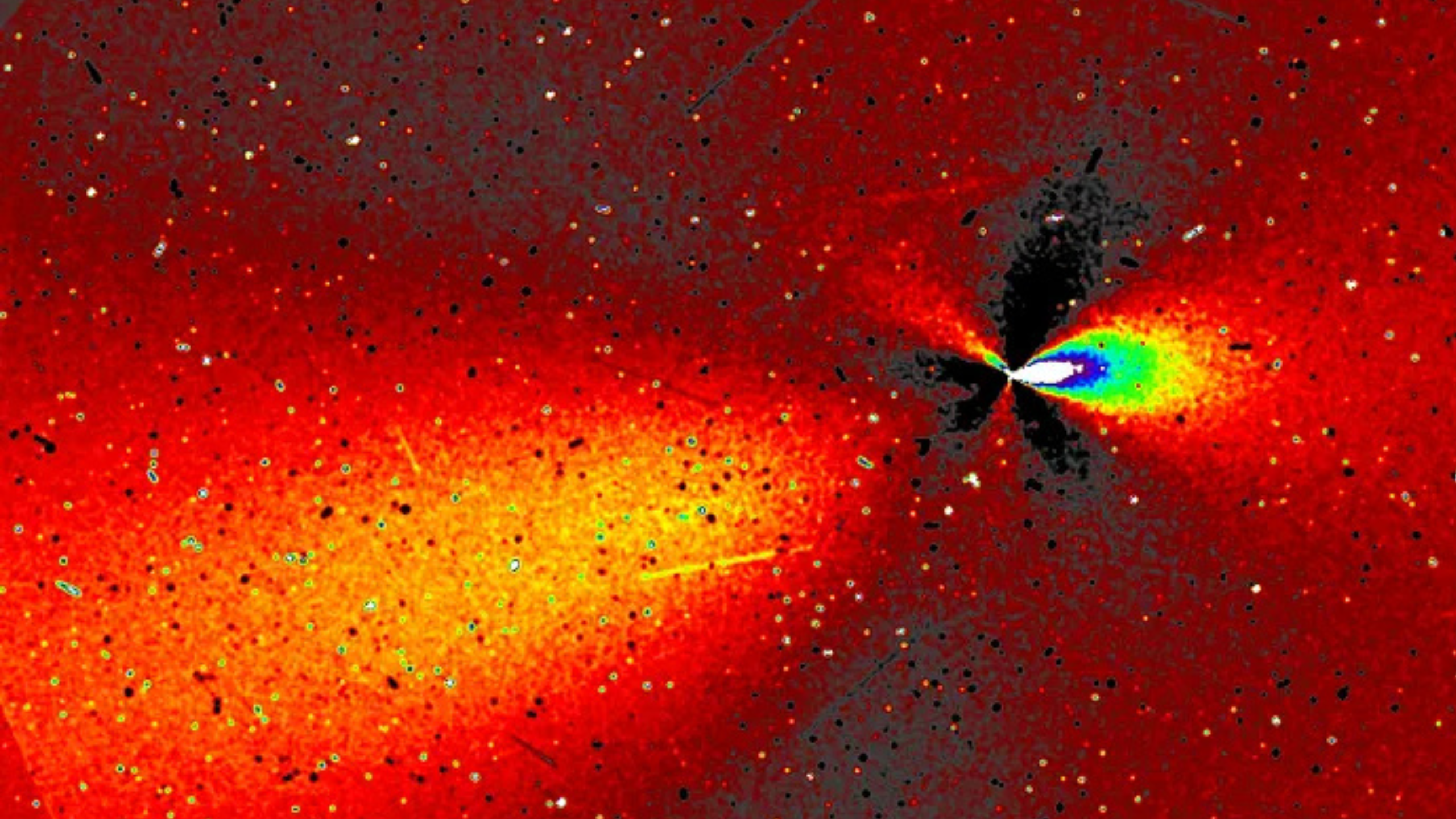
The Hubble Space Telescope has observed unexpected jet activity emanating from the interstellar comet 3I/ATLAS, challenging established cometary physics and prompting new inquiries into this unique celestial object. Discovered on July 1, 2025 by the Asteroid Terrestrial-impact Last Alert System (ATLAS), 3I/ATLAS marks only the third confirmed interstellar object observed, drawing significant attention from astronomers worldwide.
Initially, scientists anticipated that 3I/ATLAS would exhibit typical cometary behavior as it approached the Sun. Traditionally, comets are icy bodies that release gas and dust when heated. However, recent findings from Hubble and other instruments reveal a more complex behavior than expected. The telescope captured images of 3I/ATLAS on July 21, 2025, while it was approximately 365 million kilometers from Earth.
Unprecedented Jet Activity and Observations
Hubble’s observations, made public on August 7, 2025, showed a teardrop-shaped cloud of dust and gas streaming from the icy nucleus of 3I/ATLAS. This allowed astronomers to narrow down the size of the nucleus, estimating its dimensions to be between 320 meters and 5.6 kilometers across. Such a wide range indicates the challenges of observing distant objects and the limitations of current technology.
Notably, Hubble detected a plume of material being ejected from the sunward side of the comet, consistent with the sublimation process. This is where ices transform directly into gas when heated by solar radiation. While typical comets display tails that stream away from the Sun, the tail of 3I/ATLAS appears faint and unusually structured, diverging from standard cometary characteristics.
3I/ATLAS is traveling at an astonishing speed of approximately 210,000 km/h, the highest velocity recorded for any known visitor to the Solar System. This remarkable speed suggests that the comet has been drifting through interstellar space for billions of years prior to its encounter with our Sun.
New Insights from Spectroscopy
As researchers delve deeper into the activity of 3I/ATLAS, they are discovering behaviors that defy traditional comet models. Observations from Hubble, alongside data from the James Webb Space Telescope (JWST), show sustained jets of gas and dust that do not dissipate quickly as expected. Instead, these jets remain collimated and defined over extended periods, a phenomenon that has prompted further investigation.
Infrared spectroscopy conducted by JWST on August 6, 2025, revealed that the comet’s coma is predominantly composed of carbon dioxide (CO2). This significant finding diverges from typical Solar System comets, which usually have water (H2O) as a primary outgassing component. The high CO2 presence suggests that 3I/ATLAS may have formed in a different environment, potentially subjected to greater radiation or existing in regions with abundant CO2 ice.
These observations have ignited extensive discussions among scientists regarding the implications of 3I/ATLAS’s uncommon characteristics. While there is a consensus that it is a natural interstellar object, the reasons behind its sustained jet activity and unique composition are still under active investigation. Some astrophysicists propose that the high carbon dioxide content indicates a formation environment contrasting sharply with that of our Solar System.
As the scientific community continues to analyze 3I/ATLAS, Hubble’s high-resolution imaging remains crucial for ongoing research. By monitoring changes in the object’s appearance, astronomers aim to refine models of dust and gas emissions and better understand how interstellar objects interact with solar radiation.
Collaborative efforts that combine data from Hubble, JWST, and ground-based observatories are essential. Each platform offers complementary insights: Hubble provides ultraviolet and optical observations while JWST focuses on infrared spectroscopy, and terrestrial telescopes contribute broader temporal coverage. This integrated approach is vital for addressing critical questions surrounding the dynamics of 3I/ATLAS.
As 3I/ATLAS continues its journey through the Solar System, astronomers will closely monitor its activity. Future observations scheduled for early 2026 aim to capture the object’s behavior following perihelion, as it moves away from the Sun and its activity diminishes. This research will enhance understanding of interstellar comet behavior and contribute insights into cosmic processes beyond our immediate environment.
The visit of 3I/ATLAS underscores the rare opportunities that interstellar objects present to astronomers, offering direct insights into materials that originated around other stars. These findings carry implications for our understanding of cosmic evolution and the environments that shape celestial bodies across the universe.

Moyes Faces Referee Controversy Ahead of Everton vs Chelsea Clash

Man Hospitalised After Assault Outside Shop in Sandwell

Fred MacAulay and Ally McCoist Reunite for Special World Cup Show

NoOnes Targets $1 Trillion Gift Card Market to Enhance Crypto Access

Beloved Actor Matt Clark Passes Away at 89, Fans Mourn Loss

Discover How Milk Thistle Supplements Enhance Liver Health

Irish Community Care Celebrates 60 Years of Support in Liverpool

New Affordable Housing Development Planned for Crawley Site

Millions of Parking Tickets Issued Amid Calls for Reform

Claire Tomlinson Bids Farewell to Sky Sports After 27 Years

Iconic 90s TV Show House Hits Market for £1.1 Million

Nathan Cleary’s Family Celebrates Engagement Amid Romance Rumors

Tributes Flow for Kerry Gentle, Beloved RNLI Volunteer and Artist

Milk Bank Urges Mothers to Donate for Premature Babies’ Health

Shoppers Flock to Discounted Neck Pillow on Amazon for Travel Comfort

Alessia Russo Signs Long-Term Deal with Arsenal Ahead of WSL Season

Nuneaton Town FC Advances Plans for New Stadium in Stockingford

Exploring England’s Cathedrals: A Journey Through History and Architecture
-
 Lifestyle8 months ago
Claire Tomlinson Bids Farewell to Sky Sports After 27 Years
-
 Entertainment11 months ago
Iconic 90s TV Show House Hits Market for £1.1 Million
-
 Sports1 year ago
Nathan Cleary’s Family Celebrates Engagement Amid Romance Rumors
-
 Lifestyle8 months ago
Tributes Flow for Kerry Gentle, Beloved RNLI Volunteer and Artist
-
 Lifestyle1 year ago
Milk Bank Urges Mothers to Donate for Premature Babies’ Health
-
 Lifestyle1 year ago
Shoppers Flock to Discounted Neck Pillow on Amazon for Travel Comfort
-
 Sports12 months ago
Alessia Russo Signs Long-Term Deal with Arsenal Ahead of WSL Season
-
 Sports9 months ago
Nuneaton Town FC Advances Plans for New Stadium in Stockingford
-
 Lifestyle1 year ago
Exploring England’s Cathedrals: A Journey Through History and Architecture
-

 Politics1 year ago
Museums Body Critiques EHRC Proposals on Gender Facilities
-

 Business1 year ago
Trump Visits Europe: Business, Politics, or Leisure?
-

 Lifestyle1 year ago
Japanese Teen Sorato Shimizu Breaks U18 100m Record in 10 Seconds