
Science
NASA’s Juno Reveals Jupiter is Smaller and Flatter Than Expected

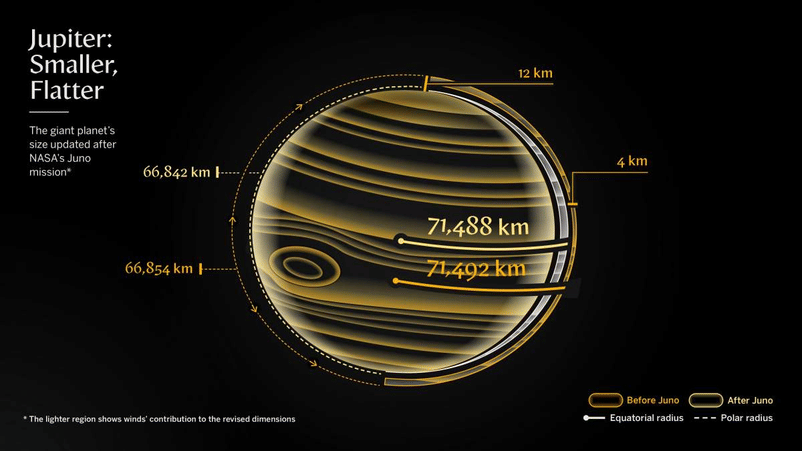
Navigating the mysteries of our solar system, NASA’s Juno spacecraft has provided new insights into the size and shape of Jupiter. Recent measurements indicate that the gas giant is slightly smaller and more flattened than previously believed, prompting a reevaluation of its physical characteristics.
New Measurements Transform Understanding of Jupiter
Data collected by Juno allows scientists to define Jupiter’s dimensions with remarkable precision. The spacecraft’s findings reveal a polar radius of 66,842 km and an equatorial radius of 71,488 km, resulting in a mean radius of 69,886 km. These measurements are smaller by 12 km at the poles, 4 km at the equator, and 8 km for the mean radius compared to earlier estimates. The uncertainty in these new figures has reduced significantly to approximately 0.4 km, compared to the previous uncertainty of over 4 km.
Previous estimates were based on a limited number of radio measurements conducted by the Voyager and Pioneer missions nearly five decades ago. Those early assessments did not adequately consider the effects of Jupiter’s intense winds, which influence the planet’s shape by altering the outward force generated by its rotation. Over recent years, Juno has provided a wealth of data that accounts for these atmospheric dynamics.
Implications for Jupiter’s Interior and Atmospheric Modeling
The updated measurements have significant implications for understanding Jupiter’s interior. They suggest a cooler atmosphere enriched with heavier elements, aligning more closely with data obtained by the Galileo probe and temperature readings from the Voyager missions. Prior models faced challenges reconciling gravity measurements, probe findings, and the effects of wind patterns.
Moreover, the refined shape of Jupiter enhances the accuracy of atmospheric feature mapping and pressure level studies. This new understanding serves as a crucial reference point for examining other gas giants, including those beyond our solar system.
The findings stem from an international collaboration utilizing Juno’s radio occultation data. The study has been published in Nature Astronomy, highlighting the importance of continuous exploration in redefining our knowledge of planetary bodies.
As scientists continue to analyze data from Juno, the insights gained will undoubtedly shape future research into the characteristics of gas giants and their atmospheres. The exploration of Jupiter remains a testament to humanity’s quest for knowledge about the cosmos.

Moyes Faces Referee Controversy Ahead of Everton vs Chelsea Clash

Man Hospitalised After Assault Outside Shop in Sandwell

Fred MacAulay and Ally McCoist Reunite for Special World Cup Show

NoOnes Targets $1 Trillion Gift Card Market to Enhance Crypto Access

Beloved Actor Matt Clark Passes Away at 89, Fans Mourn Loss

Discover How Milk Thistle Supplements Enhance Liver Health

Irish Community Care Celebrates 60 Years of Support in Liverpool

New Affordable Housing Development Planned for Crawley Site

Millions of Parking Tickets Issued Amid Calls for Reform

Claire Tomlinson Bids Farewell to Sky Sports After 27 Years

Iconic 90s TV Show House Hits Market for £1.1 Million

Nathan Cleary’s Family Celebrates Engagement Amid Romance Rumors

Tributes Flow for Kerry Gentle, Beloved RNLI Volunteer and Artist

Milk Bank Urges Mothers to Donate for Premature Babies’ Health

Shoppers Flock to Discounted Neck Pillow on Amazon for Travel Comfort

Alessia Russo Signs Long-Term Deal with Arsenal Ahead of WSL Season

Nuneaton Town FC Advances Plans for New Stadium in Stockingford

Exploring England’s Cathedrals: A Journey Through History and Architecture
-
 Lifestyle8 months ago
Claire Tomlinson Bids Farewell to Sky Sports After 27 Years
-
 Entertainment11 months ago
Iconic 90s TV Show House Hits Market for £1.1 Million
-
 Sports1 year ago
Nathan Cleary’s Family Celebrates Engagement Amid Romance Rumors
-
 Lifestyle8 months ago
Tributes Flow for Kerry Gentle, Beloved RNLI Volunteer and Artist
-
 Lifestyle1 year ago
Milk Bank Urges Mothers to Donate for Premature Babies’ Health
-
 Lifestyle1 year ago
Shoppers Flock to Discounted Neck Pillow on Amazon for Travel Comfort
-
 Sports12 months ago
Alessia Russo Signs Long-Term Deal with Arsenal Ahead of WSL Season
-
 Sports9 months ago
Nuneaton Town FC Advances Plans for New Stadium in Stockingford
-
 Lifestyle1 year ago
Exploring England’s Cathedrals: A Journey Through History and Architecture
-

 Politics1 year ago
Museums Body Critiques EHRC Proposals on Gender Facilities
-

 Business1 year ago
Trump Visits Europe: Business, Politics, or Leisure?
-

 Lifestyle1 year ago
Japanese Teen Sorato Shimizu Breaks U18 100m Record in 10 Seconds