
Science
Stargazers Prepare for Rare Six-Planet Alignment on February 28

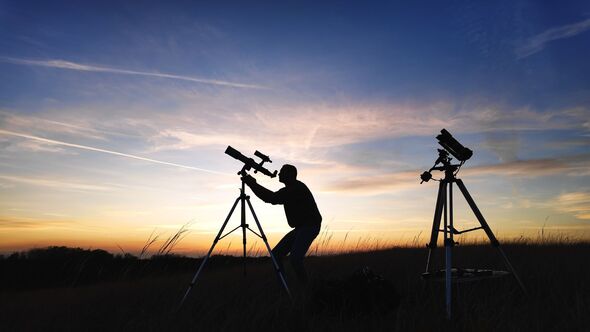
Stargazers in the UK can look forward to a captivating celestial event this month, as a rare planetary parade is set to occur on February 28, 2024. According to Dr. William Alston, an astronomer and senior lecturer at the University of Hertfordshire’s Centre for Astrophysics Research, six planets will align, providing a unique opportunity for skywatchers.
A planetary parade occurs when multiple planets in our solar system appear close together in the night sky from Earth’s perspective. Dr. Alston explained that this phenomenon is possible because the planets orbit the Sun in a similar flat plane, known as the ecliptic. “Every now and then, the relative positions of Earth and the other planets allow multiple worlds to appear in the evening sky at once, forming what looks like a parade moving across the sky,” he noted.
This weekend, the planets expected to be visible shortly after sunset include Mercury, Venus, Jupiter, Saturn, Uranus, and Neptune. Observers in the UK should look towards the western horizon approximately 30-60 minutes after sunset on February 28 to witness this celestial display.
Viewing Conditions and Tips for Stargazers
Dr. Alston provided guidance on what to expect during the planetary parade. “Venus and Mercury will be low on the horizon, while Saturn and Neptune will be positioned slightly higher. Uranus will be even higher still. Jupiter will be located near the Moon, which is projected to be at 90% illumination,” he explained.
To successfully view the parade, it is essential to trace the path the Sun took across the sky that day, as the planets will follow a similar trajectory. While Venus, Jupiter, Saturn, and Mercury should be visible to the naked eye, Dr. Alston cautioned that spotting Mercury may be challenging due to its proximity to the Sun’s glare.
For those hoping to glimpse Uranus, he noted that it usually appears faint and typically requires binoculars or a small telescope. Neptune, being even dimmer, will necessitate a telescope for visibility.
Such planetary parades are uncommon, with six or seven planets aligning only once every decade, according to Dr. Alston. He pointed out that readers may recall a similar event that took place in February 2025. The short recurrence of these parades is attributed to the slower orbits of the outer planets compared to Earth.
Ideal Locations for Star Gazing
To enhance viewing chances, Dr. Alston recommended seeking locations with a clear view of the western horizon and minimal light pollution. Good options include rural areas with open skies, nature reserves, parks away from bright streetlights, and elevated spots that allow unobstructed views.
Since some planets, particularly Mercury and Saturn, will remain low after sunset, having a flat, wide view of the western sky will be advantageous. Stargazers eager to experience this rare planetary alignment should prepare for an enchanting evening on February 28, when the cosmos will provide a striking spectacle.

Moyes Faces Referee Controversy Ahead of Everton vs Chelsea Clash

Man Hospitalised After Assault Outside Shop in Sandwell

Fred MacAulay and Ally McCoist Reunite for Special World Cup Show

NoOnes Targets $1 Trillion Gift Card Market to Enhance Crypto Access

Beloved Actor Matt Clark Passes Away at 89, Fans Mourn Loss

Discover How Milk Thistle Supplements Enhance Liver Health

Irish Community Care Celebrates 60 Years of Support in Liverpool

New Affordable Housing Development Planned for Crawley Site

Millions of Parking Tickets Issued Amid Calls for Reform

Claire Tomlinson Bids Farewell to Sky Sports After 27 Years

Iconic 90s TV Show House Hits Market for £1.1 Million

Tributes Flow for Kerry Gentle, Beloved RNLI Volunteer and Artist

Nathan Cleary’s Family Celebrates Engagement Amid Romance Rumors

Milk Bank Urges Mothers to Donate for Premature Babies’ Health

Shoppers Flock to Discounted Neck Pillow on Amazon for Travel Comfort

Alessia Russo Signs Long-Term Deal with Arsenal Ahead of WSL Season

Nuneaton Town FC Advances Plans for New Stadium in Stockingford

Museums Body Critiques EHRC Proposals on Gender Facilities
-
 Lifestyle6 months ago
Claire Tomlinson Bids Farewell to Sky Sports After 27 Years
-
 Entertainment9 months ago
Iconic 90s TV Show House Hits Market for £1.1 Million
-
 Lifestyle6 months ago
Tributes Flow for Kerry Gentle, Beloved RNLI Volunteer and Artist
-
 Sports11 months ago
Nathan Cleary’s Family Celebrates Engagement Amid Romance Rumors
-
 Lifestyle11 months ago
Milk Bank Urges Mothers to Donate for Premature Babies’ Health
-
 Lifestyle11 months ago
Shoppers Flock to Discounted Neck Pillow on Amazon for Travel Comfort
-
 Sports10 months ago
Alessia Russo Signs Long-Term Deal with Arsenal Ahead of WSL Season
-
 Sports8 months ago
Nuneaton Town FC Advances Plans for New Stadium in Stockingford
-
 Politics11 months ago
Museums Body Critiques EHRC Proposals on Gender Facilities
-

 Lifestyle11 months ago
Exploring England’s Cathedrals: A Journey Through History and Architecture
-

 Business11 months ago
Trump Visits Europe: Business, Politics, or Leisure?
-

 Lifestyle11 months ago
Japanese Teen Sorato Shimizu Breaks U18 100m Record in 10 Seconds