
Top Stories
National Trust for Scotland Unveils Top Archaeological Finds of 2025

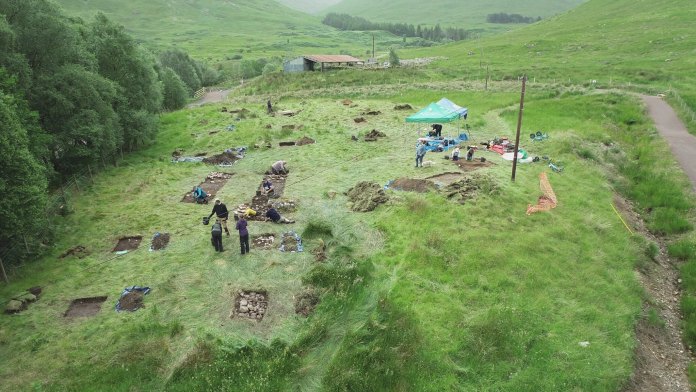
The National Trust for Scotland has announced its most significant archaeological discoveries for 2025, highlighting a range of findings that span thousands of years. Among these discoveries are the foundations of a medieval castle, a collection of 17th century coins linked to the Jacobite cause, and artifacts thought to originate from a Neolithic community.
As Scotland’s largest independent conservation charity, the National Trust oversees approximately 11,000 archaeological sites, covering periods from the Mesolithic era, around 10,000 years ago, to modern times. The dedicated archaeology team continuously seeks new sites and features to enhance the understanding of Scotland’s rich history. This year saw an impressive number of volunteers and community members engage in fieldwork, contributing to the discoveries made.
Highlights from a Year of Archaeological Discoveries
Archaeological investigations at the chambered cairn in Crarae Garden, Argyll, yielded a range of artifacts believed to be remnants of a Neolithic community. The findings include quartz flakes, burnt and unburnt flint, and two pieces of Arran pitchstone, a volcanic glass-like material.
Alice Connelly, an archaeology trainee at the National Trust for Scotland, expressed her excitement about the discovery. She noted, “The pitchstone fragments related to Arran show the interconnectedness of these Neolithic communities. It is a privilege to be a part of piecing their story back together again.” Crarae Garden has a documented history of archaeological finds dating back to 3700-3500 BC, and a 3D model of the chambered cairn is available on the Trust’s SketchFab page.
In Angus, excavations at the House of Dun revealed the foundations of a medieval castle belonging to the Erskine family. Artifacts discovered at the site include medieval pottery and a copper coin from the mid-17th century. Senior archaeologist Daniel Rhodes highlighted the unique opportunity to examine these foundations, stating, “The discoveries at the House of Dun are exceptional because the foundations of the castle are located away from the later House and can be examined by archaeological excavation.” The project involved local volunteers, including students and families from diverse backgrounds.
Exploring the Legacy of the Jacobites
The National Trust for Scotland emphasized that 2025 marked a pivotal year for understanding the Jacobite movement. Excavations at Culloden Battlefield uncovered over 100 projectiles, providing significant insights. Additionally, the excavation of a turf house in Glencoe brought to light 17th century coins, confirming its use as a residence for supporters of the Jacobite cause.
The coins found, including silver pieces from the reign of Elizabeth I and a large brass Irish gun money coin dated 1690, reflect the turbulent history surrounding the Glencoe Massacre. Derek Alexander, head of archaeology, remarked, “This is a vivid example of how archaeology can bring us closer to the people of the past and their experiences.”
The collaborative efforts of the National Trust’s archaeology team and volunteers from Glasgow University added depth to this project, which took place at Achnacon, accessible via the new Glencoe Greenway.
Monastic History and 19th Century Farming Insights
An excavation at Priorwood Garden last September unveiled a well-preserved fragment of medieval carved stonework, originally part of Melrose Abbey. This detailed sculptured stone was likely taken from the ruins during its decline around the Reformation. Daniel Rhodes explained that the area would have been bustling with activity, supporting the monastic community that thrived there.
In addition to medieval findings, investigations at Maol Cottage on Iona revealed insights into 19th century building practices. The removal of interior linings exposed timber couples that were likely repurposed from other structures, potentially even ships. “It’s exciting to uncover signs that help us understand what the building would’ve looked like in the early days of farming,” said Derek Alexander.
As the National Trust for Scotland reflects on a year filled with discoveries ranging from Neolithic times to the industrial revolution, the archaeology team is poised to continue its work into 2026. Alexander noted, “There’s lots more to be explored across Trust places to uncover stories about the people who came before us.”
Yet, the team faces challenges as climate change increasingly impacts archaeological sites. Many are experiencing damage from extreme weather events, prompting the Trust to prioritize recording features threatened by flooding and erosion. This critical work not only preserves Scotland’s heritage but also fosters public engagement with its rich history, aligning with the Trust’s 10-year strategy launched in 2022.

Moyes Faces Referee Controversy Ahead of Everton vs Chelsea Clash

Man Hospitalised After Assault Outside Shop in Sandwell

Fred MacAulay and Ally McCoist Reunite for Special World Cup Show

NoOnes Targets $1 Trillion Gift Card Market to Enhance Crypto Access

Beloved Actor Matt Clark Passes Away at 89, Fans Mourn Loss

Discover How Milk Thistle Supplements Enhance Liver Health

Irish Community Care Celebrates 60 Years of Support in Liverpool

New Affordable Housing Development Planned for Crawley Site

Millions of Parking Tickets Issued Amid Calls for Reform

Claire Tomlinson Bids Farewell to Sky Sports After 27 Years

Iconic 90s TV Show House Hits Market for £1.1 Million

Tributes Flow for Kerry Gentle, Beloved RNLI Volunteer and Artist

Nathan Cleary’s Family Celebrates Engagement Amid Romance Rumors

Milk Bank Urges Mothers to Donate for Premature Babies’ Health

Shoppers Flock to Discounted Neck Pillow on Amazon for Travel Comfort

Alessia Russo Signs Long-Term Deal with Arsenal Ahead of WSL Season

Nuneaton Town FC Advances Plans for New Stadium in Stockingford

Museums Body Critiques EHRC Proposals on Gender Facilities
-
 Lifestyle6 months ago
Claire Tomlinson Bids Farewell to Sky Sports After 27 Years
-
 Entertainment9 months ago
Iconic 90s TV Show House Hits Market for £1.1 Million
-
 Lifestyle6 months ago
Tributes Flow for Kerry Gentle, Beloved RNLI Volunteer and Artist
-
 Sports11 months ago
Nathan Cleary’s Family Celebrates Engagement Amid Romance Rumors
-
 Lifestyle11 months ago
Milk Bank Urges Mothers to Donate for Premature Babies’ Health
-
 Lifestyle11 months ago
Shoppers Flock to Discounted Neck Pillow on Amazon for Travel Comfort
-
 Sports10 months ago
Alessia Russo Signs Long-Term Deal with Arsenal Ahead of WSL Season
-
 Sports8 months ago
Nuneaton Town FC Advances Plans for New Stadium in Stockingford
-
 Politics11 months ago
Museums Body Critiques EHRC Proposals on Gender Facilities
-

 Lifestyle11 months ago
Exploring England’s Cathedrals: A Journey Through History and Architecture
-

 Business11 months ago
Trump Visits Europe: Business, Politics, or Leisure?
-

 Lifestyle11 months ago
Japanese Teen Sorato Shimizu Breaks U18 100m Record in 10 Seconds